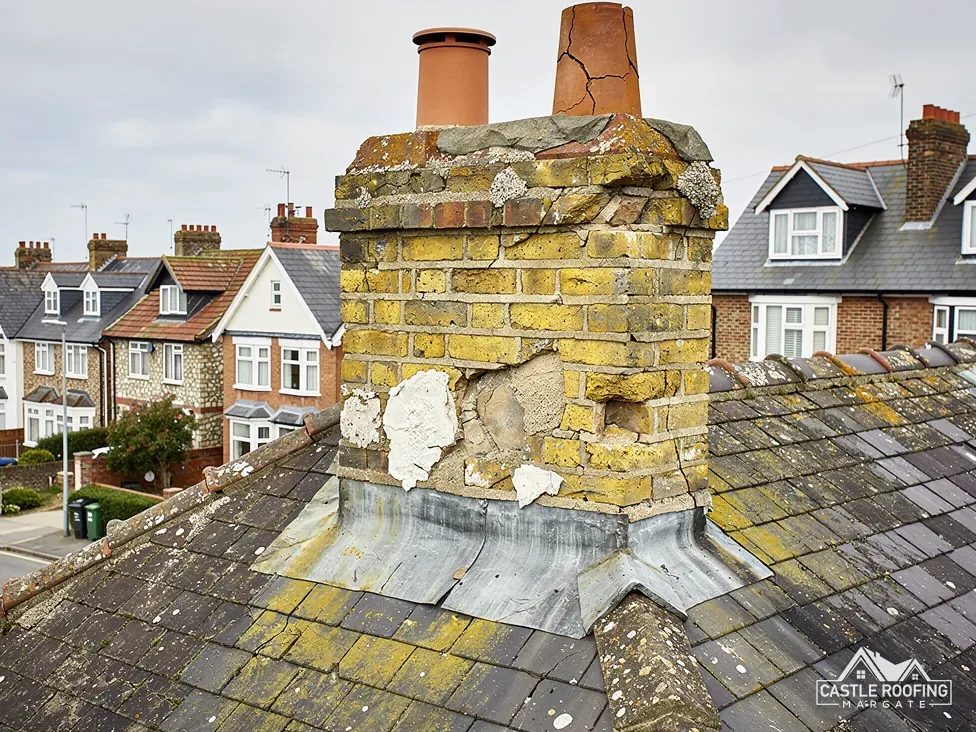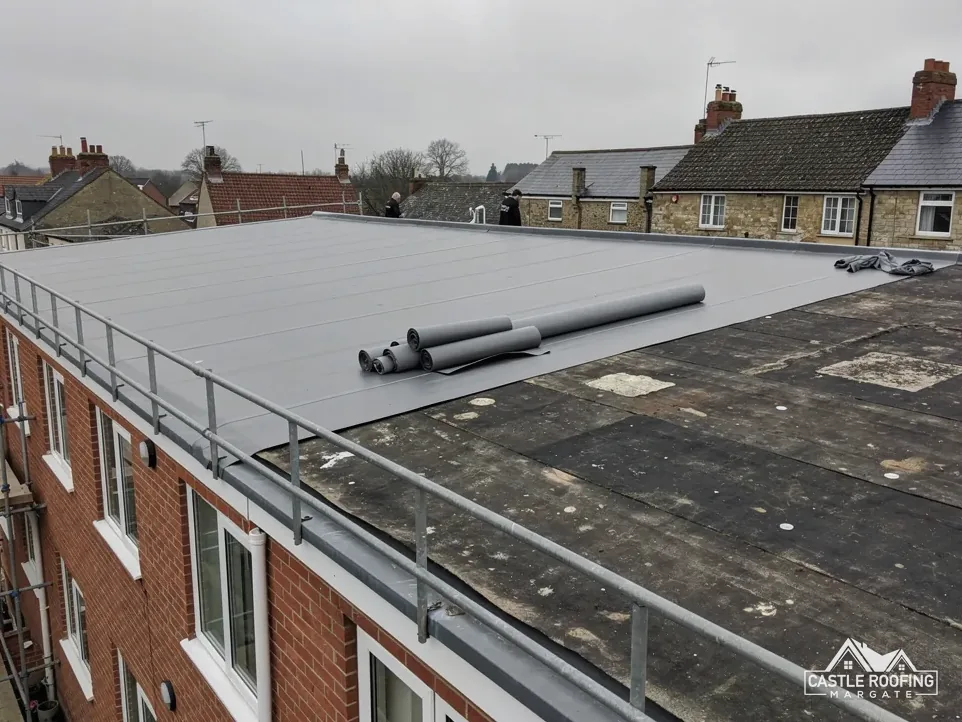
Four decisions come before a commercial roof job starts: which covering the building needs, how people will reach it safely, which duties sit with you as client, and what a written price should cover.
A commercial roof is usually bigger, flatter and harder to reach than a house roof, and a failure costs more because it lands on stock, machinery or trading days. Along the Thanet and East Kent coast the buildings in question run from corner shops and flats over shops to workshops, farm sheds and church halls, each with its own roof and its own weak points.
This guide is for the person who has to commission the work: a shop owner, a landlord, a managing agent or a farmer with a shed that has started to drip. It covers the three coverings you meet most, what to ask about asbestos cement sheets, how the safety duties fall when a contractor goes up, and how to judge a written quote. It does not tell you what to buy before the roof has been looked at, because nobody can. If the building is already leaking, our commercial roofing page explains how we survey and repair a roof like yours.
Start with what the roof is made of
Repair or replace is the first question, and the covering decides it. Three families of covering turn up on low-slope and industrial buildings, and each fails in its own way.
- Single-ply membrane: a factory-made sheet of synthetic rubber or plastic, laid in one layer and joined at the seams. EPDM is the rubber version. TPO is a plastic single-ply sheet that is heat-welded at its joints.
- Built-up felt: several layers of bitumen-based felt bonded together on site, finished with a mineral or reflective top layer.
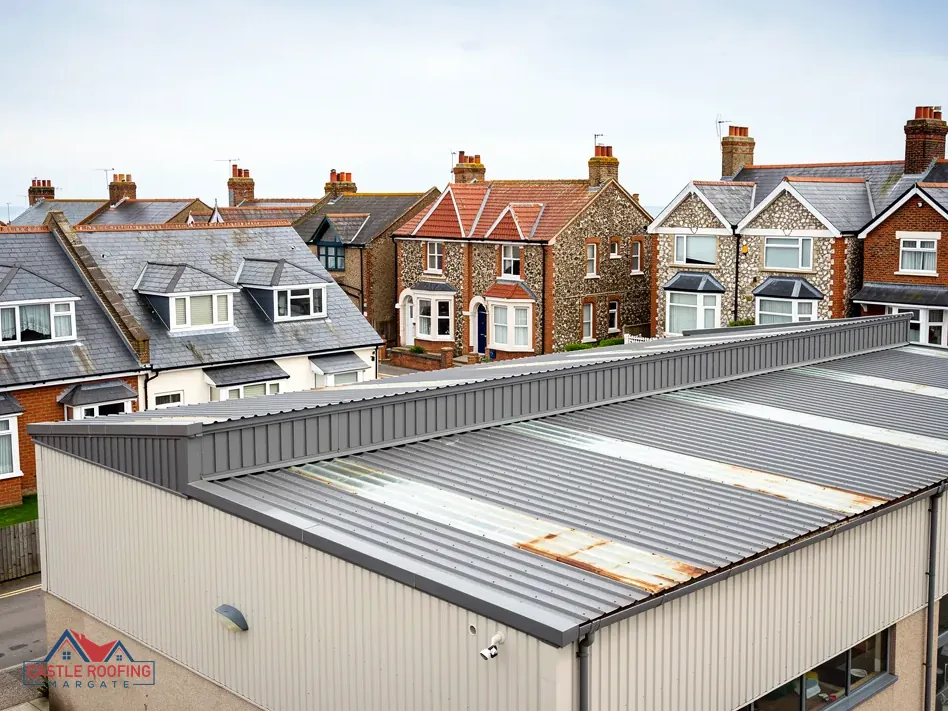
- Profiled sheet: long ribbed metal or fibre-cement panels fixed to purlins, the horizontal rails that span the rafters, common on sheds and workshops.
Lifespans are ranges, not promises, and the guides disagree. HomeBuilding gives felt 10 to 15 years and EPDM 25 to 30 years; Less gives felt 10 to 20 years and EPDM 30 to 50 years. Two sources, two answers, so treat both as a rough guide and let the condition of your own roof overrule them.
A roof near the lower figure is not automatically past saving. Dry, sound decking, which is the board or sheet the covering is laid on, can take local repairs to failed laps for a long while. The same covering over soaked insulation is a different case and usually points to replacement. That is why a surveyor needs to see the roof, and the underside of it, before anyone names a method.
Profiled sheets have their own habit: the cut edges, where the factory coating stops, are where rust starts first. It shows as orange staining along the laps.
Asbestos cement sheets and fragile roofs
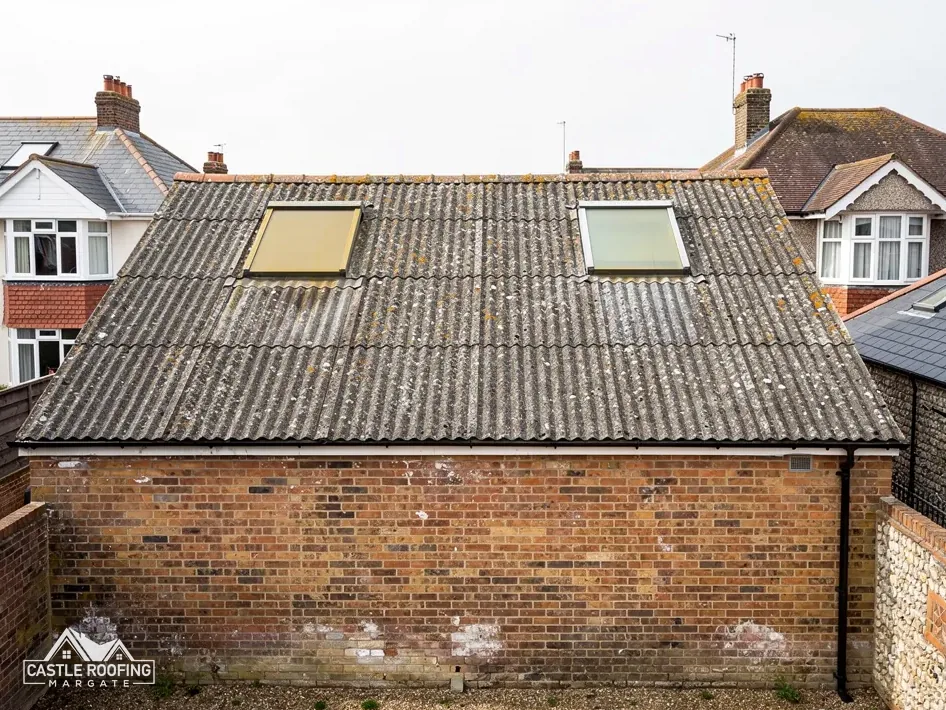
If the building was put up or refurbished before 2000, HSE advice is to treat the building as holding asbestos unless a survey shows that it does not. Corrugated sheeting on older sheds, garages and farm buildings is the usual place to meet it, in the form of asbestos cement.
In HSE guidance A14, roof sheeting made from asbestos cement is classed as fragile in every case. A fragile roof will not carry a person's weight, and sheets that look sound from the ground can give way underfoot, sometimes without warning. Old rooflights are the same, because they weather to the colour of the sheet around them and vanish from above. Nobody should step onto a roof of this kind to look, to clear a gutter or to fetch a lost ball.
- Careful removal of weathered asbestos cement that is not badly damaged is non-licensed work.
- Once the material is substantially damaged or crumbling, the job counts as notifiable non-licensed work.
- Insulating board containing asbestos, found in some external soffits, can be licensable, and a licensed firm carries that work out.
Broken-up sheeting goes into heavy sacks sealed twice over and labelled, then into a container with a lock on it, never an open one. A business moves that material as trade waste, with a consignment note and a registered carrier. Council recycling centres accept a householder's own sheets in small loads, which does not suit a firm with a whole roof to clear. Our page on fragile roof safety covers the access side in more detail.
Who carries the safety duties
Two sets of rules shape every commercial roof job, and both reach the person who orders the work as well as the roofer.
The first is the Construction (Design and Management) Regulations 2015, known as CDM. Its rule that hands a client's duties to the contractor is written for domestic clients: individuals who have building work done at their own home. A business is outside that group, so as a shop owner, landlord or farmer you should not assume the roofer takes every duty on. Ask the contractor, in writing, how the project will be planned and who answers for what before the first day.
The second is the Work at Height Regulations 2005. Regulation 6(3) puts the onus on employers to take sensible, workable measures against falls that could injure someone. On a roof that means edge protection, safe access and a plan for any fragile surface, all in place before anyone climbs up, not a ladder and good intentions. Scaffold at the eaves is the usual answer on a pitched or low-slope roof, and a temporary guard rail or a netted platform can do the same job on a flat one.
Two practical questions follow.
- How will the crew get on and off the roof, and what stops a fall at the edge?
- If the building stays open, how do customers and staff keep clear of the work zone below?
The answers belong in the survey paperwork. A contractor who cannot give them has not planned the job, however keen the price.
Changing the covering: weight, fire and falls
Renewing a commercial roof can need Building Regulations approval, and the Planning Portal sets out when. Approval is normally not needed if less than 25 per cent of the building envelope is affected and less than 50 per cent of the roof. It is needed if the replacement adds 15 per cent or more to the weight on the structure, or if the new covering behaves in a markedly different way in a fire. Before a heavier covering goes on, the Portal suggests consulting a structural engineer or surveyor. A heavier covering on a lightweight deck is exactly when that conversation matters.
Those tests are national. Dover District Council's building control page goes further, naming replacement of roof coverings, even like for like, as work that needs approval, so a Dover address means asking building control before you commit. For a Thanet address the council points you to the Portal's own check.
| Source | Figure |
|---|---|
| BS 6229:2025 guidance | 1:80 minimum finished fall |
| IKO, single-ply | design for 1:40 |
Drainage is the design point to settle first. BS 6229:2025 applies to flat roofs finished in continuously supported flexible coverings, which means membranes, not lead. Standing water that stays long after rain has stopped usually points to a fall problem, and a new covering laid over the same dip will pond in the same place. Outlets matter too: water leaves a membrane roof only as fast as the outlets and gutters allow, so their number and position belong in the specification, along with the fall.
Reading a written quote
A commercial roof cannot be priced from the road. Area, access, the state of the decking, how much old covering must come off and whether asbestos is present all move the figure, and none of them show on a photograph. Commercial rates per square metre depend on too many of those things to quote, so the figure arrives once the roof has been surveyed.
What you can fairly ask for is one total price in writing, with these points visible in the document:
- The method: repair, overlay or strip and replace, and why.
- The covering, and whether the insulation below it is kept or changed.
- How people reach the roof and how its edges are protected.
- Who removes the waste, and how asbestos is handled if it turns up.
- Is VAT included, is scaffold included, and which items does the price leave out?
VAT is 20% as standard. The domestic reverse charge is a separate question: it applies where the customer is a VAT-registered business that reports under the Construction Industry Scheme, so it can matter on a commercial job in a way it never does on a home. Your accountant can say whether it touches yours, and the quote should show the VAT treatment plainly either way.
Citizens Advice suggests getting quotes in writing from at least 3 traders. If two totals sit far apart, compare what each one covers before comparing the numbers.
Repairing first, and when to stop
Repair is often the right call on a commercial roof, and a contractor who only ever proposes a new one is selling, not advising. Typical repair jobs include re-sealing a lap or flashing on a membrane, patching a split in felt, replacing a handful of failed sheets, renewing a rooflight and relining a gutter.
Replacement becomes the honest answer in a few situations:
- The decking is soft or rotten across a wide area.
- The insulation under a membrane is wet through, so patching the surface does not dry the building.
- Corrosion has spread along the cut edges of a whole slope of sheets.
- Repairs have stacked up so thickly that each new leak sits beside the last.
Our guide to single-ply membrane roofing sets out what a membrane replacement involves when the existing felt has reached that point.
A sensible survey report ends with a recommendation, the reasons for it and photographs of the faults. Ask to see them. If the advice is repair, ask what it buys you in time and what the next step would be if the roof begins to fail elsewhere. A repair is the smaller job today, but a roof that needs one every winter is telling you something, and a good report says so plainly. Our commercial roof survey page shows what that report covers, and a site visit with photographs is how it starts.