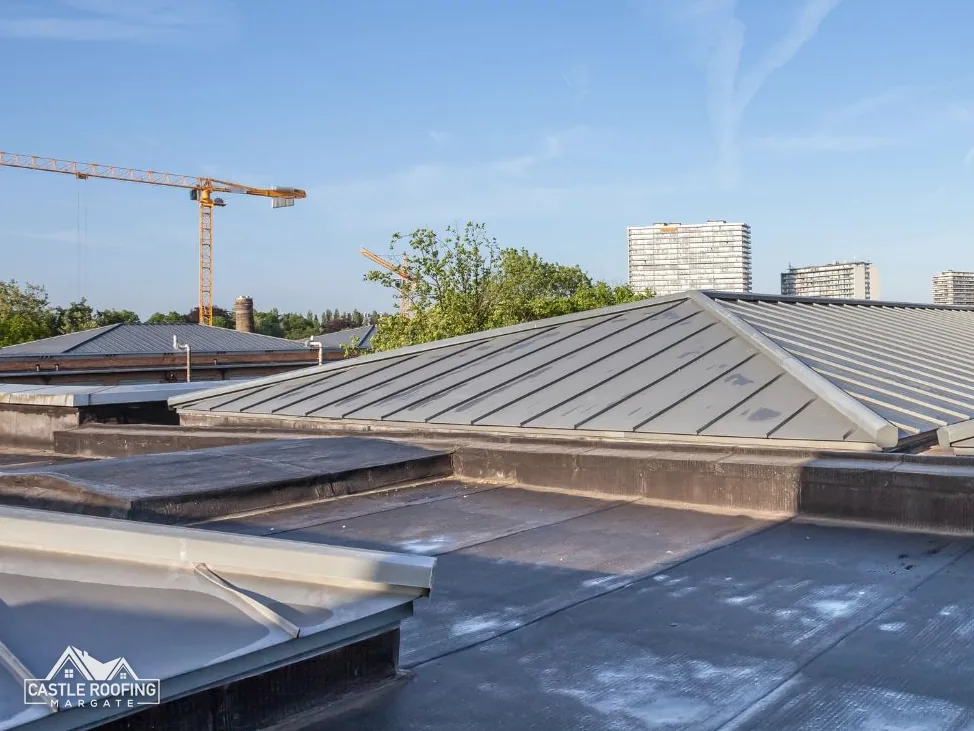
How each covering takes a footstep
A flat roof covering is a waterproof skin, not a floor. How it copes with feet depends on what it is made of and how old it has become.
| Covering | Underfoot |
|---|---|
| Felt (torch-on) | Softens in heat; heels and grit scuff the surface |
| EPDM (rubber sheet) | Flexible but can be cut by sharp objects |
| GRP (fibreglass) | Firm and often walkable, unless cracked |
| Lead or metal | Dents under heavy or repeated loads |
Age counts as much as the material. A felt roof near the end of its typical 10 to 15 years (HomeBuilding) is brittle, and a step can open a crack that was only waiting. Hot weather softens felt and single-ply, while frost leaves them stiffer and easier to split. The surface may also be hiding a soft deck, which gives way where it looks fine. A deck that has been damp for years can carry a person in one place and drop them through in the next.
The safe habit with an unknown roof is to treat the covering as breakable and the boards beneath as unproven.
Walkways and routes for maintenance
If someone has to cross the roof regularly, to reach a rooflight, a boiler flue or an aerial, the answer is a walkway. A walkway spreads the load and shields the covering from grit and heels. It is laid on the surface as a defined route, and it marks out the path that is meant to be used.
Planning a walkway covers a few simple points:
- it should run from the access point to the equipment, not across the whole roof,
- it needs to sit clear of outlets and gutters, so it does not dam water,
- it must be fixed so it does not rub through the covering or lift in wind.
Tell your roofer who goes up and why. A roof visited once a year for a gutter check needs less than one carrying plant, and the right treatment is easier to design in at the start than to bolt on later. Heavy items such as air-conditioning units and planters are best set on proper supports that spread their weight, not placed straight onto the membrane, where a corner can wear through in a season.
The Work at Height duty and fragile parts
The larger danger on any roof is falling. Under regulation 6(3) of the Work at Height Regulations 2005, an employer has to stop falls that could injure anyone wherever that can reasonably be done. That duty rests on employers, so a roofer working at height follows it, and it is a fair standard for a householder's own visit too.
Edges are the obvious risk, and many flat roofs have a low parapet or none at all. Fragile parts are the other. HSE's guidance on asbestos cement roofs is blunt: they are always fragile. An older garage or outbuilding may well be roofed in that sheeting. Rooflights and weathered sheeting can also fail without warning, so never rely on a surface you cannot identify.
Asbestos cement needs care in handling and removal, and a quick go with a hammer is the wrong approach. If you cannot say what the roof is made of, keep your feet on the ground and arrange a survey. A roofer can identify the covering, see which areas are sound and plan the access properly before anybody steps out.
A safer way to look at your own roof
Much can be checked from the ground or an upstairs window. Look for ponding after rain, lifted edges, cracks in the surface, blocked outlets and green growth. A phone with a zoom lens, or a camera on a pole, shows more than a person can see from a ladder, and it gives you a record to compare against later.
If something needs a closer look, a roofer works from scaffold, a tower or an edge protection system, using methods that keep people back from the edge. That is part of the job, and it is why a proper survey takes planning. Never set a ladder against an edge whose top you cannot see.
You can send us what you see and we explain what it means. Photos of blisters, cracks or standing water give us the first clues; see blisters on a felt roof and signs a flat roof is failing for what to look for.
For all our flat roof work, see flat roofing. Once the survey is done, the price reaches you as a single written total.