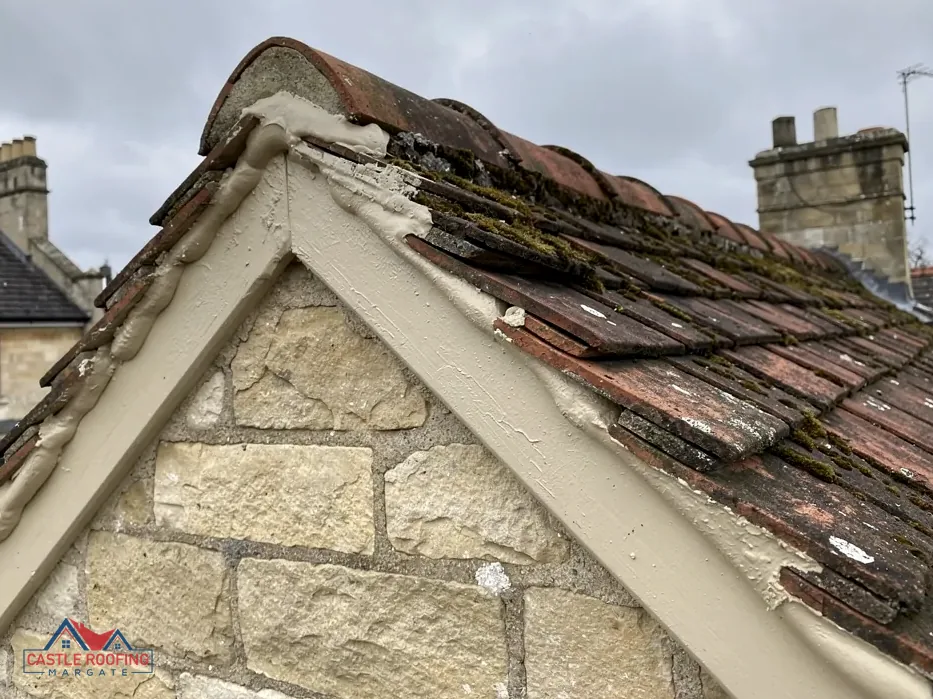
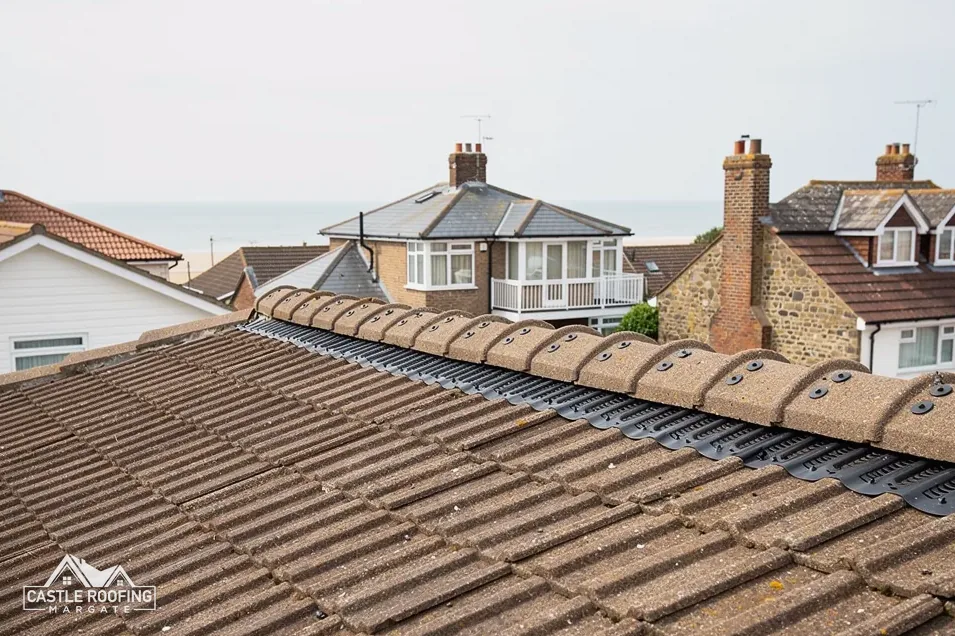
Access options for a ridge, from small to large
The ridge is the crown of the roof, so reaching it safely is half the job. The right access depends on how much work there is and what the house allows.
- A ladder to the eaves with a roof ladder over the tiles, for a short and simple job.
- A scaffold tower or a platform at the gable, for a limited repair at one end.
- A full scaffold with edge protection and a working platform, for a long ridge, a re-bed or work on several slopes.
- A mobile access platform, where there is room for one on the ground.
A ladder is for short, light work, not for carrying mortar and tiles up or for working along a run of ridge. Replacing a section of ridge, re-bedding and re-pointing all put materials and tools on the roof, so the working platform and edge protection of a scaffold earn their place. On a three-storey house or a steep roof, a scaffold is the sound choice.
A roofer who has studied the house from the pavement and the loft can say which option suits, and should give the reasons before the work is priced.
What Work at Height expects
Roofing at height is regulated work. Regulation 6(3) of the Work at Height Regulations 2005 requires an employer to put sensible, adequate precautions in place against falls that could injure, within what is reasonably practicable. Edge protection and a stable platform are one way of meeting it along a ridge, and the survey settles which kind of access a given repair warrants.
For a householder, what matters is what you see at the survey. A contractor planning access to the ridge should be able to say what the plan is for the day, whether that is a scaffold, a tower or another system, and how the people on the roof are protected from a fall.
Under CDM 2015, regulation 7(1), when a single contractor carries out the whole job, the householder's client duties fall to that contractor. So the access plan is the contractor's responsibility, not yours, though you are entitled to ask what it is.
It is worth asking early, because a ridge repair that looks small from the garden can turn out to need more of the roof opened up once the access is in place.
When a Kent County Council licence comes into it
A scaffold licence is a highways matter. Section 169 of the Highways Act 1980 is the law behind it, and Kent County Council issues the licence in every district we cover, Ashford's villages as well as Thanet's towns. On its licence page Kent County Council states that it is the scaffolding company, and not the householder, that submits the form.
The licence applies only where poles are placed above or across the highway, such as a front pavement. A scaffold standing wholly on your own drive or in the back garden does not need one. A ridge on the front slope of a terrace with the wall at the back of the pavement is a case where the poles land on the footway.
The figures are set by Kent County Council for 2026 to 2027: £52 per week, and the application must go in 5 working days before the start date. Our scaffold licence in Kent page sets out the full process, and anyone with a query before applying can ring Kent County Council's highways team on 03000 41 81 81.
Kent County Council also lists a site inspection charge of £78 for 2026 to 2027, applied only where it deems an inspection necessary.
What decides the price, and what to ask
Scaffold cost is set after the survey, since it varies with the height, the length of ridge, the ground, the number of weeks it stands and whether it crosses the pavement. The Kent County Council fee is one part of it, and it runs for each week the scaffold stays up. A repair done in a day needs far less access than a re-bed that takes several, which is a reason to batch other roof jobs into the same visit.
Before you agree to a ridge job, ask your roofer:
- What access will be used, and why that one suits this roof?
- Does any part reach over or sit upon the pavement or road?
- Has a licence been applied for with Kent County Council, and on what date does it start?
- Does the quote include VAT and the scaffold?
Clear answers mean the job is planned. Ask for the licence dates in writing too, so that a job that overruns can be renewed in time. For the repair itself, see re-bedding ridge tiles and ridge tile repair cost, or the dry ridge and verge hub.