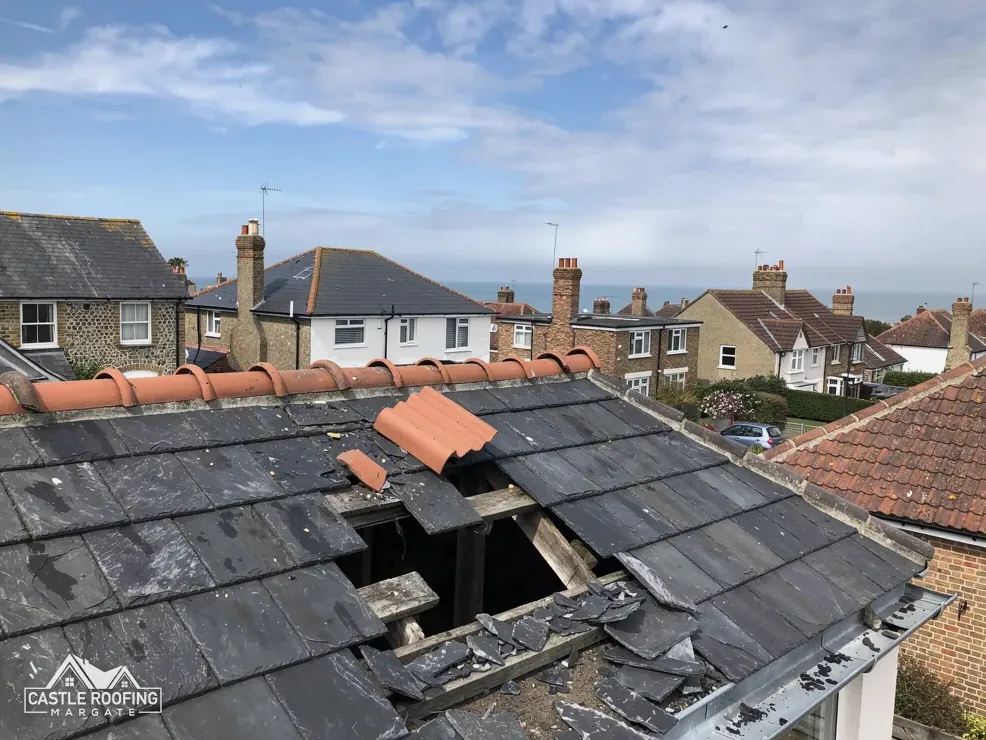
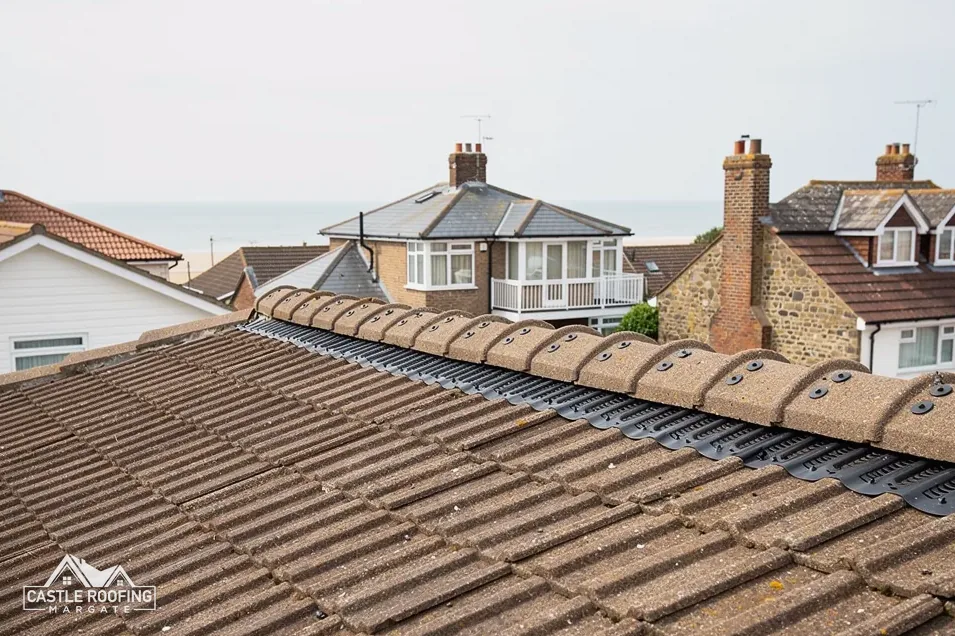
Use this to recognise a hip tile that has moved, to understand hip irons and mechanical fixing in plain terms, and to know what a repair should involve before anyone goes up.
A hip is the diagonal where two roof slopes meet at an outside corner and run from the ridge down to the eaves. It is covered by a row of hip tiles, which are shaped to straddle the join and shed water to either side. Because a hip runs downhill, its tiles want to slide, and everything about how a hip is built is aimed at stopping them.
Traditionally each hip tile was bedded on mortar, with a metal bracket called a hip iron at the bottom to hold the whole row in place. When the mortar crumbles or the iron rusts away, the row loses its grip, and a tile can drift out of line or drop off. Seen from the pavement, that looks like a gap, a tilted tile or a dark line where the hip no longer sits tight.
This guide covers how to recognise the problem, what a repair involves, and what to do about safety, because the foot of a hip is at the eaves, where the nearest drop is. A hip repair is one of the jobs within our dry ridge and verge work, and the way it differs from a ridge repair is explained below.
How a hip is held in place
Seen from below, a hip looks like a simple line of tiles, but it is a small structure with its own parts. A hip does three jobs. It closes the join between two slopes, it sheds water to both sides, and it holds its own weight on a slope. The third job is the one that fails.
The parts, working from the top down:
- the hip tiles, laid in a row, each overlapping the one below
- a bed under each tile, historically of mortar, which fills the gap between the tile and the roof covering beneath
- the hip iron, a strip of metal fixed to the hip rafter at the eaves end, which stops the row of tiles sliding down the slope
- the ridge end at the top, where the hip meets the ridge and the tiles are closed off
The eaves run along the bottom of each slope, where the slope projects past the wall and carries the gutter. A hip iron is screwed or nailed to the timber beneath the bottom tile, and it turns up to support it.
Newer methods replace some of this, and they change what a repair looks like. A dry-fixed hip uses a manufactured fixing system, covered by BS 8612:2018, and holds the tiles with screws or clips instead of a mortar bed. Either way, a hip needs two kinds of grip: something to stop each tile lifting in the wind, and something to stop the whole row sliding. A repair has to restore both.
Signs a hip tile has moved
Hip trouble can often be seen from the ground without a ladder, if you know what you are looking at. The best view is from across the road, in daylight, with the sun on the roof so that shadows show up the line of the hip.
Signs to look for:
- a gap between two hip tiles where the row used to be continuous
- a tile that sits at a different angle from its neighbours
- a tile at the bottom of the hip that has slipped forward over the eaves
- a dark line along the hip where the mortar has fallen out
- pieces of mortar in the gutter, on the path or on a flat roof below
- a tile missing altogether, leaving a bare patch where the covering shows through
A stain on a bedroom ceiling below a hip is a later sign, and by then water has already found the gap. Daylight in the loft along the line of a hip, on a bright day, tells the same story from the inside.
If you notice any of these, take a photograph from the ground and note the date. A photograph with the date helps the roofer, and it helps an insurer if the damage followed a storm. Do not try to push a slipped tile back. A tile that has moved has lost its fixing, and pressing it into place only hides the fault until the next gust.
Safety at the eaves
The foot of a hip is a dangerous place to work. It is where the slope ends, where the gutter and fascia give no handhold, and where a slipped tile can fall onto a path below. A ladder against the eaves leans on the very part that is loose.
Regulation 6(3) of the Work at Height Regulations 2005 asks an employer to take reasonably practicable steps against a fall that could injure someone. We plan a hip repair around access, usually a tower or a scaffold lift, before a tile is touched, and a ladder against the eaves is a poor second choice to either of them.
If you are the owner, the sensible steps are short:
- Stay off the roof and off the ladder, and keep children and pets away from the area below.
- Photograph the hip from the ground.
- If a tile is hanging, cordon off the path under it.
- Call a roofer and send the photographs.
A loose hip tile is a falling object. Keep people off the path beneath it until it has been made safe.
If the scaffolding has to stand on public pavement, the licence is Kent County Council's to grant under section 169 of the Highways Act 1980, and the scaffolder applies. After storm damage, the Institution of Structural Engineers recommends contacting the insurer first, then making safe, with photographs and receipts kept throughout.
Mechanical fixing on a repair
Fixing a hip tile back on a bed of fresh mortar and walking away is no longer how the job is done. Marley, the tile maker, says the 2015 amendments to BS 5534 left mortar unfit to be a roof covering's sole fixing, and that a 2018 amendment brought repairs inside the standard's scope. Compliance with it is a matter of good practice, since the code is not itself a statute.
In practice, a hip repair is built around a mechanical fixing: something screwed or clipped that holds the tile whatever the mortar does. The repair route depends on what the survey finds.
| Route | When it suits | What holds the tile |
|---|---|---|
| Re-bed with fixings | Hip is sound, a few tiles loose | Mortar plus fixings |
| Dry-fix hip kit | Whole hip failing or exposed | Fixings alone |
| Replace a tile | One cracked or missing | Fixings and a new bed |
Mortar is not forbidden. It can sit alongside a mechanical fixing, and on some period roofs it is part of the look. What the standard moved on from was a hip whose grip rested on mortar alone. A roofer who has fitted both kinds can tell from the old bed which one a given hip was built with, and can say whether the repair should follow it or change it.
Our guide to re-bedding ridge tiles in mortar explains when that route is still the right one.
Hip irons and fixings on an older roof
The hip iron is a small part that is easy to overlook, and a traditional hip depends on it. It does one job, which is to stop the bottom tile, and so the whole row above it, from sliding down the slope.
On a seaside house the iron is out in the weather as much as the tiles are. Irons are made of metal, and metal that stays wet can corrode. An iron that has rusted through or pulled away from the timber can no longer hold anything, and the first sign is a tile at the eaves end of the hip creeping out of line. Some older roofs have no iron at all, and have relied on the mortar bed alone for decades.
When the roofer reaches the hip, these are the checks:
- is there an iron at the foot, and is it sound
- is it fixed to timber that is itself sound
- do the hip tiles match each other, so they sit and lap correctly
- are the fixings the right length for the thickness of tile and bed beneath them
- is anything under the bottom tiles holding water against the timber
Where an iron is missing or rusted, it is replaced or fitted as part of the repair, because a new row of tiles on a failed iron will slide again. The detail varies by roof, which is why a survey comes before a price, and why the fixings are chosen for the site rather than from a fixed list. A hip on a roof that has had earlier repairs may carry a mixture of old and new work, and the roofer needs to see where one ends and the other begins.
What a hip repair involves and what to ask
A hip repair is a small job when it is caught early and a larger one when a slipped tile has let water in. The stages are the same either way, and you are told which one is under way each day of the work, with the photographs to match.
- The roofer surveys the hip and photographs it, from the ground and up close.
- Access is set up, so the work is done from a safe position and not from a ladder at the eaves.
- Loose tiles and failed mortar are lifted off, and the iron and the timber beneath are checked.
- The hip is rebuilt with mechanical fixing, either on a new bed or on a dry-fixed system.
- The tiles are lined up and pointed, and the debris is cleared.
Before work begins, ask for these in the written price:
- the number of tiles to be lifted and re-laid or replaced
- whether the hip iron is being renewed
- how the access is arranged, and whether a scaffold licence is involved
- that the waste is taken away
For the price range of ridge work, our guide to what ridge tile repairs cost sets out the national figures, and the written price for your own hip follows a survey of it. If the cause is a storm, keep your photographs, and check your policy's own definition of a storm before assuming a claim will succeed.