What the Ombudsman says counts as a storm
Home insurance can cover storm damage, though policies do not all word a storm the same way. The Financial Ombudsman Service, which settles complaints about insurers, holds that storm weather means fierce wind, typically accompanied by rain, hail or snow. On the Ombudsman's wording, snow, hail or rain alone can be enough to count as a storm.
Wind speed is where disputes start. The Ombudsman weighs the Beaufort Scale, and it notes that some insurers set a threshold on that scale below which winds do not count as storm-force. So one policy may treat a gusty night as a storm and another may not. The answer sits in your own policy wording, not in a rule that applies to everyone.
For a ridge tile that has come off, the question an insurer asks is simple: did weather bring it down, or was it ready to fall? Your claim is stronger if you can show that the weather on the day was severe, and that the tile and its bed were otherwise sound.
The policy booklet and schedule will carry the definition, and a phone call to the insurer can confirm it.
Wear and tear, and why old ridge mortar is the sticking point
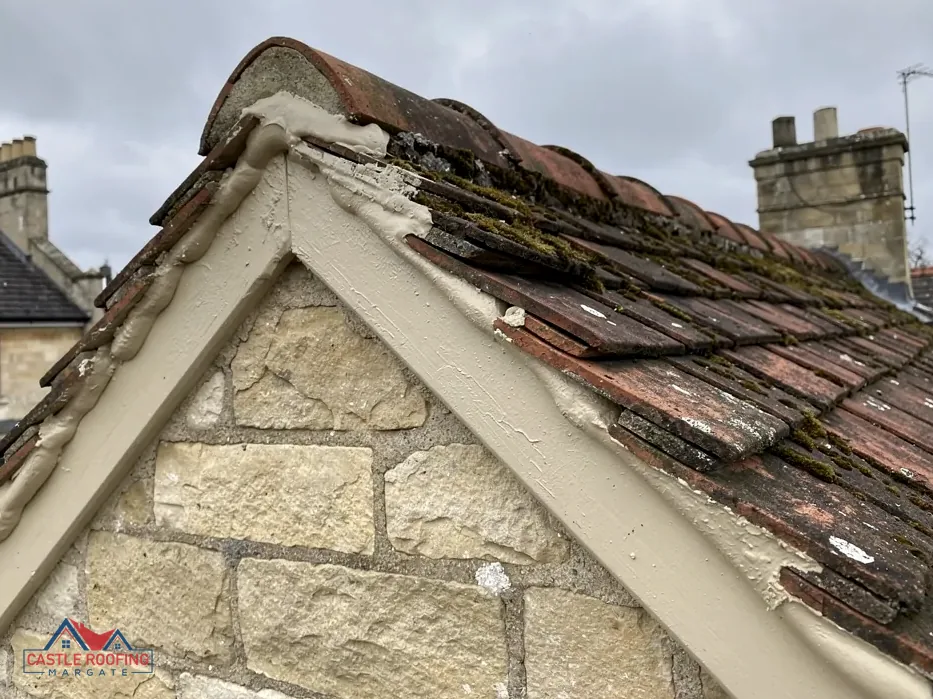
The same Ombudsman guidance lists exclusions that appear in policies, among them wear and tear and damage that builds up slowly. A ridge is a good test of that line. Mortar that has cracked and crumbled over years is wear. A clean tile lifted off by a gust, with a sound bed under it, looks like a storm.
An insurer's surveyor or loss adjuster looks for the signs:
- Old, powdery or hollow mortar behind the fallen tile.
- Moss and staining that point to long-running movement.
- Several tiles loose along the ridge, not one.
- Fresh breaks and clean edges, which suggest sudden force.
This is why photographs taken before any repair matter. They record what the bed looked like on the day. Which? has reported that only 32% of storm-related claims made in 2024 resulted in a payout, a reminder that a claim is far from a given. A roofer can describe the condition of the ridge and write it down for you, but cannot decide a claim, and neither can any contractor, so keep your own record of what was found.
If the ridge was already loose, repairing it before a storm is cheaper than arguing afterwards.
The order of events once a ridge tile has gone
Work through the steps in this order:
- Make sure nobody is at risk, then stay on the ground.
- Photograph the damage and the fallen tile in daylight.
- Contact your insurer before arranging the repair, since Which? notes that most insurers have a 24-hour emergency helpline.
- Get the roof made safe, with a temporary cover for instance, and hold on to every receipt.
- Get a written report on the roof's condition if the insurer asks for one.
The insurer may ask for a quote or may send its own contractor, so agree who does what before work begins, and ask whether the policy sets an excess. Our ridge tile fell off page covers the first hour in more detail, and ridge tiles loose in wind explains how a ridge works loose before it fails.
Any claim sits between you and the company that wrote your policy. The roofer's part is the roof itself: what is found on it, what is photographed and what the repair involves, set out in writing with the photos.
What a storm repair costs and where to go if a claim is refused
MyJobQuote (October 2026) says storm repairs start at around £300, and that extensive storm damage can cost £1,200 or more. A single ridge tile sits at the lower end of that scale. Which? Trusted Traders (November 2025) give a typical UK range of £80 to £300, excluding VAT, for a new ridge tile. Whether a claim covers the whole of that is a matter for your policy, including its excess.
If your insurer turns down a claim or you dispute its offer, raise a complaint with the insurer first. Should that fail, the Financial Ombudsman Service can examine the case, and its helpline is 0800 023 4567. Citizens Advice gives consumer advice on 0808 223 1133.
Do not delay the repair while a dispute runs on, because an open ridge lets in rain and the damage grows. Keep the old tile and the photographs somewhere dry. A temporary cover costs far less than a ceiling replaced. For the repair itself, our dry ridge and verge work covers re-fixing a ridge so that it does not rely on mortar alone.