

Roofers in Whitstable
18.7 road miles from Margate. Repairs, re-coverings and chimney work for Whitstable and Tankerton homes, with every slope checked and shown to you in pictures before we write a price.
- Canterbury decidesCanterbury City Council decides planning and listing here.
- Three conservation areasWhitstable Town, Tankerton and the Railway conservation areas.
- STG inspectsSTG Building Control, Rochester, 01634 331133.
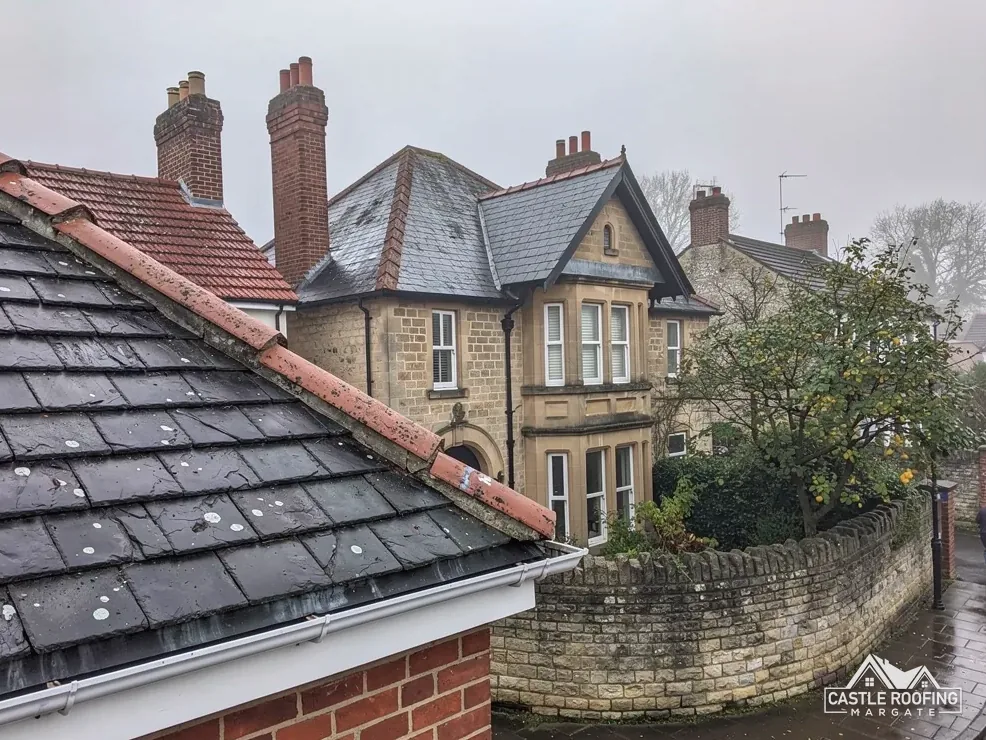
A chapel, a hotel and three conservation areas
Hotel roof
The Duke of Cumberland Hotel has been Grade II listed since 20 May 1977, so its roof comes under listed building consent.
Tankerton
Tankerton is one of three conservation areas within about 0.75 km of the centre, beside Whitstable Town and the railway area.
Shoreline site
The town centre lies 0.11 km from the water, so each Whitstable fixing schedule is worked out roof by roof.
Whitstable and Tankerton
What the paperwork says about Whitstable roofs
| Council | Canterbury City Council |
|---|---|
| Building control | STG Building Control Partnership |
| Scaffold and skip licences | Kent County Council |
| Conservation area | Whitstable Town; Tankerton; Canterbury and Whitstable Railway and Whitstable Station |
| From Margate | 18.7 road miles, about 27 min |
| Grade II, first listed 17 June 1975 | The Methodist Chapel |
| Grade II, first listed 20 May 1977 | Nos 29 and 30 (Tudor restaurant), Duke of Cumberland Hotel |
| Environment Agency flood zone, town centre | Flood Zone 2 |
| Article 4 entries in Canterbury's dataset | 3 around the town |
Whitstable follows Canterbury City Council for planning and the STG partnership for building control, a different pair from the Thanet team used in Margate. These entries show where a survey here begins.
Sources: ONS Census 2021, Canterbury City Council, Kent County Council, OSRM road routing.
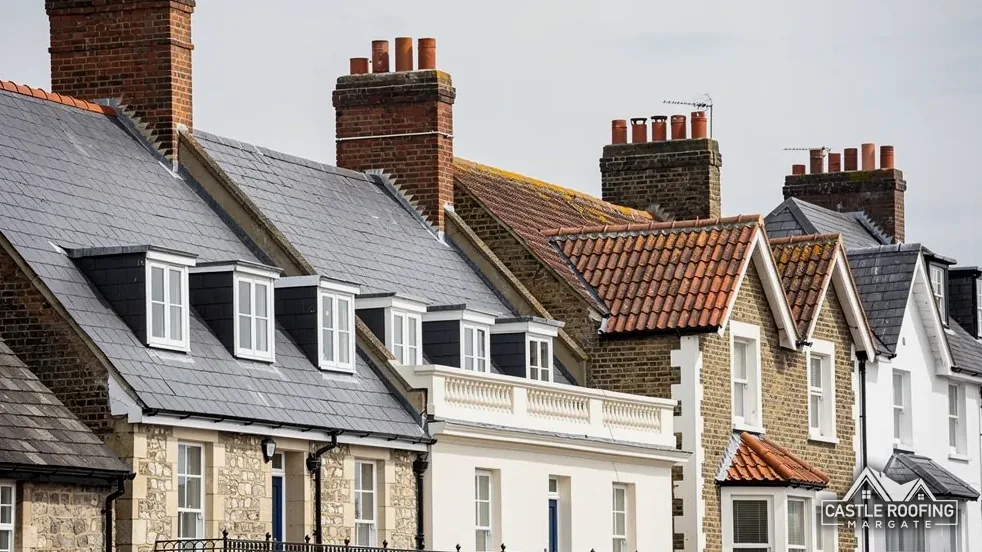
Whitstable, chapel to scaffold
Whitstable roofs, from the listed chapel and hotel to the pavement and the wind
Three chapters on the listed buildings, the three conservation areas with Canterbury's planning and building control routes, and the scaffold, skip and wind facts behind a Whitstable re-roof.
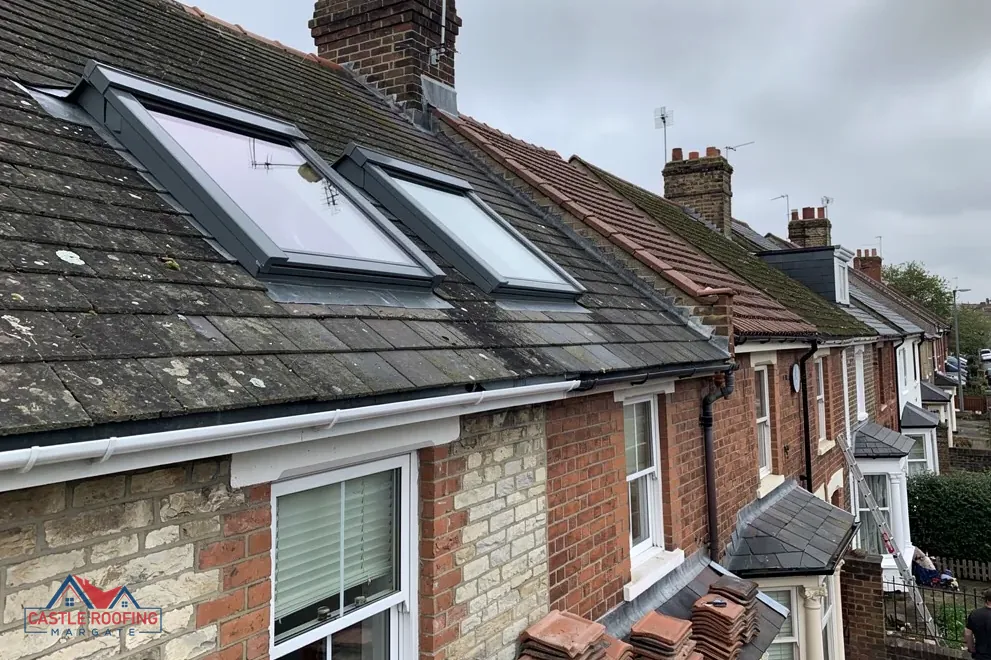
Chapter 01 of 03
Three listed roofs and what listing asks of you
Three entries on Historic England's list show the range of Whitstable's listed roofs: the Methodist Chapel, listed Grade II on 17 June 1975, and both the Duke of Cumberland Hotel and the combined Nos 29 and 30 entry for the Tudor restaurant, listed Grade II on 20 May 1977. The town lies 18.7 road miles west of Margate, about 27 minutes away, and on any older building the first thing to settle is whether it is listed, before a ladder goes up. A chapel, a hotel and a restaurant can have three different owners and three different reasons to touch a roof.
Grade II listing covers the building as a whole, the roof included. Under section 7 of the Planning (Listed Buildings and Conservation Areas) Act 1990, anything that would change a listed building's special character calls for listed building consent, and Canterbury City Council repeats that on its own listed buildings page. On a roof, character sits in the pitch and the covering, in the ridge (the crest where the slopes meet), in the stacks, and in the lead flashings (strips of dressed metal that close the gap between a slope and a wall). Relaying a roof in a different material, or taking down a stack for convenience, changes exactly what the listing protects. Even a repair that looks small, such as a new run of hip tiles or a replaced valley, has to respect the shapes already there.
The consent route turns on use. A Methodist chapel that still holds services answers to its denomination's own system; the same walls converted into a flat, shop or studio fall back on listed building consent from Canterbury City Council. The list entry names the building but says nothing about what goes on inside it today, so on a chapel roof our first call is to whoever looks after the building. A hotel or a restaurant has no such fork and goes straight to the council, and because both are business premises, the commercial side of the work matters as much as the heritage side; our commercial roofing page covers that side.
For a listed roof the entry itself is where a quote starts. We then work across every slope, valley and stack, and you receive pictures of all of it. The wording of any application matches the job on the roof, and repairs stay with the material already there unless the council has agreed otherwise. Slate and lead work on buildings like these is covered on our slate roofing and lead roofing pages.

Chapter 02 of 03
Three conservation areas, one council and one building control partner
Planning data places three conservation areas inside roughly 0.75 km of the middle of Whitstable: Whitstable Town, Tankerton, and a third that takes its name from the Canterbury and Whitstable Railway and the town's station. Canterbury City Council counts 97 conservation areas across its whole district, so a Whitstable address might fall in one of these three, on a boundary line, or in none. Conservation areas count as article 2(3) land, and there the dormer class of permitted development falls away; our roof window planning guide sets out what that means for windows and additions.
Canterbury's Article 4 map is separate from its conservation area map, and the published dataset has three entries around Whitstable. An Article 4 direction removes named permitted development rights over a set area. Which rights, and for which properties, only the council can say for a given front door, so your address goes to Canterbury City Council, and we wait for its answer rather than guess from the house next door. That pause costs a few days, whereas a notice to undo finished work costs far more. Until that reply arrives, no outward change to a Whitstable roof is priced.
| Question | Who answers it |
|---|---|
| Planning and listing | Canterbury City Council |
| Building control | STG Building Control |
| Scaffold licence | Kent County Council |
| Skip permit | Kent County Council |
Source: Canterbury City Council; STG Building Control; Kent County Council
Building control is a different door. Canterbury City Council hands building control to the STG Building Control Partnership, whose Rochester team works for four councils and answers on 01634 331133. The Planning Portal's national test is that a re-roof calls for no application in the ordinary case when it affects less than 25 per cent of the building envelope and less than 50 per cent of the roof. Picking a covering with 15 per cent more weight than the present one, or higher, brings approval into play at once, so a tired Whitstable frame gets a structural opinion before any slates are ordered, and the weight figures go on paper first.
Three bodies, then, hold four different answers about one roof. The table below sorts them, and it is the list we work down before a price is written. A Whitstable owner can take the same rows to the council or to building control and ask each body directly; its written reply then sits with the survey photos in the job file.

Chapter 03 of 03
Scaffold licences, skips and wind on the shoreline
Any scaffold standing on a Whitstable pavement needs a licence under section 169 of the Highways Act 1980. Kent County Council, not Canterbury, issues it. The county's own wording puts the paperwork on the scaffolding firm, and we settle the calendar with them after the survey has fixed how big the job is. The fee is £52 per week for 2026 to 2027, with 5 working days' notice, and Kent County Council reserves a £78 inspection visit for sites where it sees a need. Questions before an application go to its highways line on 03000 41 81 81.
Skips get a separate Kent County Council permit: £45 per week for 2026 to 2027, 5 working days ahead, and no larger than 5 metres by 2 metres. Whatever comes off the roof has to go somewhere. Stripped slates, battens (the thin timbers slates are hung from) and underlay (the waterproof sheet beneath the covering) are loaded so that the skip leaves the road on the day we do, and the permit dates are chosen to fit that plan. If a job is likely to overrun, the permit is renewed before it lapses, not after, because a skip left without cover invites a retrospective fee and an inspection charge from Kent County Council.
For weather, the Met Office gives figures from Manston, a Thanet station, for 1991 to 2020: roughly 613 mm of rain over twelve months, wind averaging 9.86 knots at 10 metres, 110.05 days with 1 mm or more of rain and 21.43 days of air frost. Those are Manston's figures, not Whitstable's, but they show what the weather in this corner of east Kent asks of a roof across a normal year, from steady wind to frosty mornings. Cupa, the slate maker, puts buildings in coastal areas into a higher exposure grade, and Whitstable's centre is only 0.11 km from the water.
So a fixing schedule is worked out roof by roof under BS 5534, the code of practice behind fixing slates and tiles, and a job on a sheltered street elsewhere is no template for it. The re-roof itself then runs in a fixed order with news from us at every stage; the steps below take it from first look to cleared pavement.
Order of work at Whitstable
Survey and photos
A look from the street and from close up, then the pictures sent to you.
Planning and listing check
Your address against conservation maps, the list and the building control route.
Licence and permit
The scaffolder applies to Kent County Council ahead; the skip is permitted.
Work and clearance
Fixings set for the exposure, a daily update, and waste taken away.
10-Year workmanship guarantee. In writing
Around Whitstable
Inland from Whitstable, across the Canterbury district
Canterbury City Council, the STG partnership and Kent County Council's highway licences also cover Blean, Harbledown and Barham, so a roof in any of those villages is dealt with through the same offices.
Whitstable chapels, conservation areas and licences
Does re-covering a roof in the Tankerton part of Whitstable need consent?
That depends on the work and the address. Tankerton is one of three conservation areas near the centre of Whitstable, and Canterbury City Council has Article 4 entries around the town that can withdraw some permitted development rights. Replacing like for like is a different question from adding a roof window. We put your address to the council and tell you which case yours is before pricing.
Which office checks Building Regulations on a Whitstable re-roof?
Canterbury City Council passes this to the STG Building Control Partnership, based in Rochester on 01634 331133. In the Planning Portal's test, a job normally needs no application while under 25 per cent of the building envelope and under 50 per cent of the roof is involved. Approval is required for any covering at least 15 per cent heavier than the old, however small the area.
Is a Whitstable chapel roof handled like any other listed roof?
Not always. Listing needs consent under section 7 of the Planning (Listed Buildings and Conservation Areas) Act 1990 for works that affect character. A chapel still in use by a denomination such as the Methodists may follow that denomination's own system, while the same building in new use, or a hotel, goes to Canterbury City Council. We ask who holds the building before anything else.
Who books the scaffold for a Whitstable street roof?
The scaffolding company submits the application to Kent County Council, the highway authority, and the licence cannot start sooner than 5 working days after filing. For 2026 to 2027 the fee is £52 per week. Kent County Council requires public liability insurance of at least £5 million, and pre-application questions go to its highways team on 03000 41 81 81.
Does the Flood Zone 2 mapping at Whitstable centre alter a roof job?
The Environment Agency places Whitstable's centre in Flood Zone 2, but that classification describes ground-level water risk. It does not decide how a roof is covered or fixed, though it can matter for ground works and access. On the roof itself we look at the slopes, the lead and the fixings, then tell you what the survey found.
Start with your Whitstable roof
Message pictures of the Whitstable roof, or ask us to visit, and a single written total follows once we have surveyed it.