

Roofers in Seabrook
29.6 road miles from Margate. Roof repairs, replacements and leadwork in Seabrook, planned around the Martello tower, the military canal and the council paperwork before one price is written.
- Grade II MartelloMartello Tower No 9 is Grade II, listed 1975.
- Within 2.5 kmSandgate and Newington conservation areas lie within 2.5 km.
- In-house inspectionFolkestone & Hythe's own Building Control team.
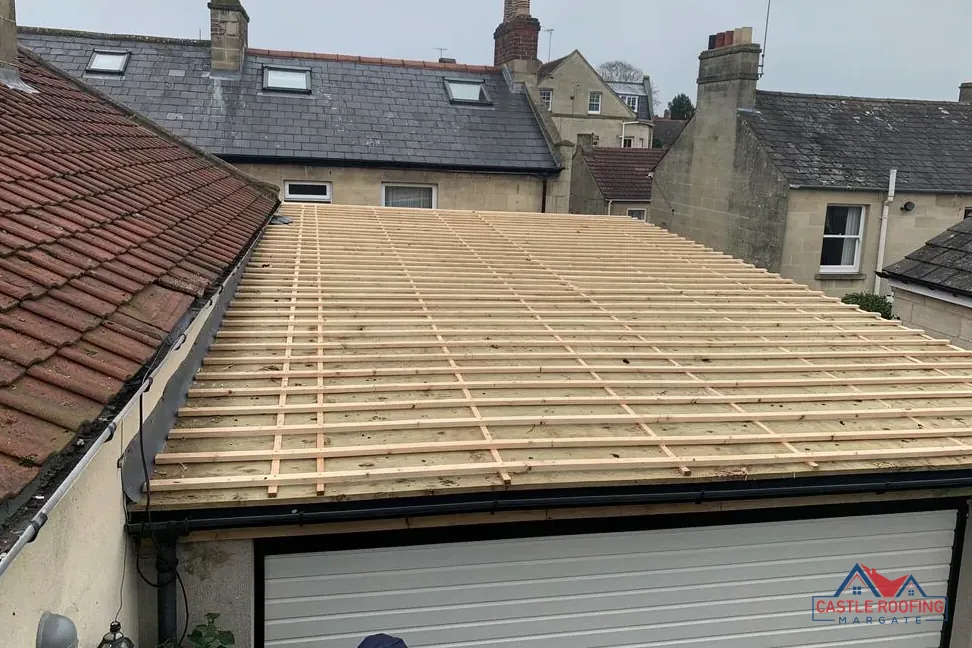
A Martello tower, a mill house and the military canal
Tower grade
Martello Tower No 9 and Mill House are both Grade II, which puts their entries first on any nearby survey.
Canal stretch
The Royal Military Canal, from Seabrook Lodge Bridge to Seabrook Sluice, is a scheduled monument within 500 m.
Nearest areas
Sandgate High Street, Sandgate The Esplanade and Newington are the closest conservation areas, within about 2.5 km.
Seabrook, Hythe parish
Seabrook's tower, mill house and canal on the record
| Council | Folkestone & Hythe District Council |
|---|---|
| Building control | Folkestone & Hythe District Council's own Building Control team |
| Scaffold and skip licences | Kent County Council |
| From Margate | 29.6 road miles, about 44 min |
| Listed entries within 500 m | 2 on the Historic England list |
| Grade II, first listed 1973 | Mill House |
| Grade II, first listed 1975 | Martello Tower No 9 |
| Scheduled monument | Royal Military Canal, Seabrook Lodge Bridge to Seabrook Sluice |
A short list of heritage entries sits right beside Seabrook's houses: two listed buildings within 500 metres and a scheduled canal stretch, so the first check covers three entries.
Sources: ONS Census 2021, Folkestone & Hythe District Council, Kent County Council, OSRM road routing.

Seabrook, tower to sluice
Seabrook roofs, from the Martello tower to the canal sluice and back to the street
Three chapters on the tower, mill house and scheduled canal, the nearest conservation areas with the district's building control, and the exposure, scaffold and skip facts behind a Seabrook job.

Chapter 01 of 03
Martello Tower No 9, Mill House and the scheduled canal
Seabrook lies 29.6 road miles from Margate, around 44 minutes heading south-west. Historic England's National Heritage List has just 2 listed entries within 500 metres of the village centre, which keeps the search brief. Mill House was first listed at Grade II on 21 December 1973. Martello Tower No 9 is Grade II too, first listed on 11 March 1975. Close by, the Royal Military Canal between Seabrook Lodge Bridge and Seabrook Sluice is a scheduled monument within about 500 metres, and a scheduled monument belongs to a different set of rules from a listed building. Whether or not the house is listed, the inspection looks at the same things: the pitch, the ridge, the verge and the way each stack is flashed into the slope.
Two separate laws are in play. Under section 7 of the Planning (Listed Buildings and Conservation Areas) Act 1990, listed building consent is required for works that affect a listed building's character, and the roof's covering, ridge, stacks and lead all count towards it. For the canal the route is scheduled monument consent, because section 2 of the 1979 monuments Act makes unauthorised works to a scheduled site an offence. Your own house is neither listed nor scheduled unless an entry says so, but if it stands beside the canal, scaffold feet and skips are placed to keep clear of scheduled ground.
A Seabrook survey starts at a desk. The address goes into the list, the roof gets a look from the road and a closer one from above, and a set of pictures reaches you before any price does. The jobs that tend to follow are covered on our roof repairs and guttering, soffits and fascias pages, which explain what each repair involves and when replacement is the better answer.
Where a listing does bite, the existing covering and detailing set the standard for the repair, and any change goes to Folkestone & Hythe District Council as an application. The wording on that form is lifted straight from the quote, so the council and the customer are reading one description. A house that is not listed follows the ordinary routes in the next chapter.
Checking a listing, stage by stage
Search the entry
The address is looked up on the National Heritage List.
Match the building
The entry is matched to the roof, not just the street name.
Pick the route
Listed building consent, scheduled monument consent, or neither applies.
Word the job
The quote and the application describe the same work.
Chapter 02 of 03
Sandgate, Newington and the nearest conservation areas
Which conservation area is closest to a Seabrook roof? On the national planning dataset the answer is a trio within about 2.5 km: Sandgate High Street, Sandgate The Esplanade and Newington. A dataset distance is no substitute for the council's own map, which shows boundaries street by street, and Folkestone & Hythe District Council settles any individual Seabrook address. Inside a boundary a house stands on article 2(3) land and loses the dormer allowance under permitted development; our roof window planning guide shows what else changes.
Article 4 is the second layer to check. By direction, a council can remove rights that a house would otherwise hold within a defined area, and the notice names the rights removed. Whether one reaches a Seabrook house is a question for the district council, and not asking can cost a refused application after the drawings have been paid for.
| Area | Position |
|---|---|
| Sandgate High Street | Within about 2.5 km |
| Sandgate The Esplanade | Within about 2.5 km |
| Newington | Within about 2.5 km |
Source: planning.data.gov.uk conservation-area dataset
Folkestone & Hythe District Council runs Building Control itself, on 01303 853538 between 10:00am and 4:00pm, and it lists replacing roof coverings under alterations that may need approval. For a first view, the Planning Portal draws its line at 25 per cent of the building envelope and 50 per cent of the roof, and a job below both limits does not normally need an application. A covering heavier by 15 per cent or more brings approval regardless of size, and a doubtful frame goes to a structural engineer for an opinion before slates or tiles are ordered.
Flats sit outside the usual householder rules, because the General Permitted Development Order defines a dwellinghouse so as to leave out a building containing flats. For a converted house the question is who owns the roof: a landlord, a freeholder or the leaseholders' company. That is asked at the first call so no one books a scaffold against the wrong decision-maker. If nobody can yet say who that is, no date is pencilled in, because a scaffold booked on the wrong person's word still has to come down again. The council's map is open to everyone, and the result is put in the job notes beside the list entry so it travels with the quote. A boundary at Newington, for instance, says nothing about a Seabrook roof unless the map shows the street inside it.

Chapter 03 of 03
Exposure, scaffolds and skips on a Seabrook street
A roof this near the shore is judged on its own site, not on a postcode. Cupa, a slate maker, grades coastal sites as more exposed than sheltered ones, and BS 5534, the slating and tiling standard, is the method that turns the grade into a fixing specification. The Manston averages belong to a Thanet station and give scale and nothing more. The survey notes which slopes face open ground and which are sheltered by neighbours, and that note shapes the fixing schedule.
Over 1991 to 2020 the Met Office measured about 613 mm of rain a year at Manston, with 9.86 knots as the mean wind at 10 metres (January: 11.21 knots) and 110 days with 1 mm or more of rain. Those numbers give a feel for the rain a roof at Manston sheds over a year. They do not describe a given Seabrook roof, which is why the fixing specification is written for each site's own exposure, and why the survey notes how open the position is. Faults are described by cause: a slipped slate has one, a failed flashing has another, and the repair is chosen to remove it. On some houses repair is the better buy, and when it is, that is what the quote says.
Kent County Council licenses scaffolding on any Seabrook road or footway (Highways Act 1980, section 169). The application comes from the scaffolding company, at £52 per week in 2026 to 2027 with 5 working days' notice, and Kent County Council may add a £78 inspection. A gap of 1.2 metres is kept between scaffold and carriageway. While the scaffold stands, gutters and outlets are cleared and checked, and each outlet is run with water to prove it drains before the boards come down, and downpipes are left discharging away from the walls.
The skip permit from Kent County Council is £45 per week for 2026 to 2027 under the same 5 working days' notice, for a skip up to 5 metres by 2 metres. Old battens (the timber strips that carry slates or tiles), underlay and lead go straight into it as the roof is opened, and the street is swept before the crew leaves, so neighbours are not left with grit on the pavement. Each evening you hear what was finished, what comes next and whether a forecast might shift the plan, and the final visit ends with a walk round the finished roof and the ground below it.
Myth
A roof close to the coast can be fixed exactly like one inland.FactCupa grades coastal sites as more exposed, so the fixings are calculated for the site under BS 5534.
Myth
Manston's wind figure is the wind figure for a Seabrook roof.FactManston's 9.86 knots is a Thanet station average for 1991 to 2020. It gives scale, and exposure is judged house by house.
Source: Cupa; BS 5534; Met Office, Manston 1991 to 2020
10-Year workmanship guarantee. In writing
Around Seabrook
From Seabrook towards Hythe and Sandgate
Seabrook shares Folkestone & Hythe District Council and its Building Control team with Saltwood and the wider district, while Kent County Council deals with highway paperwork from the Seabrook shore road to the hills beyond.
Seabrook's tower, canal and coastal fixings
Does Martello Tower No 9 limit roof work on houses near it in Seabrook?
It does not. The tower's Grade II listing, from 11 March 1975, covers the tower, and a neighbouring house carries its own entry or none at all. Your address on Historic England's National Heritage List settles the point. Listed houses need consent first, under section 7, when a job touches their character.
The Royal Military Canal is scheduled: does that touch my roof?
Only where work would reach scheduled ground. The stretch from Seabrook Lodge Bridge to Seabrook Sluice is a scheduled monument, and scheduled monument consent covers works to it. A house roof is separate, but where a house stands beside the canal, scaffold and skip positions are planned so nothing rests on scheduled land.
Which conservation area is nearest to a Seabrook house?
On the national planning dataset, Sandgate High Street, Sandgate The Esplanade and Newington sit within about 2.5 km. Whether a boundary reaches your own address is for Folkestone & Hythe District Council to say, and the reply decides if article 2(3) land rules apply to the roof. That reply is asked for before any plan is drawn up.
Do houses this near the water need different roof fixings?
Under BS 5534 the fixing specification is worked out site by site, and Cupa grades coastal sites as more exposed. That describes a method and not a blanket rule, so a house is assessed on its position and height. Manston's Met Office averages give scale only and are not a measurement taken at Seabrook.
What does Folkestone & Hythe's Building Control say about a re-roof?
Its approval page includes replacing roof coverings in a list of alterations that may call for approval, so the team on 01303 853538, open 10:00am to 4:00pm, is the one to ask. The Planning Portal sets the working test at 25 per cent of the building envelope and 50 per cent of the roof, and extra covering weight of 15 per cent or more needs approval.
A Seabrook roof, looked at first
Message photos, or arrange to meet on site, and the survey produces a single written Seabrook total.