

Roofers in Sandgate
28.6 road miles from Margate. Sandgate roof repairs, chimney work and re-covers, begun with a survey and a set of pictures of your own roof before any price is set in writing.
- Two protected areasTwo conservation areas within 0.75 km.
- Scheduled castleSandgate Castle: Grade I and scheduled.
- Council inspectsBuilding control from Folkestone & Hythe District Council.
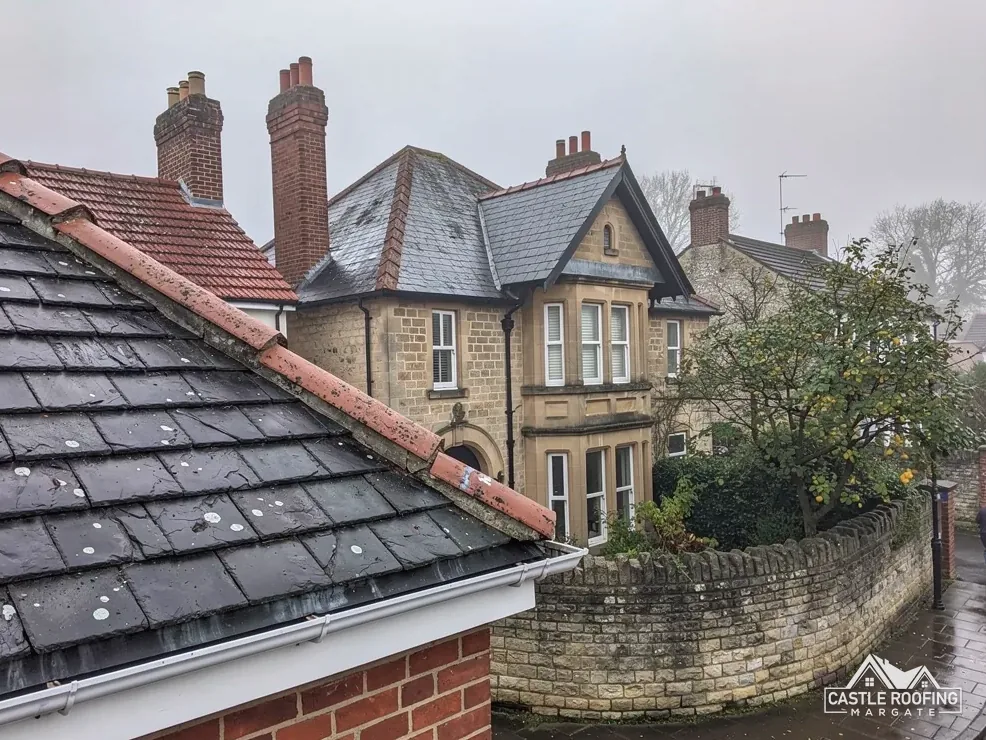
A Grade I castle, a Grade II* house and two conservation areas
Scheduled castle
Sandgate Castle is both Grade I and a scheduled monument, and a scheduled monument needs its own consent for works.
Two boundaries
The High Street and The Esplanade each have a conservation area, and both lie within about 0.75 km of the centre.
Matching dates
Wells House, Grade II*, and the Church of St Paul, Grade II, were both first listed on 11 March 1975.
Sandgate, Folkestone & Hythe district
Sandgate's listings, boundaries and licences together
| Council | Folkestone & Hythe District Council |
|---|---|
| Building control | Folkestone & Hythe District Council's own Building Control team |
| Scaffold and skip licences | Kent County Council |
| Conservation area | Sandgate High Street; Sandgate The Esplanade |
| Population, 2021 | 4,928 (Sandgate parish) |
| From Margate | 28.6 road miles, about 44 min |
| Sandgate Castle | Grade I, first listed 5 December 1949 |
| Wells House | Grade II*, first listed 11 March 1975 |
| Church of St Paul | Grade II, first listed 11 March 1975 |
| Listed entries within 500 m | 57, National Heritage List |
Sandgate has 4,928 residents, 57 listed entries within 500 metres of its centre and two conservation areas, so a list entry and two boundary maps all come before a quote is written, whether the job is a leak, a chimney or a full re-cover.
Sources: ONS Census 2021, Folkestone & Hythe District Council, Kent County Council, OSRM road routing.

Sandgate, castle and esplanade
Sandgate roofs sit among a Grade I castle, a Grade II* house and two conservation area boundaries
Three chapters: the castle and its neighbours on the National Heritage List, the High Street and Esplanade boundaries, and what myth and fact say about consent and licences.
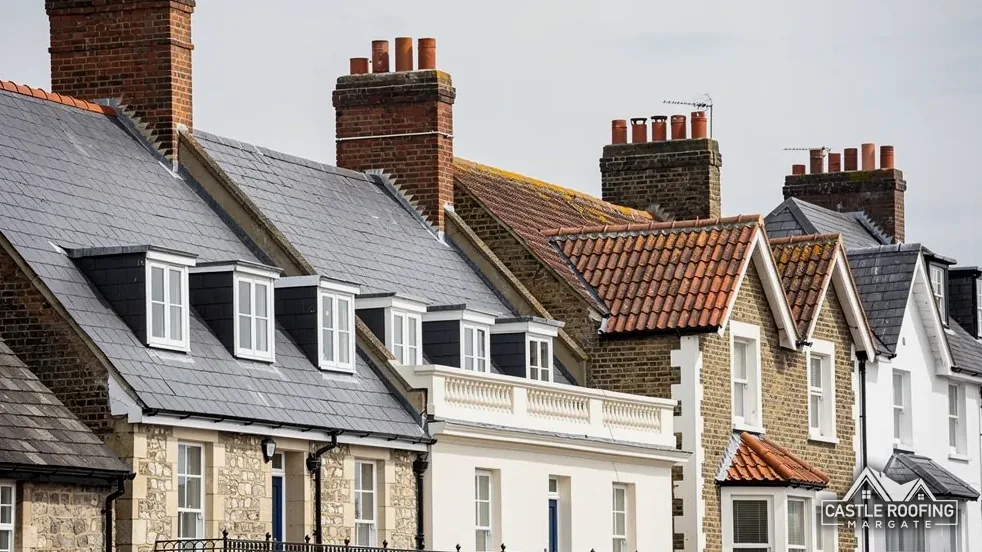
Chapter 01 of 03
Sandgate Castle, Wells House and 57 listed entries
Sandgate is 28.6 road miles from Margate, about 44 minutes by car, and 4,928 residents lived in the parish at the 2021 Census. Historic England's National Heritage List shows 57 listed entries within 500 metres of the centre, so the register is the natural first stop for a roof in the village, and it is quicker to consult than to argue about afterwards. A single entry can take in a whole terrace, so the quote carries the exact address, not just the street name. Where the survey turns up an entry you did not know about, you hear it from us first, with the entry reference.
Three entries show the range. Sandgate Castle holds Grade I status from 5 December 1949, and it is also a scheduled monument within about 500 m of the centre, which brings scheduled monument consent into play: works to a scheduled monument are an offence unless authorised. Wells House is Grade II*, listed on 11 March 1975, as was the Church of St Paul, which is Grade II. St Paul's serves the Church of England, so the faculty system, not the council, rules on works to it.
For a listed house the test is section 7 of the Planning (Listed Buildings and Conservation Areas) Act 1990: consent before works alter the building's character. A roof contributes a good deal to that character, through its slope, its covering and the metalwork at junctions. The chimney is a fair example, because the stack, the pots and the flaunching (the sloping mortar bed around the base of each pot) can all be part of what the entry protects.
On a roof like this the useful question is what is original. Old lead may be sound enough to keep, a replacement covering in a different size or colour can change a street, and chimney pots that are intact are rebedded, not renewed. A written note of each decision goes with the quote, so a consent application, if there is one, describes the work in the same words as the schedule. Chimney repairs on a listed stack are specified to match, and the guttering, soffits and fascias are scoped in the same visit.
From list entry to consent route, in Sandgate
Find the entry
Look the address up on the National Heritage List before anything else.
Note the grade
Grade I, II* or II, or a scheduled monument, sets the consent route.
Place the boundary
Match the street against the High Street and Esplanade conservation areas.
Match the repair
Specify covering, ridge and lead to match what the entry protects.
Chapter 02 of 03
Two conservation areas: High Street and The Esplanade
Two conservation areas lie within about 0.75 km of the centre of Sandgate: Sandgate High Street and Sandgate The Esplanade. Folkestone & Hythe District Council sends owners to its interactive map, so the boundary for your address is a question for the council, answered in writing if you ask for it that way. The answer is worth having on file when the house is next sold. The two boundaries are drawn by the council, not by street names, so a house on the High Street is not automatically inside the High Street area. Any roof job near the middle of Sandgate should assume a boundary is close until the map says otherwise.
The two areas are separate designations, so a house can be in one, in the other or in neither, and a roof near the point where they meet deserves a map check rather than an assumption. Conservation areas are article 2(3) land, which covers designated places where some roof extensions need an application. Our roof window planning guide carries the conditions in full. Demolishing an unlisted building in a conservation area also needs planning permission, and the council's page gives a volume of more than 115 cubic metres as the trigger for that.
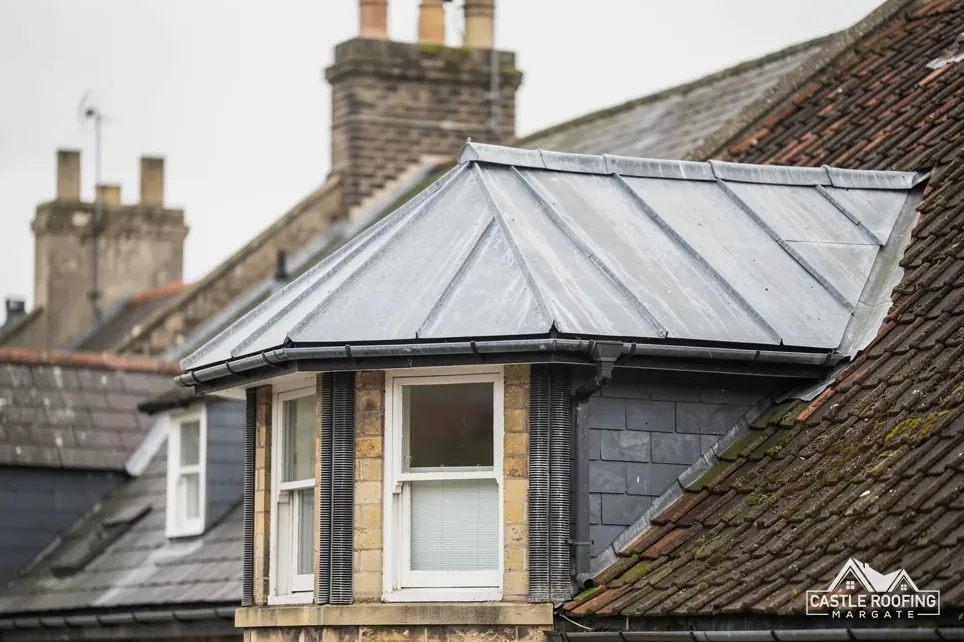
Trees can come into a Sandgate job as well. Tree work in a conservation area needs a section 211 notice at least six weeks in advance, according to Folkestone & Hythe District Council's page. If branches overhang the roof, that notice comes before any specification that depends on cutting them back, which is why the survey looks up at the canopy as well as across the slates and the gutters.
An Article 4 direction is the council's way of withdrawing named permitted development rights from a mapped area. Ask the council if a direction covers your address and keep the reply. Where the house is a flat, there are no permitted development rights at all, so outside changes need planning permission, and the same survey sorts out which case you are in before a date is booked. Listing and designation are different things: listing protects a building, a conservation area protects the character of an area, and a house can have either, both or neither.
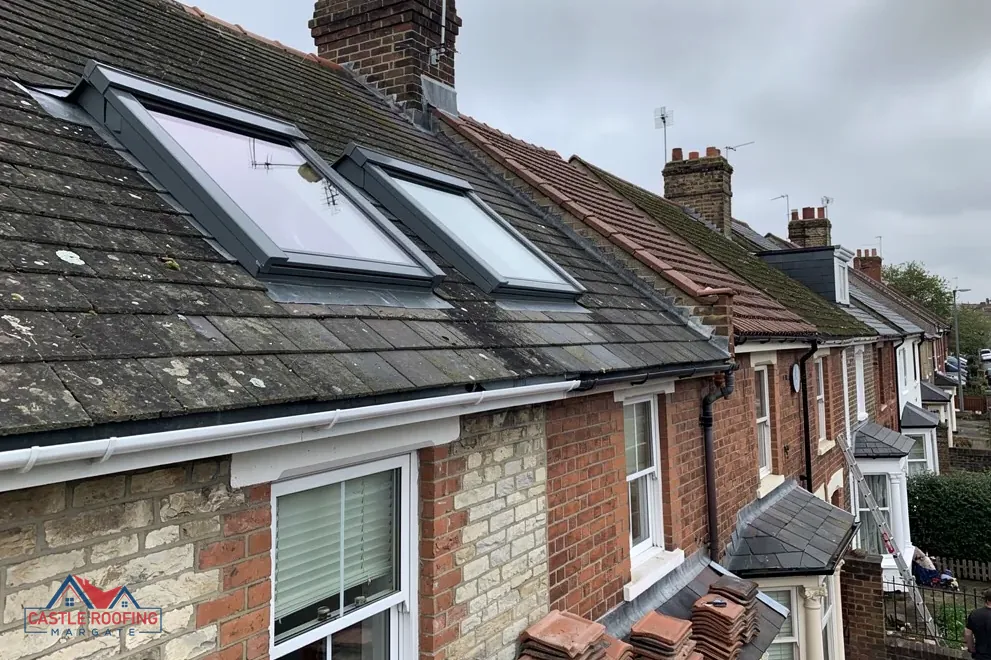
Chapter 03 of 03
Consent, licences and weather on a Sandgate job
Folkestone & Hythe District Council's own Building Control team deals with Sandgate Building Regulations, on 01303 853538. The national test is the Planning Portal's: no application is normally needed while less than 25 per cent of the building envelope and less than 50 per cent of the roof is affected. On weight, Approved Document A speaks of loading rising by more than 15%, and the Planning Portal says 15 per cent or more. For a flat, the lease decides who orders roof work, which is worth settling before a quote is accepted.
For the scaffold, Kent County Council is the licensing authority, under section 169 of the Highways Act 1980, and the scaffolding firm's application needs 5 working days. Kent County Council charges £52 per week for 2026 to 2027, with £78 for an inspection if it wants one, and public liability insurance of £5 million is required. Kent County Council permits a skip separately, £45 per week, no larger than 5 m by 2 m, and a footway skip must leave a 1.5 metre walkway.
Sandgate's centre sits right by the sea, and coastal buildings sit in a higher exposure band in Cupa's slate guidance, so BS 5534 fixings are chosen for the particular roof. For weather, the Met Office publishes averages for Manston, the Thanet station, 1991 to 2020: 613 mm of annual rain, 9.86 knots of mean wind, 11.21 knots in January. They are Manston's, used as a reference and never as Sandgate's own record, and a roof here is specified for its exposure, not for a number. On any roof the verge and the ridge are where that calculation shows most clearly, so both are written into the specification before the scaffold goes up.
Each day you get a note on the work done and the next day's plan. Waste leaves with us, and the survey's single written total is the price that stands, with any change to the plan sent to you first as a photograph. A written start date for the scaffold, the skip and the first morning's work reaches you before the licence application goes in, so neighbours on the road can be told as well.
Myth
Listed building consent covers every historic site.FactA scheduled monument needs scheduled monument consent, and works are an offence unless authorised.
Myth
A conservation area only matters for demolition.FactIt also brings six weeks' notice for tree works, a section 211 notice, and narrows permitted development.
Source: Ancient Monuments and Archaeological Areas Act 1979 s2; Folkestone & Hythe District Council, conservation areas
10-Year workmanship guarantee. In writing
Around Sandgate
Sandgate beside Folkestone: one district, two sets of streets
Sandgate sits in the same district as Folkestone, with the same Building Control team and Kent County Council behind its highway licences, but its castle, its two conservation areas and its Esplanade are its own to check, which is why a Sandgate quote is not copied from a Folkestone one.
Sandgate roofs: castle, boundaries and highway notices
Does Sandgate Castle's scheduled status affect houses nearby?
Not on its own. The castle is Grade I and a scheduled monument, so works to it need scheduled monument consent. A house nearby is judged on whether it is listed in its own right and where it falls against the two boundaries, so each address is checked separately. Fifty-seven listed entries lie within 500 metres of the centre of Sandgate.
Which Sandgate conservation area is my house in?
Two lie within about 0.75 km of the centre, Sandgate High Street and Sandgate The Esplanade. Folkestone & Hythe District Council's interactive map shows the boundaries, and an enquiry with your address settles which applies, if either. Ask for the area by name, and keep the written reply with the house papers.
Does re-roofing a Sandgate house need Building Regulations approval?
The route depends on scale. Folkestone & Hythe District Council's own Building Control team, on 01303 853538, confirms it for Sandgate addresses. On the Planning Portal's test, work below the 25 per cent envelope and 50 per cent roof thresholds normally needs no application, but a covering at least 15 per cent heavier does.
What notice does tree work near a Sandgate roof need?
In a conservation area, Folkestone & Hythe District Council's page says a section 211 notice must go in at least six weeks ahead of tree works. If branches overhang the roof, that notice comes before any specification that depends on cutting them back, so the survey looks at the trees as well as the slates, and the date is planned around the notice.
How does a scaffold get licensed on a Sandgate road?
Kent County Council grants the licence after the scaffolding firm applies, with 5 working days in hand. The 2026 to 2027 charge is £52 per week, and a separate £45 per week permit covers a skip standing on the road. Kent County Council highways answer questions on 03000 41 81 81 before an application goes in, and the scaffolder agrees the dates with you first.
Your Sandgate roof, mapped before it is priced
Send a photo and the street; castle, boundaries and list entry come first, then the survey and one written total.