

Roofers in Dover
21.7 road miles from Margate. Slate, tile, lead and chimney work in Dover and the streets round the castle hill, with listed and conservation-area roofs checked against the record before anything is priced.
- Eight conservation areasEight conservation areas near Dover's centre.
- Dover's own teamDover District Council's own building control team.
- Grade I castleGrade I castle, Pharos and St Mary Sub-Castro.
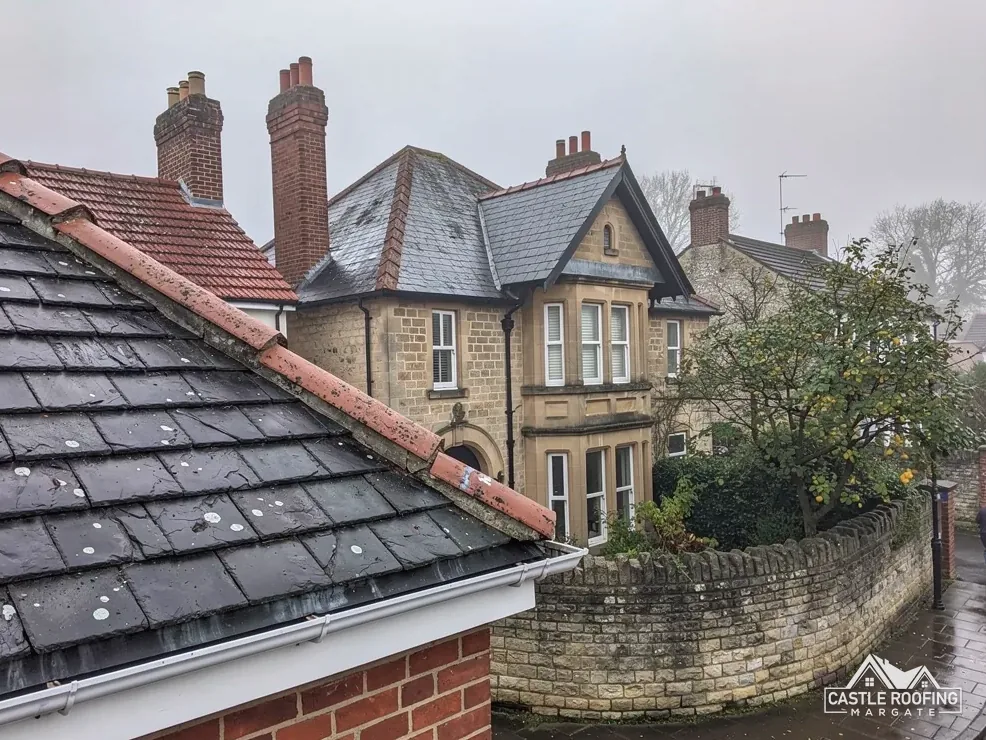
Castle hill listings and a council that checks every re-roof
Grade I trio
Dover Castle, the Roman Pharos and St Mary Sub-Castro share one listing date, 7 March 1974.
Eight boundaries
Eight conservation areas fall within about 0.75 km of the centre, from Dour Street across to Western Heights.
Like for like
Dover District Council puts re-covering a roof on its approval list, even when the new covering matches the old.
Dover town centre and the castle hill
What the records say about a roof in Dover
| Council | Dover District Council |
|---|---|
| Building control | Dover District Council's own building control team |
| Scaffold and skip licences | Kent County Council |
| Conservation area | Dover - Dour Street; Dover - Dover Castle; Dover - Dover College; Dover - London Road; Dover - Town Centre; Dover - Waterloo Crescent; Dover - Western Heights; Dour Street - Extension |
| Population, 2021 | 31,970 (Dover parish) |
| From Margate | 21.7 road miles, about 31 min |
| Listed entries within 900 m | 92, National Heritage List |
| Conservation areas near the centre | 8, within about 0.75 km |
| Scheduled monument | St Martin's Church, entry 1004189 |
Dover has more heritage packed into one centre than most of our towns: Grade I entries on the hill, a scheduled monument below it and eight conservation area boundaries within walking distance of each other.
Sources: ONS Census 2021, Dover District Council, Kent County Council, OSRM road routing.
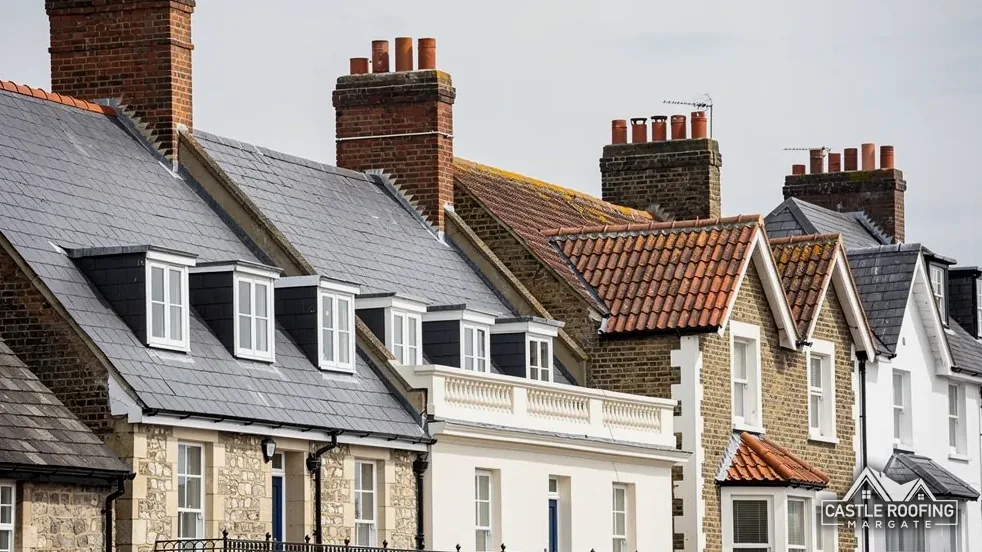
Dover, castle hill to kerbside
Dover roofs, from the Grade I castle hill down to the scaffold in the street
Three chapters covering the listed entries, the eight conservation areas with the council's own re-roofing line, and the permits and weather records behind a Dover job.
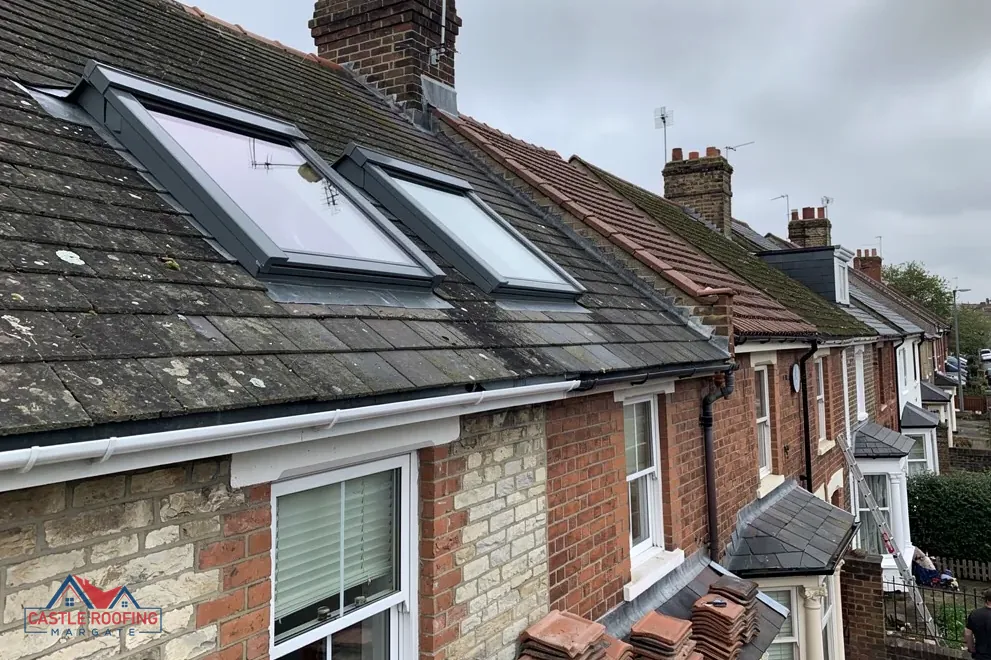
Chapter 01 of 03
Grade I on the hill, and the roofs beneath it
Dover lies 21.7 road miles south of Margate, about 31 minutes by car, and before a ladder goes up the question is whether the building, or something attached to it, appears on the heritage list. Historic England's register has 92 listed entries within 900 metres of the town's centre point. Three Grade I entries, each first listed on 7 March 1974, show how much of old Dover is covered: Dover Castle, the Roman Pharos and the Church of St Mary Sub-Castro. That is a dense list for one small centre, so a Dover survey begins on the register and only then moves to the roof.
Grade I is the top grade, and a listing takes in the whole structure, roof and all. Under section 7 of the Planning (Listed Buildings and Conservation Areas) Act 1990, anything that alters a listed building's character needs listed building consent. On a roof the character lives in the covering, the pitch, the ridge (where two slopes meet at the top), the hips (the sloping joints at a corner), the stacks and the lead flashings (lead strips dressed to close the gap between slope and masonry). Listing does not spread sideways: a Grade I tower beside your house leaves your house unlisted, so the entry for your own address is what counts, and we look it up before the survey is booked.
The Church of St Mary Sub-Castro appears on the register as a church, yet the register does not say who worships there today, so its consent route is something to establish rather than assume. Church of England buildings in use fall under the faculty system, Methodist, Baptist, United Reformed and Roman Catholic congregations each run their own, and Churches Conservation Trust, Quaker and Unitarian buildings follow the listed building consent route a house would. Within about 500 metres of the centre, St Martin's Church is a scheduled monument (entry 1004189), and altering one without authorisation is an offence under section 2 of the 1979 monuments legislation.
Where a roof does need consent, we describe the work the way the application will, keep slate, clay, lead and mortar to the existing pattern unless you and Dover District Council settle on a change, and give you photographs of each slope and stack. Our slate roofing and lead roofing pages go further into those materials.
| Entry | Status | First listed |
|---|---|---|
| Dover Castle | Grade I | 7 March 1974 |
| The Roman Pharos | Grade I | 7 March 1974 |
| Church of St Mary Sub-Castro | Grade I | 7 March 1974 |
| St Martin's Church | Scheduled monument | Entry 1004189 |
Source: Historic England, National Heritage List for England
Chapter 02 of 03
Eight conservation areas and Dover's own re-roofing line
Dover District Council counts 57 conservation areas across the district. The national planning dataset puts eight of them within about 0.75 kilometres of the centre of Dover: Dour Street, Dover Castle, Dover College, London Road, Town Centre, Waterloo Crescent, Western Heights and the Dour Street extension. With that many boundaries packed together, two houses on neighbouring roads can sit under different rules, which is why every survey begins with the street address. A conservation area is article 2(3) land under the General Permitted Development Order, which removes some householder rights, and our roof window planning guide covers the effect on windows and additions. Dover District Council's own conservation page notes that building roof dormers is one of the works needing permission in a conservation area, though it is usually allowed elsewhere.
What the council says about re-covering
Myth
A like for like re-cover needs no approval anywhere in Kent.FactDover District Council's building control page says otherwise for Dover addresses, while other councils word the question differently.
Myth
Being near the castle puts every Dover house in one zone.Fact57 conservation areas sit in the district and eight near the centre, so each boundary is checked against the address.
Source: Dover District Council, building control and conservation pages; planning.data.gov.uk
Dover District Council's own building control team handles approvals here, and its page names a new covering on a pitched or flat roof, even like for like, as work needing approval, and it adds roof lights and every loft conversion to the same list. We repeat that only for Dover District addresses. It asks for more than the Planning Portal does, since the portal clears a re-roof touching less than 25 per cent of the building envelope and less than 50 per cent of the roof, in the ordinary run of cases. So in Dover we settle the route with the council first, however small the slope.
Weight is its own trigger: the Planning Portal asks for approval when a new covering raises the roof covering's weight by 15 per cent or more, and it advises an engineer's or surveyor's opinion beforehand. We raise that early whenever the new covering would weigh more than the old, because a heavier covering can mean strengthening the rafters (the timbers running up the slope under everything else) before a single slate is hung, and that changes both the programme and the survey.
Dover's conservation page also warns that an article 4 direction may take in changes to the roof where that side of a house fronts a road, water or ground open to the public, and Dour Street is on its list, dated 26 July 2017. For a front slope we ask the council whether a direction covers your address before anything is priced, and we put the answer in writing for you alongside the photographs.
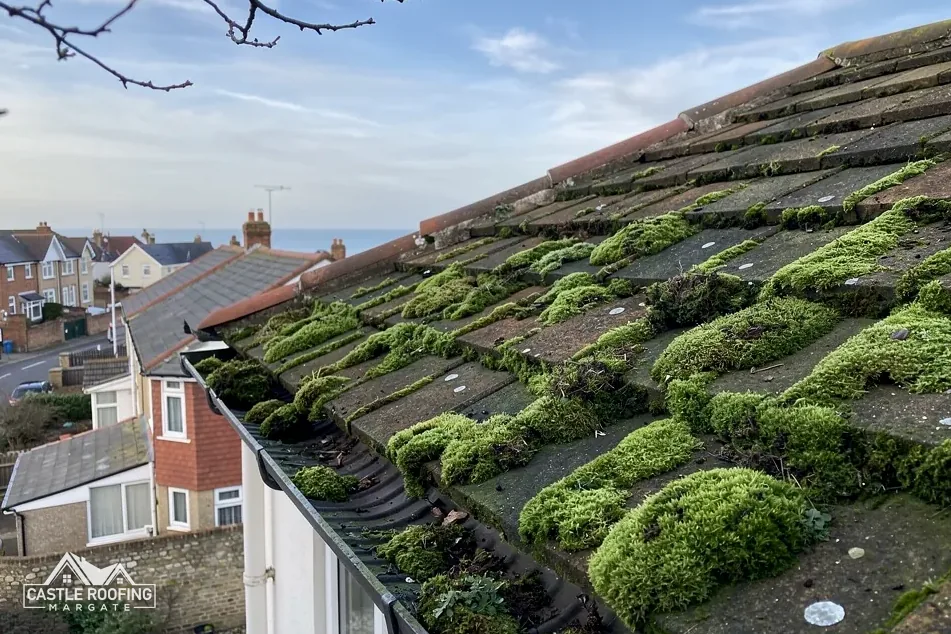
Chapter 03 of 03
Licences, skips and gale records on a Dover street
Any scaffold that stands on a Dover pavement or roadway needs a licence under section 169 of the Highways Act 1980, and the body that issues it is Kent County Council as highway authority, not Dover District Council. The scaffolding firm lodges the application, and Kent County Council's 2026 to 2027 fee is £52 per week. Applications go in 5 working days ahead of the licence start, and the applicant must meet the council's public liability requirement. If the council sends an inspector, the visit costs £78, and highways staff take questions before an application on 03000 41 81 81.
On Dover's steep streets the licence conditions bite: the scaffold must leave at least 1.2 metres between itself and the carriageway, its uprights are painted white for the bottom 2.5 metres, and it is lit at night if it stands in or within 45 centimetres of the road. Skips are permitted separately at £45 per week for 2026 to 2027, with 5 working days' notice, and may be up to 5 metres long and 2 metres wide. A skip on a footway also needs express permission, and 1.5 metres of path must remain for walkers. We book the waste round those dates, so old slates, battens and underlay leave as the crew does, and the street is left as we found it.
Dover has a documented gale in its history. The Met Office case study of the 1987 storm records a ship at Dover blown over, a ferry driven ashore near Folkestone and Force 11 winds, 56 to 63 knots, across many coastal parts of the south-east. That describes one night, not a Dover roof today, but it is the reason a sheltered-looking hillside terrace still gets a fixings schedule rather than a guess.
For ordinary years the Met Office publishes long-term averages for Manston (1991 to 2020): about 613 mm of rain, and a mean wind speed at 10 metres of 9.86 knots, or 11.21 knots in January. Those describe Manston rather than Dover itself. Cupa, the slate maker, grades coastal sites for higher exposure, so each Dover roof gets fixings set for that site's exposure under BS 5534, never copied from another job. The order of work follows.
A Dover re-roof, in order
Survey and photographs
Roof seen from the street and close up, photographs of each slope sent.
Council confirmation
Dover District Council confirms the route; listing and boundaries checked.
Licence and skip permit
The scaffolder applies to Kent County Council; the skip permit follows.
Strip, fix, clear
Fixings set for the site, daily updates, waste taken away.
10-Year workmanship guarantee. In writing
Around Dover
Dover and the Dover District Council villages round it
Dover shares Dover District Council and its own building control team with Alkham and Whitfield, so the like-for-like re-roofing line follows the district boundary, while Folkestone & Hythe and Swale addresses take other routes.
Dover listings, boundaries and gale records
Does a roof on a house near Dover Castle need listed building consent?
Only if the house itself is listed, or its roof forms part of a listed structure. Section 7 of the Planning (Listed Buildings and Conservation Areas) Act 1990 applies to the listed building, not to its neighbours. The register entry for your address decides. We look it up first, then tell you whether consent from Dover District Council is part of the job.
How do I find which of Dover's eight central conservation areas my street is in?
Dover District Council holds the boundaries, and the national planning dataset shows them on a map. Eight lie within about 0.75 km of the centre, among them Dour Street, London Road and Western Heights. Give us your address and we look it up before pricing, because the answer changes what a roof slope may have done to it without an application.
Dover District Council wants re-roofs approved even like for like: why?
Its building control page puts a fresh covering on a pitched or flat roof on the approval list, like for like included, and we follow that wording for Dover addresses. The council's own team can confirm how it applies to your roof. The Planning Portal's 25 per cent and 50 per cent test is a separate national guide.
What did the 1987 storm do in Dover, and does it alter the fixings?
The Met Office records one ship at Dover blown over and Force 11 winds in many coastal regions of south-east England. It is history rather than a design figure. Any roof's fixings are worked out against the site's exposure under BS 5534, and Cupa notes that coastal buildings are graded with higher exposure.
Does Dover's article 4 wording mean a new front slope needs an application?
It can. Dover District Council says article 4 directions may reach changes to a roof where a side of the house fronts a road, water or public space, and its list includes Dour Street from 26 July 2017. Whether a direction reaches your address is the council's answer, so we ask it before work is planned.
Send photographs of your Dover roof
Message us a photograph or book a visit to your Dover roof; one written total follows the survey.