

Roofers in Brabourne
28.3 road miles from Margate. Farmhouse, coachhouse and village roofs in Brabourne mended, re-covered or rebuilt, each job begun with a survey and pictures of your own roof.
- Grade I churchChurch listed Grade I on 27 November 1957.
- Own conservation areaBrabourne conservation area within 0.75 km.
- Ashford inspectsBuilding control: Ashford Borough Council's own team.
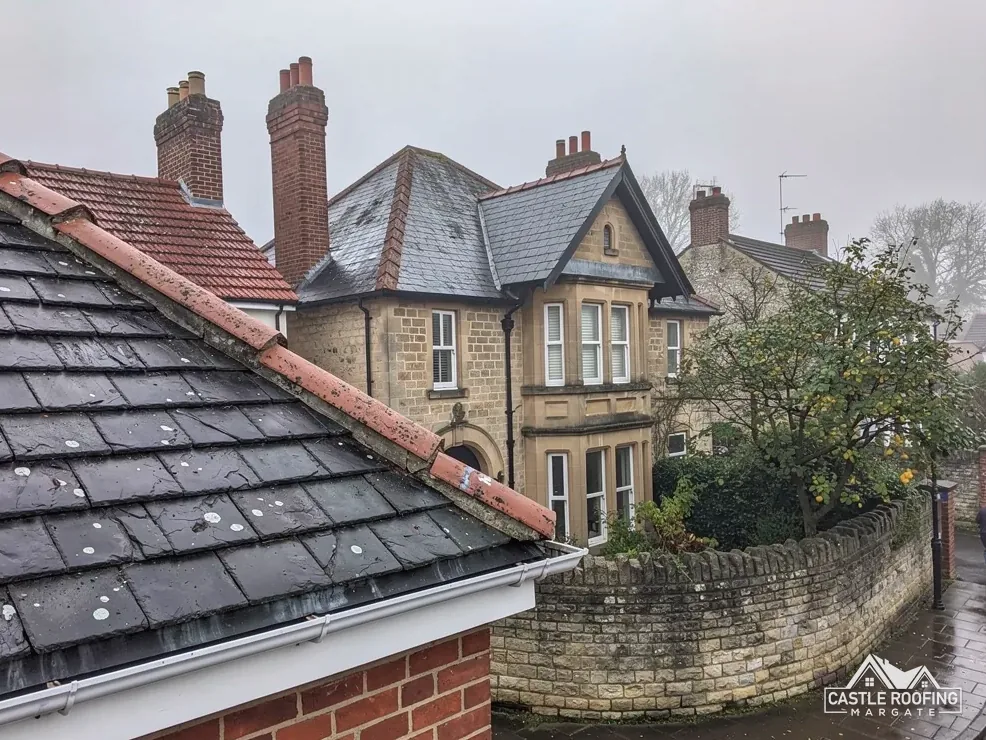
One Grade I church, a listed farmhouse, a coachhouse and the Downs
Parish church
St Mary's church has been Grade I since 27 November 1957, and works to it go through the faculty system.
Farm listings
Parsonage Farmhouse and a coachhouse with stables are both Grade II, so their roofs raise listed building consent questions.
Downs village
Brabourne sits inside the Kent Downs National Landscape, so some roof extensions need a planning application that other places would not.
Brabourne, Ashford borough
Brabourne's listed roofs in one short table
| Council | Ashford Borough Council |
|---|---|
| Building control | Ashford Borough Council's own Building Control team |
| Scaffold and skip licences | Kent County Council |
| Conservation area | Brabourne |
| Population, 2021 | 1,306 (Brabourne parish) |
| From Margate | 28.3 road miles, about 42 min |
| Church of St Mary | Grade I, first listed 27 November 1957 |
| Parsonage Farmhouse | Grade II, first listed 27 November 1957 |
| Coachhouse and stables near Coquet Lodge | Grade II, first listed 16 February 1989 |
| Listed entries within 500 m | 19, National Heritage List |
Brabourne is a Kent Downs village of 1,306 residents with 19 listed entries within 500 metres of its centre, among them a Grade I church, Parsonage Farmhouse and a listed coachhouse.
Sources: ONS Census 2021, Ashford Borough Council, Kent County Council, OSRM road routing.
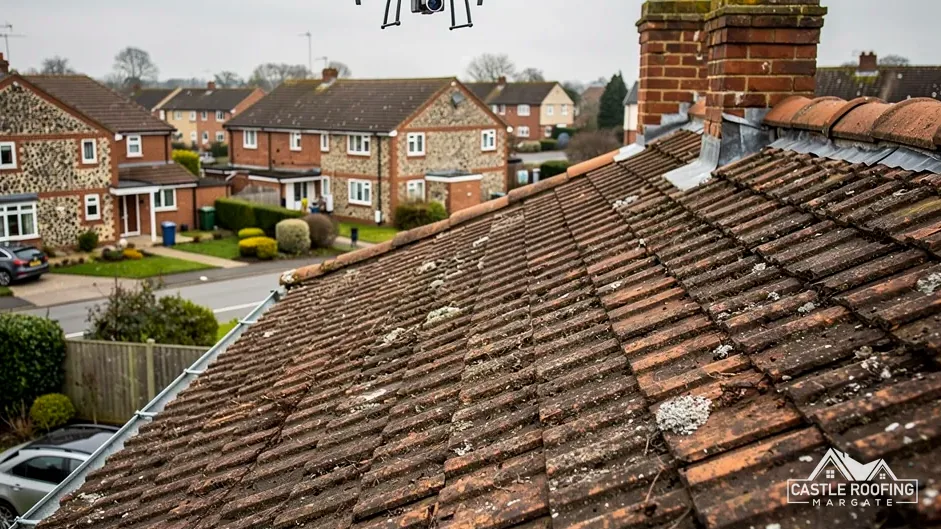
Brabourne, farm and church
Brabourne roofs run through a Grade I church, listed farm buildings and the Downs designation
Three chapters: the listed farmhouse and coachhouse, how the church and its faculty differ from a house, and the licences and building control a Brabourne job needs.
Chapter 01 of 03
Parsonage Farmhouse, the coachhouse and 19 listed entries
Brabourne lies to the south-west at 28.3 road miles, about 42 minutes' drive from Margate, and it is a small place: 1,306 residents at the 2021 Census. Even so, Historic England's National Heritage List shows 19 listed entries within 500 metres of its centre. That ratio means a roofer arriving at a Brabourne gate has to ask, before anything else, whether the building in front of them has an entry of its own.
Two of the Grade II entries show the range beyond the church. Parsonage Farmhouse was first listed on 27 November 1957, and the Coachhouse and Stables About 10 Metres North of Coquet Lodge on 16 February 1989. A listing names a building and protects all of it, so a coachhouse roof is part of its entry in the same way a farmhouse roof is. The test for work is set by section 7 of the Planning (Listed Buildings and Conservation Areas) Act 1990: consent is needed for works that alter the character of a listed building, and Ashford Borough Council decides.
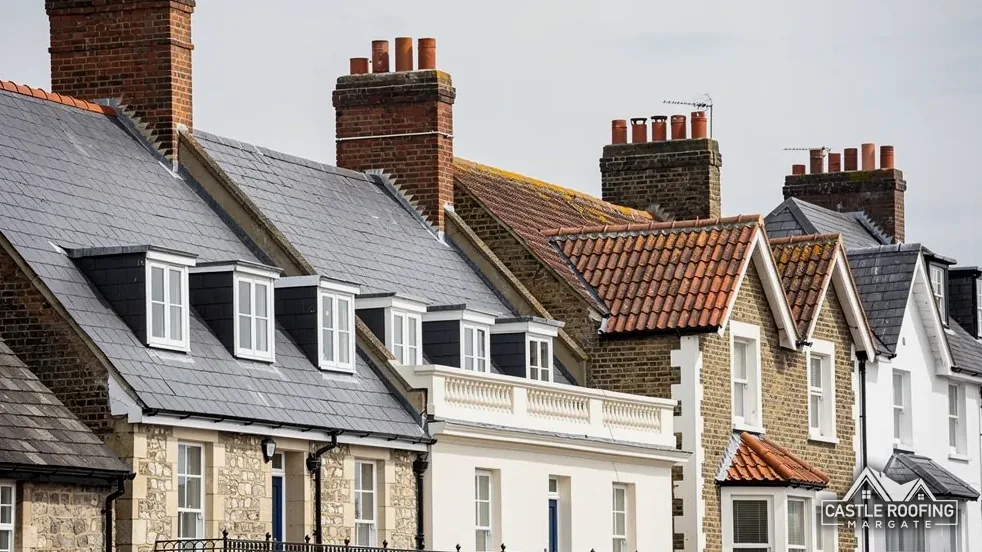
Character on a roof lives in details a surveyor can point at. The ridge is the crest that caps the roof, the verge is the edge along a gable, the hip is the sloping join between two slopes, and flashings are the lead worked into a joint so rain cannot track behind the brickwork. Changing the profile of a ridge or swapping a lead flashing for a different material is the kind of work that can need consent. Repair matched to what the entry describes is the safest course, and it is how pitched roofing is specified on a listed house.
The entry is the legal description, but it is short, and it does not list every slate or ridge piece. The survey fills the gap: slope by slope, with a note of what looks original and what earlier repairs have changed, so the schedule of work and any consent application rest on what is actually up there. On a farm there are often several roofs: house, outbuilding, barn. Each can have its own entry or none, so each is looked at separately. Pictures of every slope go to the owner after the survey, with a note of which entry each building falls under, and the single written price covers the whole schedule. For leaks that cannot wait, roof repairs and emergency make-safes keep the structure dry while consent is sorted.
Chapter 02 of 03
St Mary's church and the faculty system
The Church of St Mary is Grade I, listed on 27 November 1957, and it still holds Anglican worship. That puts it under a different consent regime from every house around it. Under section 60 of the Planning (Listed Buildings and Conservation Areas) Act 1990 and the Ecclesiastical Exemption Order 2010, listed building control does not apply to a church in use for the denominations the Order names, and the Church of England's faculty system takes its place. The point for a homeowner is boundaries. The exemption belongs to the church building, not to its neighbours, so Parsonage Farmhouse or a cottage nearby follows its own entry, with listed building consent if listed, and with no special route if not. Works to the church itself, by contrast, run through the faculty process, outside the council's listed building route altogether. A house that shares a boundary with the churchyard is still judged only on its own entry and its own position against the conservation area.
The Brabourne conservation area lies within about 0.75 km of Brabourne's middle, and Ashford Borough Council holds its boundary. Inside a conservation area some everyday permitted development changes, and demolishing an unlisted building needs planning permission. Ashford publishes its Article 4 directions on its interactive map, so before altering a roof slope that faces the lane, check whether a direction applies with Ashford Borough Council.
Myth
Every old building beside a church follows the church's rules.FactThe ecclesiastical exemption belongs to the church building in use; neighbouring houses follow their own list entries.
Myth
Listing only protects the front of a building.FactListing extends to every part of a building, roof included, and the entry names the building as a whole.
Source: Planning (Listed Buildings and Conservation Areas) Act 1990 s7 and s60; Ecclesiastical Exemption Order 2010
Then there is the landscape. Brabourne lies inside the Kent Downs National Landscape, a designated Area of Outstanding Natural Beauty and so article 2(3) land. The conditions for additions such as roof windows are set out in the roof window planning guide, and that guide is the place to read them before any opening is planned. A straightforward re-cover is a lighter question than a new dormer, but it is still an address-by-address one.
For a Brabourne owner this becomes a sorting exercise with three outcomes. If the building is listed, listed building consent comes first and the repair is written to match. If it is unlisted but inside the conservation area, the questions are permitted development and any Article 4 direction. If it is neither, the job is an ordinary one, and the remaining checks are Building Regulations and the highway.
Chapter 03 of 03
Who answers what on a Brabourne roof job
Any scaffold that takes up road or pavement space needs a licence under section 169 of the Highways Act 1980, and Kent County Council is the authority that grants it. Kent County Council takes the request from the company putting the scaffold up, and wants 5 working days to deal with it. Its charge for 2026 to 2027 is £52 per week, and a site inspection, if Kent County Council thinks one necessary, adds £78. Public liability insurance of £5 million is a condition for applying.
A skip on the road runs under a different permit, £45 per week in 2026 to 2027, again on 5 working days' notice, for skips up to 5 m by 2 m. Questions go to Kent County Council highways on 03000 41 81 81. Kent County Council issues both permits to the firm that places the item on the highway, so the dates are agreed with the scaffolder and the skip firm first, and the paperwork then follows the calendar. If the farm has a yard, the skip may not need the road at all, which saves the permit.
For Building Regulations the starting point is the Planning Portal. A re-roof is outside the application route while it affects less than 25 per cent of the building envelope and less than 50 per cent of the roof. Approval is also needed for a covering that raises the roof's weight by 15 per cent or more. In Brabourne the contact is Ashford Borough Council's own Building Control team, and a registered building control approver is the private route.
On the day itself, the household is told what is being done and what comes next, the waste is cleared by us, and the written price agreed after the survey stands as one total. A farmhouse with a long roof run or a coachhouse with a small one is priced on the survey, not on a rate per square metre. Between the survey and the first morning, three dates are fixed in writing: the day the scaffold licence starts, the day the skip is delivered, and the day the last slope is expected to be finished. If weather moves the finish date, you hear that day, by message, with a photo where the roof has changed the picture.
| Question | Who answers |
|---|---|
| Listed building consent | Ashford Borough Council |
| Building Regulations route | Ashford Borough Council's own Building Control team |
| Scaffold licence, skip permit | Kent County Council |
| Works to St Mary's church | The faculty system |
Source: Ashford Borough Council; Kent County Council highway permits
10-Year workmanship guarantee. In writing
Around Brabourne
Brabourne beside its Ashford neighbours and the Folkestone boundary
Brabourne shares Ashford Borough Council with Chilham, while Folkestone and Sandgate answer to Folkestone & Hythe District Council, so a few miles along the road can change which office handles a roof's paperwork.
Brabourne questions about listing, notices and licences
Does the Grade II listing of a Brabourne coachhouse cover its roof?
Yes, because a listing covers the whole building. The Coachhouse and Stables About 10 Metres North of Coquet Lodge has been Grade II since 16 February 1989, and works that alter the character of a listed building need listed building consent from Ashford Borough Council. Your own entry shows what is listed, and it is read before any figure is given.
Does living in the Kent Downs change what can be added to a Brabourne roof?
It can. The Kent Downs National Landscape is an Area of Outstanding Natural Beauty, which makes it article 2(3) land, so some roof additions need a planning application that a village outside the designation could avoid. Our planning guide sets out where those conditions begin, and the answer for your address is confirmed before any survey is priced.
Who deals with repairs to the roof of St Mary's church in Brabourne?
The church is Grade I and still holds Anglican worship, which sends works to it through the faculty system, not listed building consent. Our work is on the houses and farm buildings around it, each of which follows its own list entry and the conservation area boundary held by Ashford Borough Council.
Is Building Regulations approval needed to re-roof a Brabourne farmhouse?
Not if the work stays under the Planning Portal's limits: less than 25 per cent of the building envelope and less than 50 per cent of the roof. A covering 15 per cent or more heavier needs approval anyway. When the whole roof is involved, Ashford Borough Council's own Building Control team gives the answer.
How long before a Brabourne scaffold can go up on the lane?
The scaffolding contractor files the licence application, and Kent County Council wants 5 working days' notice for it, with identical warning for a skip permit. Kent County Council charges £52 per week for scaffold and £45 per week for a skip in 2026 to 2027, so the application sets the earliest start, not the weather.
Your Brabourne roof, surveyed first
Send a photo and the name of the house or farm; the written price comes after the survey, as one figure.