Why a tile breaks underfoot
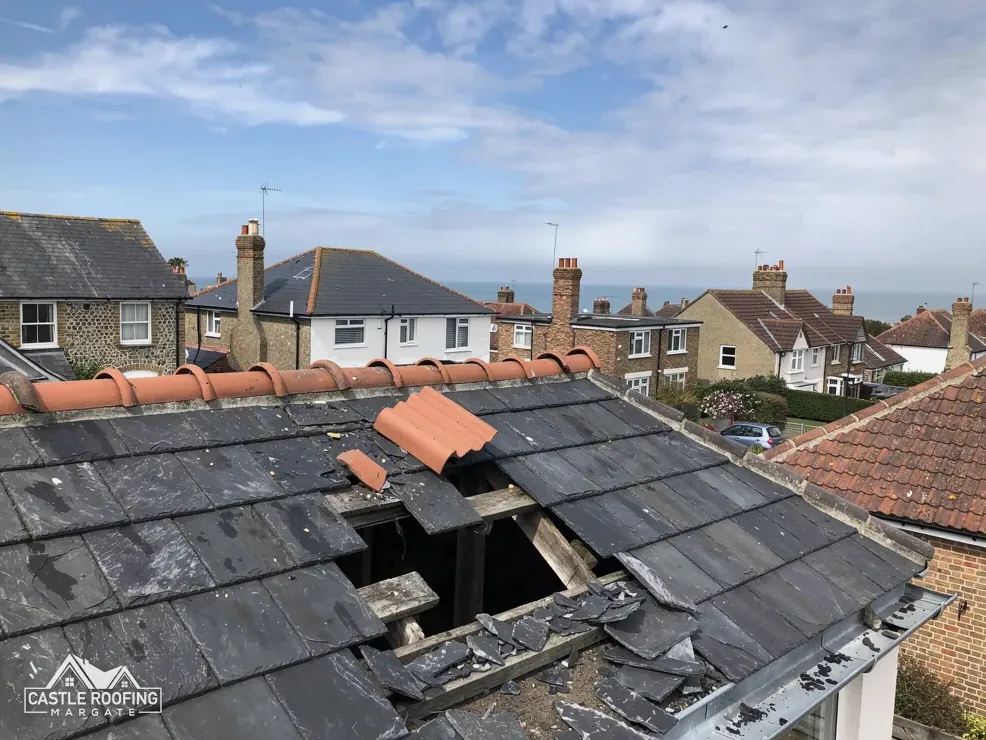
A roof tile is designed to shed water and to hang from a batten, held at its head by a nail or a nib. It is not designed to take a person's weight across its middle. A foot placed mid-tile bends it, and clay and concrete are both stronger when squeezed than when bent. The tile cracks, often along a line you cannot see from above, and the crack lets water through later.
Where a tile is stepped on matters. Because of the overlap, the part of each tile supported by the batten and by the tile below is a narrow strip, and a foot placed there does far less harm than one in the open middle. A trained roofer reads the pattern, but no one reads it perfectly, and tiles that are cold, frosted or weathered break more readily.
Slates are thinner and more brittle. Fibre-cement and old asbestos cement sheets are worse still: HSE's guidance A14 is plain that an asbestos cement roof is fragile. Nobody should step onto an old outbuilding or garage roof until that has been settled.
Roof ladders and crawling boards
A roofer on a tiled slope does not walk on the tiles. Two pieces of kit do the work instead:
- A roof ladder, a lightweight ladder with a hook that goes over the ridge. It lies flat on the slope and spreads the load across several rows of tiles, so no single tile takes a foot.
- A crawling board, a plank with cross-battens that sits across the slope and gives a place to kneel or crawl without stepping on the covering.
Both depend on something strong at the top to hold them. The ladder hooks over the ridge, which needs the ridge to be sound. Where the ridge itself is loose or the roof is steep, other measures come first, such as a scaffold or a tower.
Edges matter as much as the slope. A scaffold at the eaves with a guard rail catches a slip before it becomes a fall, and Kent County Council issues the licence if the scaffold stands on the highway. The page on scaffold licences in Kent sets out who applies for it.
What the Work at Height Regulations say
Regulation 6(3) of the Work at Height Regulations 2005 sets the duty on an employer: measures must be "suitable and sufficient", and falls are to be prevented "so far as is reasonably practicable" where they are "liable to cause personal injury". That duty falls on employers.
For the person who owns the house, the point is practical. A roofer cannot meet that duty if the customer or a friend has already been up the slope and shifted a dozen tiles, and an injury on your own roof is your problem if nobody else is responsible for it.
A quote for work that needs access should still say how the roof will be reached. If the proposal is a scaffold, a tower, or a roof ladder on its own, ask which and why. The answer comes from the height, the slope and the job itself, and it should be explained before anyone goes up. A roofer may also decline to work from a ladder alone on a high or steep slope and ask for other access.
What to do from the ground instead
Looking at a roof does not require standing on it. The ground gives you most of what a first look needs:
- Use a phone with zoom, or binoculars, along each slope in daylight.
- Look for slipped tiles, gaps along the ridge, tiles sitting proud, moss gathering on one side and gutters that overflow.
- Check the loft with a torch from the hatch, looking for daylight, damp patches or drips.
Photograph what you see and note which slope it is on. Resist leaning a ladder on the gutter for a better angle: plastic gutters are not built to take the load, and a ladder that slides on a wet wall can bring you down with it.
If something is wrong, a roofer can look properly with the right access and give you one written total after the survey. The page on replacing a single roof tile shows how a small job is done, and the whole range of tiled roof work sits under pitched roofing. A repair is always safer when someone with the right kit does it, and a phone photo costs nothing.