Read this if a garage, porch or extension roof in Thanet is due a new felt covering. You get the build-up from the deck to the cap sheet, the site safety around a naked flame and two published lifespans.
Torch-on felt is a flat roof covering made from rolled bitumen sheet. Bitumen is the black, tar-like material that makes the sheet waterproof. The roofer unrolls each sheet, heats its underside with a gas torch until the surface turns glossy and soft, and presses it down so it bonds to the layer beneath. The cap sheet is not nailed through, and the joins are lapped and sealed by the same heat.
It goes on garage roofs, porch roofs, dormer cheeks, small extensions and outbuildings around Thanet and the wider East Kent coast and countryside. It sits beside rubber and GRP as one of the covering choices for a flat roof, and each behaves differently in age, in cost and in the way it is laid.
This guide takes the system in order: the layers, how the heat does its work, the fire precautions that go with a naked flame on a roof, what the published lifespans say, and what keeps a felt roof draining. It is one part of our flat roofing work, which also covers repairs that stop short of a new covering.
What a felt system is made from
A torch-on system is a build-up of bitumen sheets, never a single layer. Each sheet has a reinforcing core, a woven or matted fabric that gives it strength, coated in bitumen on both faces. The top sheet is the cap sheet. It takes the weather, the sun and the footsteps, so its surface is often finished with mineral granules, small stone chips pressed into the bitumen to protect what lies beneath.
Under the cap sheet sits at least one more sheet, usually called the underlayer or base layer. Its job is to bond to the deck or the insulation and give the cap sheet something sound to stick to. With two sheets in place, water that gets through a lap or a puncture in the cap sheet meets a second barrier before it reaches the deck.
Words used on this page:
- deck: the board surface the roof is built on, usually plywood or OSB laid over timber joists
- cap sheet: the top bitumen sheet, the one facing the weather
- upstand: the part of the covering turned up a wall or a kerb
- lap: the overlap where one sheet meets the next, joined by heat
- fall: the slope that carries rainwater to the outlet
Not every felt roof is torch-applied. Some are bonded with cold adhesive or laid as self-adhesive sheets, which suits places where a flame is unwelcome. The torch method is the one this guide follows, because it is the one that needs the most care on site.
The build-up from deck to cap sheet
The order of the layers depends on whether the roof is warm or cold, a choice set out in our guide to warm roof and cold roof build-ups. Working up from the joists on a new deck, a torch-on build-up usually runs like this:
- The deck is laid with a fall built in, by tapered boards or firring strips, so water runs to the outlet.
- A vapour control layer goes over the deck where the design calls for one, to hold back moist air rising from the rooms below.
- Insulation board follows if the roof is a warm roof, with the insulation above the deck.
- The underlayer is bonded or mechanically fixed, its laps kept clear of the deck joints.
- The cap sheet is torched on, its laps offset from those in the layer under it.
- Upstands, edge trims and outlets are dressed in and sealed.
Staggering the laps matters more than it looks. If every join in both sheets sat in the same line, one failed seam would run straight to the deck. Offset joins force any water to travel sideways before it can go down.
On a repair or an overlay, the old covering stays in place only when a survey shows it is dry and firm. Wet insulation or a soft deck underneath means the old layers come off, because bonding new felt over a damp base only buries the problem. We look at the underside from inside where the roof allows it, and you see photos of what is found.
How the torch does its work
The bond is made by heat, which is why the roof has to be dry. The roofer holds the torch so its flame plays across the roll and the surface it is being laid on at once. When the bitumen softens and a small bead of it rolls ahead of the sheet, the roll is pushed forward and pressed down. Too little heat leaves a sheet that peels at the edge; too much burns the reinforcing core and thins the bitumen.
Laps get their own attention. The side lap and the end lap are heated and trowelled flat so the seam is continuous, and the finished edge shows a thin line of bitumen where it has flowed out. A seam with no bleed line is a seam that has not fully bonded.
Corners, upstands and the neck of each outlet are worked with a smaller hand torch, because a large roll will not lie into a tight angle. Wall upstands are finished with a flashing or a termination bar fixed at the top, so water running down the wall cannot get behind the felt.
Conditions matter too. A damp or frosty deck stops a good bond, and wind makes a flame unpredictable. On a cold or wet morning the sensible call is to wait, or to leave the torch-on layers until the deck is dry, and the day-to-day plan is agreed with you as the work goes on.
Fire safety on site
A gas torch on a roof is hot work, and the risk is not on the surface in front of the roofer but in what the heat can reach out of sight. Bitumen sheet turned up under an eave, a gap beside a roof light or a void in a soffit can pass heat into timber that nobody can see. What follows is general good practice for torch work, not a regulation, and every site is judged on its own layout.
- Clear anything combustible from the roof edge and from within reach of the flame.
- Look for gaps where heat could pass into the roof void, the soffit or an adjoining roof, and close or shield them first.
- Keep a fire extinguisher on the roof beside the person working, never down at the van.
- Store and move gas cylinders with the same care as on any building site, away from the work area.
- Use hand torches at junctions with timber, and leave a flame off the wall of a neighbouring building.
- Check the work area again after the last flame goes out, and look once more before the crew leaves site.
If the roof sits against a thatched house or a property where the roof space cannot be checked, say so at the survey. A different covering method is a perfectly sound answer there, and a thatched neighbour's owner is best advised by a specialist thatcher on any thatch question.
How long torch-on felt lasts
Two published guides give a range for felt, and they do not match. Both are typical ranges for a covering in decent condition, never a promise for a given roof. Read them as a planning guide for a budget and a maintenance diary, and not as a date on which a roof is due to fail.
| Guide | Typical life | Page dated |
|---|---|---|
| HomeBuilding | 10 to 15 years | September 2025 |
| Less | 10 to 20 years | October 2026 |
The two agree at the bottom and disagree at the top. Where a given roof lands depends on how it is built and used: the quality of the laps, the number of layers, the drainage, and whether people walk on it. A warranty term printed on a product is a separate thing from a lifespan, and no number in the table should be read as a guarantee. Ask for the roof to be looked at before you decide how much life is left in it.
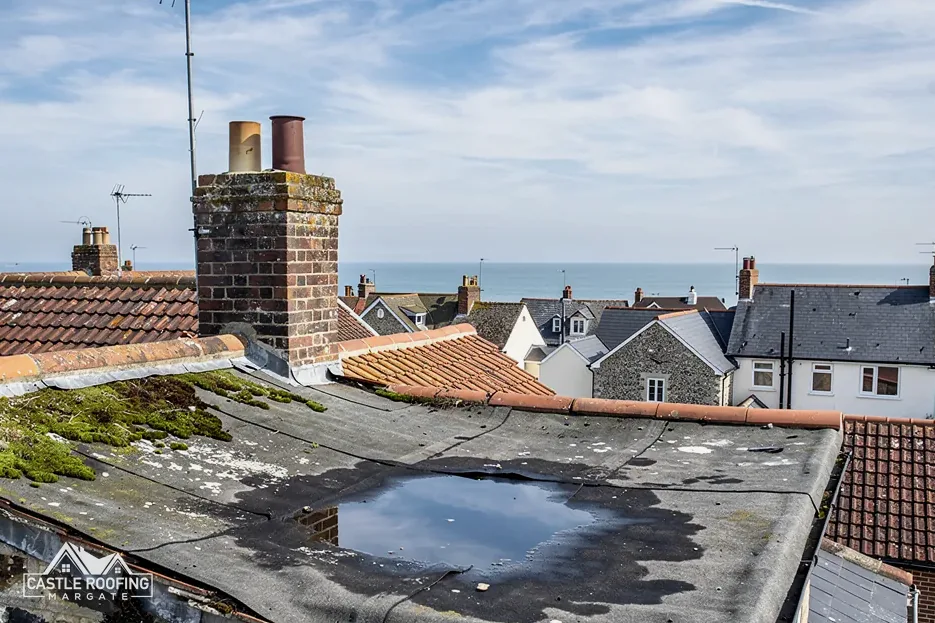
What shortens a felt roof's life is mostly water that stays put. Ponding at a low spot softens and stresses the surface. Blisters, which are pockets of trapped moisture or air under the sheet, can split and let rain in. Foot traffic on a cap sheet in hot weather scuffs the granules off, and a blocked outlet leaves water standing against an upstand.
Our pages on how long a felt flat roof lasts and on blisters on a felt roof go further into the signs to watch for.
Falls, outlets and what sets the price
Felt is only as good as the water it sheds. BS 6229:2025, the edition now current, is the code for flat roofs covered with continuously supported flexible membranes, and the 2018 edition is withdrawn. The 2025 update keeps a minimum finished fall of 1:80 across the main roof and along internal gutters. IKO, a membrane maker, advises designing to a fall of 1:40. A fall of 1:40 is a drop of 25 mm for every metre of run. Flat in the name is a figure of speech: a roof that is truly level holds water.
On an existing deck the fall is checked at the survey, because a deck that sags or dips holds water whatever is laid on top of it. Where the fall is poor, tapered insulation or new firring strips are part of the answer, and that changes the work and the price.
Which? Trusted Traders, in November 2025, gave a typical UK range of £1,400 to £3,500 for felting a single garage roof of 6m by 3m, ex VAT, and added that South East prices tend to be higher, and Kent is part of that region.
The size, the deck, the number of layers, the insulation and the access all move the figure. The written price follows the survey and arrives as one total, and it says whether VAT and access are included.