A drip in a conservatory rarely starts where it lands. This guide follows the water back to its entry point, sets out the usual failures in order, and explains when mending the roof beats replacing it.
A conservatory roof is a lightweight skin held in a set of glazing bars, and it has more joints per square metre than a house roof. Every joint is a place the weather can test. When water drips onto the floor, the wet patch tells you where it ended up, which is seldom where it came in.
The route from entry to drip can run along a bar, down the inside of a wall, or behind a gutter before it shows. That is why a stain on the ceiling line by the house wall can come from a failed flashing above it, a blocked gutter beside it or a split bar cap near the ridge.
This guide follows the water in the order a surveyor checks. The wall joint comes first, then the seals and bars, then the gutters, and last the question of whether the roof is worth repairing. It sits within our conservatory roofs work, where the survey covers the entire roof and the route the water takes, not only the damp patch on the ceiling.
Is it a leak or is it condensation?
Before looking for a hole, rule out moisture from inside the room. Warm, damp air meeting a cold roof makes drops on the underside of sheets and bars. It looks like a leak and it drips like one, and no amount of sealant on the outside will stop it.
A few differences help you tell them apart:
- Condensation appears on cold mornings, evenings and after cooking or drying clothes, and is often there when it has not rained for days.
- A leak appears during or soon after rain, and often returns in the same place.
- Condensation covers wide areas of the roof underside in a fine film. A leak tends to follow a line, such as a bar or the wall joint.
- Condensation leaves the same pattern on dry days. A leak leaves a stain that grows after each wet spell.
Both can occur together, and a roof with a small leak and heavy condensation is a common puzzle. Our guide to conservatory roof condensation covers the moisture side in detail.
One practical test costs nothing. Note the weather on each day the drip appears, along with the wind direction if you can tell, take a photo of the wet area and the time, and repeat for a week. A pattern that matches rain points to a leak, and one that matches cold, still mornings points to condensation. The photos then do double duty, because they show a roofer what you saw.
The seam along the house wall
The wall abutment is the first place to look. It is the long seam running along the house wall at the top of the slope, and it takes run-off from the wall above as well as from the conservatory roof. A flashing is a strip of lead or other metal that laps over a seam so rain runs off it, and it is there to keep that seam dry.
When the joint fails, the signs are on the house side as much as inside the room:
- a damp stain on the ceiling line next to the wall
- wet plaster or blown paint on the inside of the house wall
- a flashing that has lifted, split or pulled away from the mortar
- a line of sealant along the brickwork that has cracked or shrunk
Sealant is the quick fix here, and a short-lived one. A bead on the face of the brickwork peels away as the masonry shifts through the seasons. A lasting repair has the flashing tucked into a cut in the wall and lapped down over the roof, so the water is shed before it reaches the seam.
Lead is the material for that detail. On lead flashing, MyJobQuote gives a life of over 80 years, which is a floor rather than a forecast, and the thickness of lead for each detail is settled in the specification for the job. Our answer on a conservatory wall flashing leak goes through the repair step by step.
Seals, glazing bars and bar caps
The rest of the roof is a grid of bars holding sheets or glass units in place. The bars have caps, the sheets have edges, and the whole system is sealed with gaskets and sealant. Each part ages in its own way, and any one of them can let water in.
The usual failures, in the order a surveyor checks them:
- Cracked or lifted bar caps, which let rain run down the bar into the room.
- Perished gaskets, where the rubber seal between sheet and bar has hardened and shrunk.
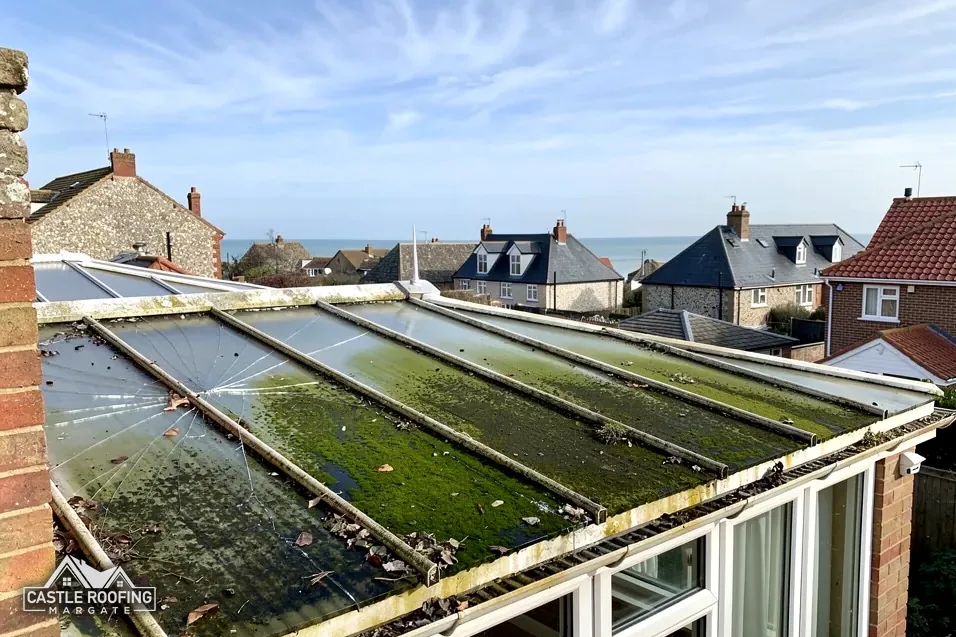
- Sheet edges that have lifted, split or crazed in the sun, so water gets under the bar.
- A failed seal along the ridge, where the two slopes meet.
- Corroded or bowed bars, which move under load and open the seals above them.
Many of these can be repaired without a new roof. A bar cap can be replaced, a seal can be renewed and a cracked sheet can be swapped. The limit comes when the failures are spread across the roof, because each repair then buys a few months before the next. Where the sheets themselves are tired, repair is spending on a covering that has a short time left.
Standing on the roof to inspect it is not a good idea. Polycarbonate and glass are not made to take a person's weight, and Work at Height Regulations 2005 reg 6(3) expects measures to prevent falls. Photos from the ground or from a ladder at the eaves are better, and a closer look is best taken from a safe platform by someone equipped for it.
Gutters and downpipes on the conservatory
A conservatory roof sheds a lot of water in a short time, and the gutter at the eaves has to carry it away. If it cannot, the water backs up, spills over, and finds the nearest joint. That is often the wall abutment at one end or the first bar at the other.
Gutter problems that show up as a leak:
- leaves and silt that block the outlet, so the gutter fills and overflows
- joints that have opened and drip down the face of the frame
- a gutter that has dropped or lost its fall, so water stands in it
- a downpipe that is blocked or has come away from the wall
Brett Martin, the guttering maker, gives the fall for a gutter as 1 mm for every 600 mm. A conservatory run is short, so the margin is small, and a bracket that has loosened can leave water standing where it should run to the outlet.
Overflow often looks like a roof leak because the water runs along the underside of the gutter and into the frame. A short, careful clear-out is the first step, done from a ladder placed on firm, level ground with someone footing it. If water still stands afterwards, the fall or the joints need attention, and a gutter that has simply sagged can be re-fixed on new brackets without being replaced.
Our answer on conservatory gutter leaks covers the repair. It is also worth checking the house gutter above the conservatory, because that outlet can discharge onto the conservatory roof itself.
Repair or replace: the honest comparison
Not every leaking conservatory roof needs replacing. A single failed bar cap, a lifted flashing or a blocked gutter is a repair, and spending on a new roof for any of them would be wasteful. The decision turns on how many things are wrong and how old the roof is. Each fault found at the survey is photographed so that you can see the count for yourself, and the answer follows from that count.
HomeBuilding quotes a typical life of 10 years for polycarbonate conservatory roofs, and The Eco Experts say about 10 to 15 years. Read them as ranges, not as a date for any one roof. A roof inside that range with one clear fault is a repair candidate. A roof at the far end, with leaks in several places, is not.
| Survey finding | Likely answer |
|---|---|
| One failed cap or seal | Repair |
| Lifted wall flashing | Repair, in lead |
| Blocked or tilted gutter | Clear or re-fix |
| Leaks in several bays | Replacement is worth pricing |
| Corroded, bowed bars | Replace the roof system |
Mending wins when it fixes the cause, and the table above shows how the findings usually point. Replacing wins when the same repairs would keep coming round. The written price for either one comes after the survey, so you can compare the two with the evidence in front of you, and a repair can be priced on its own.
What to do while the leak is active
A drip can be managed until the roof is looked at. The aim is to limit damage, keep evidence and avoid a fall, so none of the steps below involves going up on the roof, and each one takes only a few minutes.
- Catch the water. A bowl or a towel under the drip is enough, and move electrical items away from the wet area.
- Photograph the leak, the stain and the weather on the day, with the date.
- Look at the house wall inside and outside for damp staining near the joint.
- Clear any leaves you can reach from the ground, without climbing on the roof.
- Keep the photos and any receipts for the repair.
If the conservatory is insured, tell the insurer first. IStructE advises that photographs give visual evidence of damage, so the record you start now helps. On storm damage, the Financial Ombudsman Service's test starts from violent winds, usually with rain, snow or hail, and its common exclusions take in gradual damage and wear and tear. Nothing here promises a payout, and the insurer decides.
If water has reached an electrical socket, a light fitting or the house consumer unit, switch off the supply to that circuit and call an electrician before anything else. Water and electricity are a bigger problem than a wet floor, and a tripped circuit that keeps tripping after rain is another sign that water is getting in somewhere it should not.
Send the photos to us and the roof gets a proper look. The survey finds the entry point, whether that is the wall joint, a seal, a bar or a gutter, and the photos of your roof show what was found.