For a warehouse manager or owner with water on the floor. It sets out where leaks start on a big roof, how they are traced without anyone stepping on weak material, and what happens between the first call and the repair.
A warehouse roof is big, high and mostly out of sight. The first sign of a leak is rarely the leak itself. It is a wet patch on the floor, a dripping racking bay, a stained pallet or a puddle in the aisle that returns every time it rains. By then the water may have travelled a long way from where it came in.
Tracing it is a job of elimination. The roof has a limited number of places where water can enter: the laps between sheets, the fixings, the gutters and valleys, the rooflights and the penetrations. A survey works through them in order, rather than guessing at one and sealing it.
This guide describes those places in general terms for sheeted and membrane roofs on warehouses and units in Margate, Ramsgate, Canterbury, Dover and across East Kent. It also covers the risk that comes with the job, since a warehouse roof cannot be assumed safe to stand on, and it explains how a leak is made safe before anything is repaired. The page sits within our commercial roofing work, and the repair is priced in writing once the roof has been seen.
Tracing where the water comes in
Water on a warehouse floor shows where it landed, not where it entered. On a profiled metal roof it runs down the underside of a sheet, along a purlin or a liner and off the lowest point it can find. A drip over bay 6 may have entered ten metres up the slope.
The trace follows a set order:
- Mark the wet areas on a plan of the floor, with the date and the weather at the time.
- Look from inside, at the underside of the sheets, for staining, rust runs and white salt deposits that show a long-term path.
- Go up the slope from each wet area and look at the first lap, fixing, rooflight or gutter above it.
- Check the gutters and outlets, since a blocked gutter can push water back over the sheet edge.
- Where the cause is still unclear, a hose test starts low on the slope and works upward in stages, with a colleague watching from inside.
A moisture meter or a thermal camera can help on a membrane roof, because wet insulation reads differently from dry. They find wet areas but do not name the fault, so the survey still comes down to looking at the roof.
The survey leaves you with photos of your own roof, each suspect point marked. That record also serves when a landlord, a tenant or an insurer asks what was found.
Laps, fixings and sealant on metal sheets
On a profiled steel roof, a leak can start in the details between sheets as readily as in a hole through the sheet itself. They fall into a few groups.
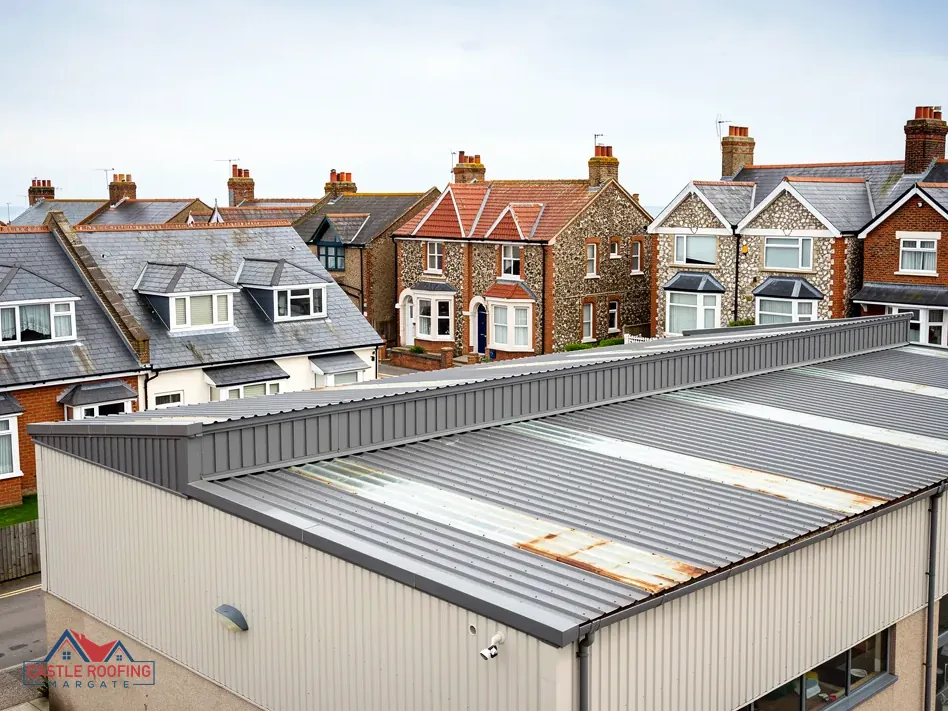
A side lap is the seam where neighbouring sheets overlap along the run. The end lap is where the upper sheet overlaps the one below. Both are sealed with sealant tape pressed between the sheets when the roof is built. Over the years the tape can dry out, creep or be squeezed flat by the load on the lap, and the joint opens.
Fixings are screws with a sealing washer. They go wrong in a few ways:
- the washer has perished or split, so water runs down the screw
- the screw was driven in crooked or too hard, which crushes the washer
- the coating has failed on the screw head and the fixing has rusted
- the hole has enlarged because the sheet moves in the wind
Repairs are matched to the fault. A failed lap is re-sealed with new tape or a purpose-made sealant. A loose or crushed fixing is replaced with a new screw and washer, sized to the purlin. A sheet with a split or a corroded run is cut out and replaced, or overlaid with a new sheet fixed to the purlins.
Where many fixings and laps are failing across a whole slope, the roof may be near the end of its useful life, and the survey will say so. Our guide to an emergency commercial roof leak covers what to do while a repair is arranged.
Gutters, valleys and outlets
Large roofs shed a lot of water to a small number of gutters. A warehouse with two long slopes and a valley between them may have a box gutter running the full length of the building, discharging through a handful of outlets. If one outlet blocks, the gutter fills and overflows, and where it overflows depends on the details.
An internal valley gutter is a clear example. It sits between two roof slopes, lined with a metal or membrane liner, and its sides are only as high as the sheet laps allow. When it overflows, the water goes under the sheet laps and into the building, so the leak shows up along the line of the valley.
The checks are straightforward:
- clear the outlets and the gutter of leaves, moss and bird debris
- look for standing water, which means the gutter has lost its fall or the outlet is too small
- check the gutter lining for splits, open joints and failed sealant at the ends
- look at the downpipes and the connection to the drain, since a blocked drain backs up the whole system
Brett Martin sets a gutter's fall at 1mm for every 600mm of run. A gutter that has dropped out of line holds water at a low point and fails there. A failing lined gutter may be relined rather than replaced, a point our page on industrial gutter lining expands.
Cleaning a gutter is a maintenance job, and a leak that returns after each rain can mean the gutter was the cause all along.
Rooflights and other openings
Rooflights deserve their own look on every warehouse survey. They are made of plastic that ages in sunlight, they sit in the lap pattern of the sheets, and they carry their own seals and fixings. A cracked panel, a failed edge seal or a lifted fixing lets water in just like a gap in the sheet does.
The openings to check on the roof:
- rooflight panels and their end and side laps
- roof vents, smoke vents and fans, with the kerb around each
- flue and pipe penetrations, with the flashing or boot at each
- the ridge and the verge, where capping meets the sheet
- the junction with a wall, where a flashing is dressed over the sheet or the membrane
Condensation can look like a leak. A warm, humid building under a cold metal roof sheds drops from the underside of the sheet on a still, cold morning, with no rain. The pattern differs: condensation drips appear across large areas at similar times, while a leak follows rain and clusters near a fault. BS 5250:2021 covers the management of moisture in buildings, and a ventilation or insulation fix may be the answer where condensation is to blame.
Rooflights at the end of their working life are best replaced along with the sheets nearby, which saves a repeat visit. The new panels are matched to the sheets, so each light sits properly in the lap pattern and carries its own fresh seals and fixings.
Fragile roofs and safe access
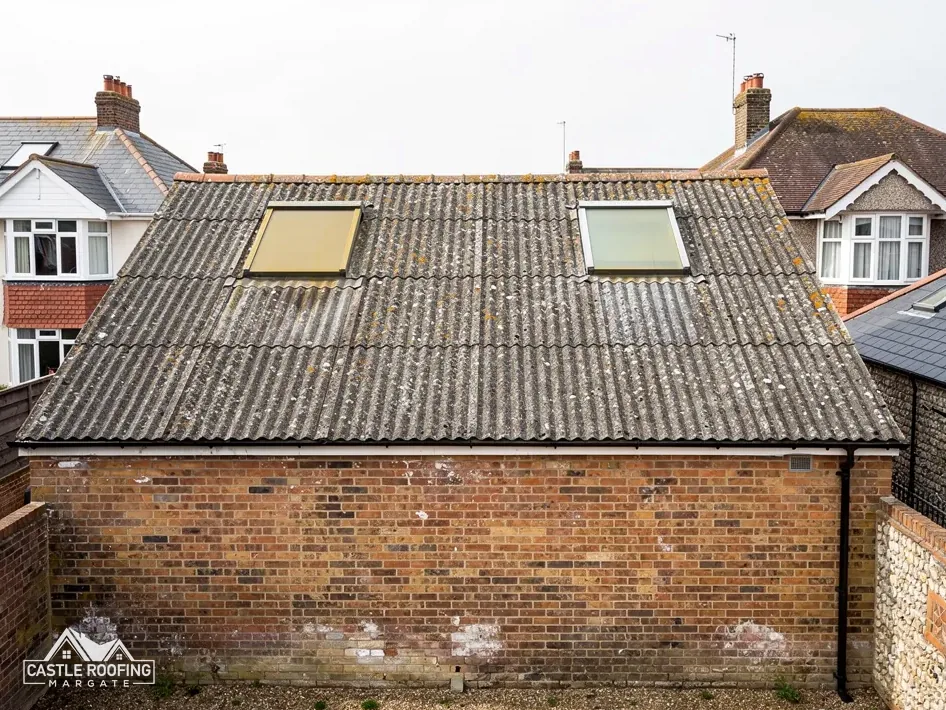
Much of the danger on a warehouse roof is the roof itself. Roofs made of asbestos cement are always fragile, the Health and Safety Executive's A14 guidance says, and a building from before 2000 should be assumed to contain asbestos. Rooflights can be fragile whatever the age of the building, and a rooflight that has been painted over or covered in moss is easy to step on by mistake.
Regulation 6(3) of the Work at Height Regulations 2005 makes the employer responsible for preventing, as far as reasonably practicable, any fall that could injure. For a leak call that comes down to:
- reaching the eaves from a mobile platform, not by stepping onto the roof
- edge protection at the eaves and gables before anyone is on the slope
- boards laid across the purlins to share a person's weight
- netting or soft-landing kit under the sheets where it can be rigged
- every rooflight covered or guarded and marked on a plan
A leak that needs urgent attention does not alter any of this. Inspections can start from the inside of the building and from a platform, and the sheeting is only walked on once its type and condition are known. Our guide to fragile roof safety describes the equipment. If asbestos cement is present, repairs are planned to avoid breaking the sheets, and any waste is double-wrapped and removed in a lockable skip.
Make safe first, then a written price
When a warehouse is taking in water, two things happen in order. The first is to make the leak safe, and the second is to price the proper repair.
Making safe is a short, practical job. It may be a temporary patch over a split sheet, a tarpaulin or sheet clamped over a failed rooflight, a cleared outlet, or a diverter fitted inside to carry water away from stock and electrics. Move stock and cover racking where you can, and isolate electrics near the leak. It buys time without being the repair.
MyJobQuote, in its emergency roofer guide of 22 October 2026, gives a typical UK range of £150 to £300 for an emergency roofer call-out, and says extensive storm damage repairs can cost £1,200 or more. Those are national guide figures, not our price, and a warehouse is priced after a survey.
Then the repair is priced. Its price is set by the type of fault, the roof's height and access, the area to be repaired or replaced, whether asbestos is present, and how much scaffold or platform hire is needed. The price arrives as one written total once the survey is done.
If it may be an insured event
If the damage may be an insured event, tell the insurer before anything else, secure the building, and keep every photo and receipt. In the Financial Ombudsman Service's storm guidance, violent wind is the usual mark of a storm, often joined by rain, hail or snow, and wear and tear and slow-building damage sit among the exclusions it calls common. Check your policy's own storm definition as well, and the Ombudsman's helpline is 0800 023 4567.