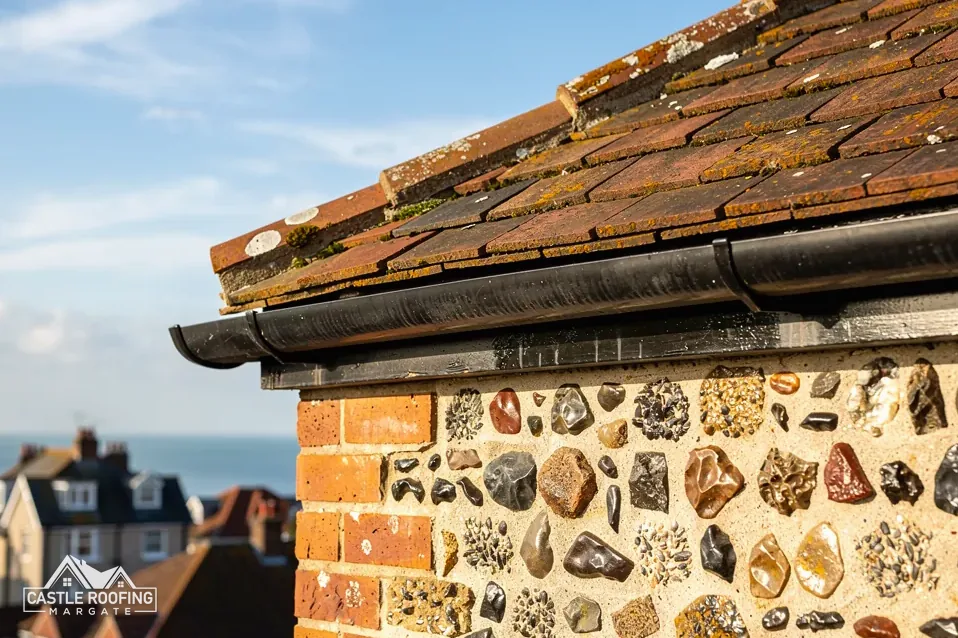
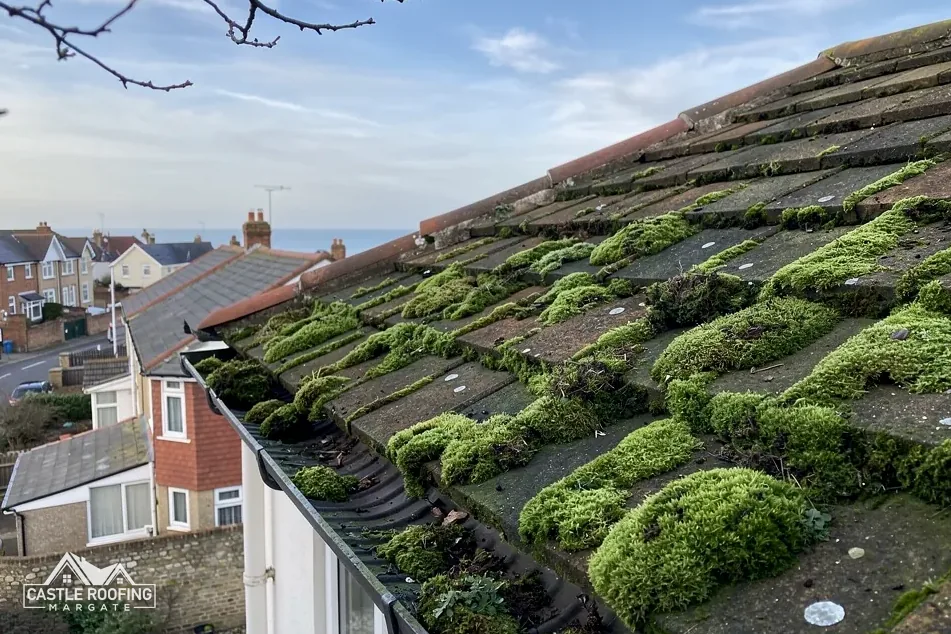
Re-hanging and replacing tiles in sequence, choosing reclaimed tiles that match, what BS 5534 asks of a repair, the point where a repair becomes a re-roof, and the consent a protected building needs.
A tiled roof that has gone patchy, with a few tiles hanging low or a bare gap along a slope, is not necessarily finished. In many cases the sound tiles can stay, and the loose or broken ones can be re-hung or swapped for matching ones. That is the approach worth looking for if the roof contributes to how the house looks from the lane, and it is cheaper in materials than starting again.
This post is about general repair practice for tiles held on the battens by pegs. It covers what a repair involves, how matching works when a tile has to be replaced, what the British Standard for fixing says about re-roofing and repairs, and where the repair stops being a repair. It also covers the point at which listed building consent comes in. If your roof needs work, our pitched roofing page shows the range of jobs, and our post on what a Kent peg tile is introduces the tile itself.
Re-hanging a slipped tile, step by step
A tile that has dropped usually has a failed fixing behind it, whether a broken peg, a rusted nail or a batten that has gone soft where the tile hangs. Putting the same tile back without finding out why it fell only buys a short reprieve.
A sound repair follows an order:
- Lift the tiles above the slipped one, working from the top of the gap, to expose the batten and the underlay beneath.
- Check the batten along the whole length of the slipped course. Decayed timber comes out and new goes in, rather than being patched.
- Look at the underlay for tears, and renew the torn section so water cannot run behind the tile.
- Re-hang the tile on a new fixing, and re-hang each tile above it in sequence, keeping the lap and the gauge of the surrounding courses.
- Replace broken tiles with matching ones. A cracked tile is not worth re-fixing because it can split the next time it is walked on or hit by hail.
- Check the course above and below, because a loose tile often has loose neighbours.
A tile held by a tired fixing will drop again, so a repair stands or falls on the fixing, and a roofer who simply drops the tile back on its batten has not repaired anything. If the slipped tiles are close to the ridge or the verge, the cause may be there instead. Our post on why roof tiles slip explains the usual causes.
Reclaimed tiles and matching the colour
Replacement tiles are where a patch repair succeeds or fails. A new tile laid among weathered ones can stand out for years, and a mismatch in size, thickness or camber also affects how the course lies. The usual choices are these:
| Choice | Strength | Watch for |
|---|---|---|
| Reclaimed tile | Weathered colour already | Cracks, frost damage, a mixed batch |
| New clay tile | Fresh, sound fixing | Colour looks bright at first |
| Tiles from a hidden slope | Same age, same colour | Leaves a gap on the rear |
Reclaimed tiles come from other roofs, so each one carries its own history. Tap them: a good clay tile rings, and a dull sound suggests a crack. Ask the supplier how the batch was sorted, whether tiles were checked individually, and how many of each shade are available, since a second delivery may not match the first. Tiles for the visible slope can be swapped with sound ones from a less visible one, a swap that moves the new tile where it will not be seen.
Sound clay lasts well. Marley reports BRE's minimum life expectancy for clay tiles as 60 years, and HomeBuilding gives clay a range of 60 to 80 years. Both are typical figures. Neither is a promise, and a tile with a hairline crack will not reach either.
Matching is covered more fully on our pages about matching old roof tiles and reusing peg tiles.
What BS 5534 asks of a repair
BS 5534:2014+A2:2018 is the standard that slaters and tilers fix to. It is not law: Marley says installing to BS 5534 isn't required by law. What changed in 2018 is the scope, because Marley records that the A2 amendment brought normal re-roofing work, and repairs, into its scope. For a roofer, that makes it the benchmark.
The point that gets passed around is mortar. According to Marley, the 2015 amendments settled that mortar alone cannot be trusted to hold a covering in place. Mortar remains in use; what altered is that ridge and hip tiles need a mechanical fixing as well, or a dry-fix system to BS 8612:2018, instead of mortar alone. Where a roof keeps its mortar bedding for the look of the ridge, a fixing sits behind it to do the holding.
On a repair, three things follow:
- Each tile is fixed in an appropriate manner, which is the wording of Approved Document C paragraph 6.8.
- Each fixing is specified by calculation for how exposed the particular site is, which counts for a lot on a house that stands open to the wind.
- Ridge and hip work uses a mechanical fixing alongside any mortar.
None of this stops a repair from looking right. A good tiler can tuck a clip out of sight and still bed the ridge as the roof was built. Our page on BS 5534 tile fixing shows how that works course by course.
When a repair becomes a re-roof
Every roof reaches a point where patching costs more than it saves. The signs are a pattern rather than a single fault: tiles failing across a whole slope, battens rotten in many places, underlay crumbling wherever you lift it, or old fixings breaking as tiles are touched. If you are replacing a large share of tiles, you are in effect re-roofing, and building control comes into the picture.
The Planning Portal gives the national test, which is met when the work touches less than 25 per cent of the building envelope and under 50 per cent of the roof. The same page brings in approval where the replacement covering is at least 15 per cent heavier than the existing one, or would act very differently in a fire. Weight deserves thought if anyone suggests switching the type of tile to cut the cost.
The honest comparison is between a repair that leaves the old structure as it is and a re-roof that renews the battens and the underlay at the same time. A short job on a sound roof is a repair. A slope that needs a third of its tiles replaced, with battens to match, is worth pricing as a re-roof so the two options can sit side by side. Each is quoted as one written total after a survey, and the survey photographs help you judge.
Kent County Council grants the licence for any scaffold set up over the road or pavement edge; the scaffolding company applies, giving 5 working days' notice.
Listed buildings and conservation areas
If the building is listed, any work that affects its character needs listed building consent under section 7 of the Listed Buildings Act 1990. Canterbury City Council states it plainly: "You will need listed building consent for any changes which affect the building's character." Listed houses keep their ordinary Class B and Class C rights, but consent is a separate question.
For a tiled roof, the sort of change that can touch character includes:
- Changing the tile type, colour or size.
- Altering the way the courses lie or the profile of the ridge.
- Re-roofing with a different kind of fixing that shows on the surface.
- Replacing the underlay and battens in a way that alters the roof's depth at the eaves or verge.
- Removing and not replacing an old detail, such as a hand-finished verge or an eaves course.
Replacing a few tiles with matching ones is less likely to affect character than renewing the covering. That is a judgement the council's conservation officer makes for your building, and it is wise to ask before work begins, with photographs. Our page on listed house tile repairs goes through how the process runs.
In a conservation area, Thanet District Council advises that work matching the existing roof makes a planning application less likely, and dormers lose their permitted development right. See the post on conservation areas in Margate and roof work for the areas and dates.
Planning a peg tile repair so it lasts
A repair that lasts is mostly preparation. Use the weeks before the work to settle a few points, and the job goes more smoothly once it starts.
Start with the photographs. Take pictures from the road and the garden of every slope, close up on the area that has failed, and a wide shot of the whole roof, so the roofer can see what has to match. Add the loft, where the roof's underside shows rot, daylight and damp that cannot be seen from outside. Send them with a note of when you first noticed the problem.
Then settle the practical points:
- Ask for the tile source to be named: reclaimed, new or taken from a hidden slope.
- Ask what happens to the old tiles that cannot be re-used, and who takes the waste away.
- Ask how the ridge and hips are fixed, in light of BS 5534 and BS 8612.
- Ask whether battens or underlay will be renewed along the repaired area, and whether the roofer will show you the old ones before they go in the skip.
- Agree access: scaffold or tower, and who arranges any licence.
Tidy sites matter on a roof that sheds old mortar and broken clay, so ask how the garden and gutters will be cleared at the end of each day. Once you have the written price, check it is for the whole job at one total. The cost of a repair depends on the extent of the failure, how the roof is reached and how hard the matching proves, and none of that can be named before a survey. Ask for the sample tiles to be seen on site before the order goes in, so that the colour is judged in daylight against your own roof.