
Roofers in Woodnesborough
11.8 road miles from Margate. Repairs, re-roofs, chimney stacks and lead flashings for Woodnesborough houses, with a price given only once we have studied the roof and shared pictures of it.
- Planning: DoverPlanning applications go to Dover District Council.
- Grade II* churchSt Mary the Virgin church, listed Grade II*.
- Dover's own teamDover's own building control team inspects.
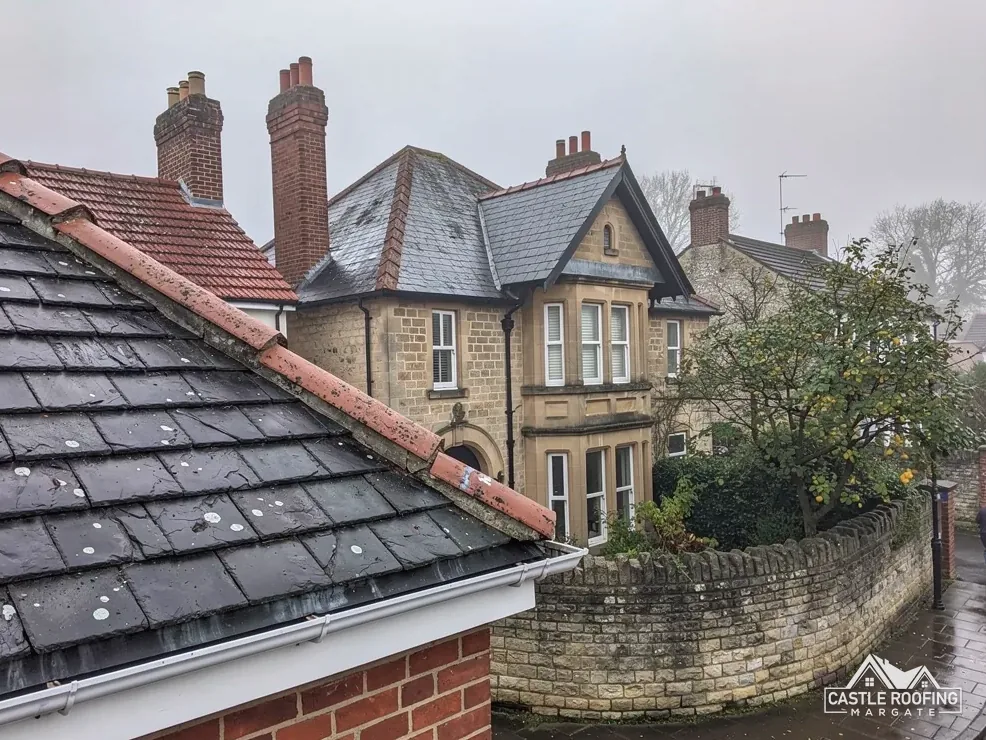
A Grade II* church, eleven listed neighbours and Dover's wording
Churchyard entries
St Mary the Virgin is Grade II*, and the sundial and three tomb chests in its churchyard are each listed Grade II.
Dover's wording
Dover District Council requires approval to re-cover a roof even with identical materials, so we confirm that route first.
Ash nearby
The national dataset names three Ash conservation areas within about 2.5 km, and your own address is checked with Dover before pricing.
Woodnesborough parish, 1,241 residents
What the heritage list shows around the church
| Council | Dover District Council |
|---|---|
| Building control | Dover District Council's own building control team |
| Scaffold and skip licences | Kent County Council |
| Population, 2021 | 1,241 (Woodnesborough parish) |
| From Margate | 11.8 road miles, about 19 min |
| Listed entries within 500 m | 11, National Heritage List |
| Parish church, St Mary the Virgin | Grade II*, first listed 11 October 1963 |
| Sundial and tomb chests | Grade II, first listed 26 November 1987 |
A parish of 1,241 people holds a Grade II* church and two Grade II churchyard entries, and Historic England counts eleven listed entries within 500 metres of its centre, so a survey here opens with the heritage list.
Sources: ONS Census 2021, Dover District Council, Kent County Council, OSRM road routing.
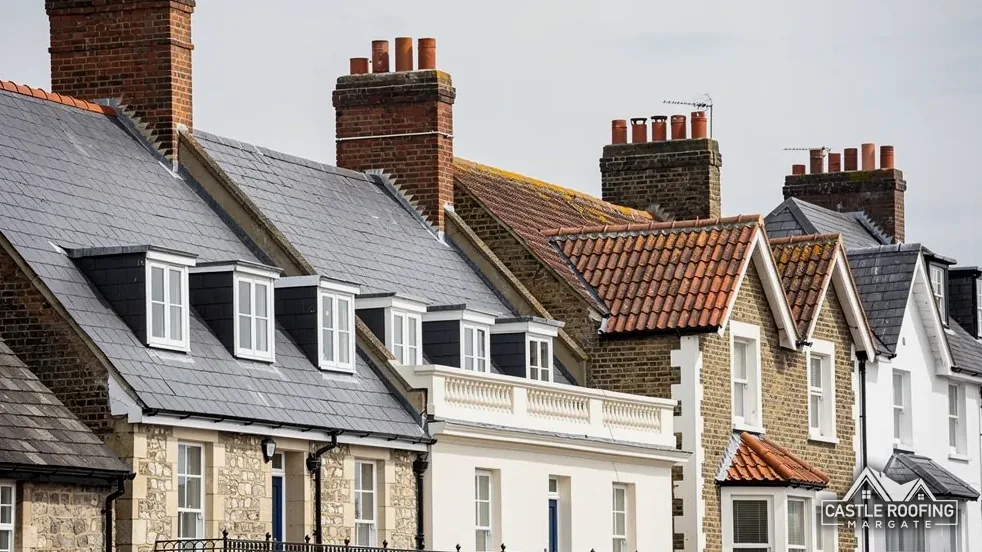
Woodnesborough, church and council
The church group, Dover's wording and the scaffold licence behind a Woodnesborough re-roof
Three chapters: the churchyard listings and the faculty route, Dover's approval line and the Ash conservation areas, then the licences and order of work for a village roof.
Chapter 01 of 03
St Mary's church, its sundial and its tomb chests
The drive from Margate to Woodnesborough is 11.8 road miles, about 19 minutes heading south-west, and the roof questions start at the parish church. The parish church, St Mary the Virgin, is listed Grade II* (National Heritage List entry 1281495, first listed on 11 October 1963). The churchyard holds two more entries: a sundial about 15 metres north of the church and a group of three tomb chests north of the chancel, each listed Grade II on 26 November 1987. Historic England's list also shows 11 listed entries within 500 metres of the village centre, which puts many houses here close to something protected.
Listing attaches to one named building, and it takes in the whole of it, roof included. Under section 7 of the Planning (Listed Buildings and Conservation Areas) Act 1990, work that alters a listed building's character needs listed building consent. On a roof, character lives in the covering, in the ridge (the capped line where the highest slopes meet), in the chimney stacks and in the lead flashings (lead sheet shaped over a joint to keep the rain out). For any house in the village the first job is therefore to look the address up on the list, before anyone prices a slate. Applications for this village go to Dover District Council as the planning authority.
The church follows a separate route. St Mary's serves the Church of England as a parish church, a denomination exempt from listed building consent, so works to the building go through the Church of England's faculty system. A chapel, or a church in the hands of a different denomination, follows a separate route, so we begin by asking who uses the building. Our part is to look over the roof, set out the slates, lead and pots in plain words, and hand over a clear set of pictures for whoever signs the application.
Where a listed house does need consent, matching is the job: the same type of slate or tile, lead dressed the same way, a stack rebuilt with its flaunching (the sloped mortar bed that holds the pots in place). Our slate roofing, lead roofing and chimney repairs pages explain those materials and details.
Chapter 02 of 03
Dover's approval line and the conservation areas at Ash
Re-roofing is where Dover's own wording matters for an address in the village. On Dover District Council's building control pages, a new covering on any pitched or flat roof counts as approval work, whether or not it is like for like. The flat parts of a house, such as a rear extension, fall under the same line as the pitched roof above. The Planning Portal's national test is looser, with no application normally needed while less than 25 per cent of the building envelope and less than 50 per cent of the roof is affected. Dover's line applies to Dover addresses, so before a re-roof in Woodnesborough we settle the route with the council's own building control team, and the application is built around the roof we have surveyed.
Planning and building control are asked separately. The national planning dataset names three conservation areas near the village, three Ash areas named Street End, The Street and Guilton, within about 2.5 km of the centre. Dover lists 57 conservation areas across the district, so whether a particular Woodnesborough house sits inside one is a point we put to Dover District Council before pricing. Inside a conservation area some normally permitted work needs an application, and Dover's page names building roof dormers among it. Our roof window planning permission guide holds what dormers and roof windows must meet, and it is worth reading before you commission drawings.
| The question | Who answers it |
|---|---|
| Re-roof approval | Dover District Council building control |
| Conservation area or Article 4 | Dover District Council planning |
| Scaffold or skip on the road | Kent County Council highways |
| Church of England church roof | The faculty system |
Source: Dover District Council; Kent County Council; Church of England faculty system
Article 4 is a third layer. An Article 4 direction lets a council take specified permitted development rights away within a set area. Dover says a direction may reach roof alterations to a house, limited to the parts seen from public open space, from a waterway or from a road. Whether one applies to a given house is the council's answer to give, so we ask it and keep the reply with your survey pictures.
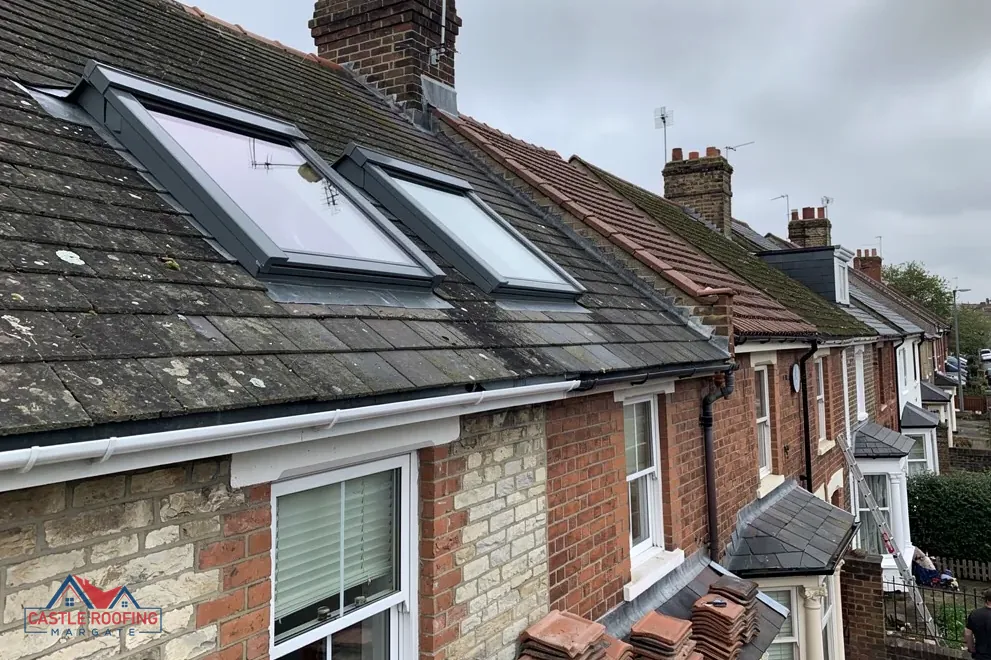
The survey is the same task in any village. We go along the ridge and the verges (the roof edges at a gable), into the valleys (the angle where two slopes meet and drain), round every flashing at a chimney or a wall, and into the loft to see the battens and underlay from below. A flat extension roof or a garage gets its own look, because it fails in different places from a pitched roof: at upstands, outlets and the joints between sheets. Any problem we find is described in the survey with a picture beside it, so you can compare it with what you see from the ground.
Chapter 03 of 03
Kent's licence, the skip and the order of work
A scaffold or a skip standing on the highway needs permission from Kent County Council, the highway authority for Woodnesborough. Section 169 of the Highways Act 1980 makes a licence necessary before anyone erects or keeps scaffolding that obstructs the highway. Kent County Council's rule is that the firm placing the scaffold makes the application, so the scaffolders handle it for you, and Kent asks for the application to arrive at least 5 working days beforehand, which is a firm lead time. The fee for 2026 to 2027 is £52 per week, plus £78 if the council decides a site inspection is necessary, and the scaffolder must carry public liability insurance of £5 million or more.
A skip needs its own separate permit, £45 per week for 2026 to 2027, with the same 5 working days of notice, and skips are limited to 5 metres by 2 metres. Scaffold or a skip on a private drive or in a garden falls outside the highway rules, and our survey says which case your house is. For questions ahead of applying, ring Kent County Council's highways team on 03000 41 81 81.
The notice period shapes the diary. A planned re-roof is booked around those 5 working days, while a leak that cannot wait is made safe first and the rest is scheduled once the licence is in place.
Met Office averages for Manston, 1991 to 2020, give about 613 mm of rain each year, falling on 110 days with at least 1 mm, and that is the background against which flashings, valleys and gutters are judged at the survey. Under BS 5534 each site's exposure sets the fixings for slates and tiles, which means nail types and clips are chosen from the building in front of us and not from a rule of thumb. A stack or valley that has leaked is checked again from the loft side, where damp shows first. After each working day you get a message covering the job so far and the next step. Old slates, battens and lead are taken away at the end of each stage, and the site is left clear so the household can use its drive and garden.
Order of work for a village roof
Survey the roof
Every slope, stack and gutter is checked, and you receive pictures of each.
Check the paperwork
List entry, council route and any scaffold or skip application.
Work in sections
Each slope is opened, repaired and closed up in turn.
Clear and report
Waste leaves with us and the site is tidied.
10-Year workmanship guarantee. In writing
Around Woodnesborough
Eastry, Ash, Sandwich and Worth around the church
Woodnesborough shares Dover District Council, its building control team and Kent County Council's highway licences with Eastry, Ash, Sandwich and Worth, so the approval route for a re-roof reads the same in all five.
Churchyard, Dover and the road outside
Does St Mary's listing in Woodnesborough reach the houses around the church?
Not automatically. Listing attaches to each building named in its own entry, and the church, the sundial and the tomb chests are separate entries. A house needs listed building consent only if the list names it separately, which you can check on the National Heritage List. Dover District Council decides applications, and the entry is read before any price is given, so the work matches what is listed.
Is a like-for-like re-slate in Woodnesborough exempt from approval?
Dover District Council's building control page puts re-covering among the jobs needing its approval, pitched roofs and flat ones alike; matching the old covering is no exemption. For a Woodnesborough address that means the route is confirmed with the council's building control team before a start date is fixed, and the application describes the roof as we found it.
Do the Ash conservation areas affect a house in Woodnesborough?
The national planning dataset names three Ash areas (Street End, The Street and Guilton) within about 2.5 km of the village. That is a pointer, not an answer for your house. Dover District Council holds the boundaries and says what applies at an address, so we send the council your address before pricing and pass on its answer.
What does a skip outside a Woodnesborough house involve?
Where the skip stands on the highway it needs a Kent County Council permit, which costs £45 per week for 2026 to 2027 and needs 5 working days' notice. The skip company submits the application, and the skip may not be longer than 5 metres or wider than 2 metres. On your own drive, off the highway, no permit is needed.
Who inspects the finished roof work at a Woodnesborough house?
Where building control applies, Dover District Council's own team gives advice, visits site and issues approvals. You can appoint a registered building control approver instead; registration started on 6 April 2024, and private building control existed before that. We tell you at survey which route your roof needs and what has to be inspected.
Roof questions near St Mary's
Send pictures or book a visit; we survey first, and the written price follows as one total.