
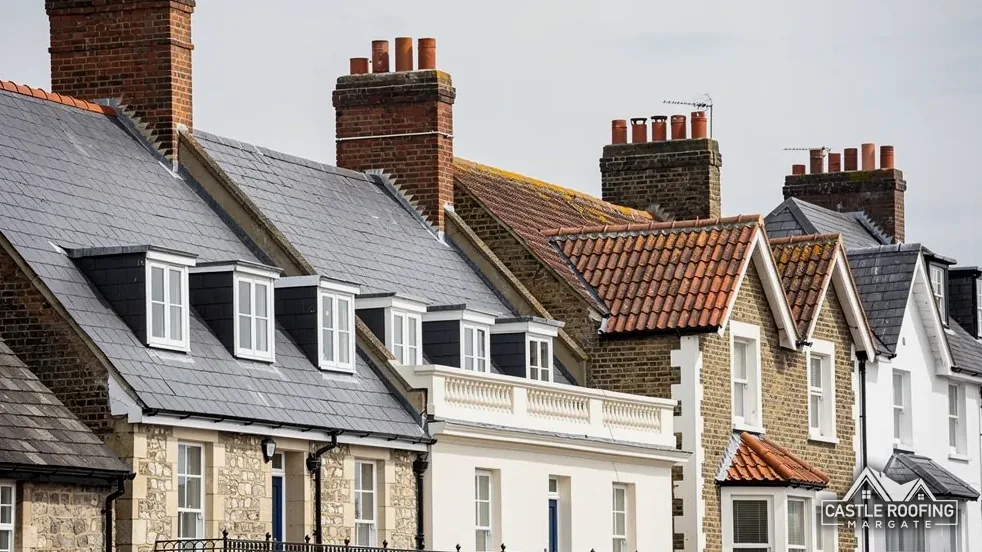
Roofers in Ash
11.3 road miles from Margate. Roof repairs, re-roofs and chimney work in Ash, with pictures of your own roof sent to you and one written total price after the survey.
- Dover planningAsh falls under Dover District Council planning.
- Three conservation areasGuilton, Street End and The Street conservation areas.
- Dover's own teamBuilding control: Dover District Council's own team.
A Grade I church, a Grade II* house and three boundaries
Grade I church
The Church of St Nicholas is in use for Church of England worship, so roof work follows the faculty system.
Two older houses
Chilton House was first listed on 11 October 1963 and Bank House on 26 November 1987, each with its roof protected.
Three Ash areas
Guilton, Street End and The Street are the conservation areas within about 0.75 km of the village centre.
Ash, in Dover district
The Church of St Nicholas, Chilton House and what stands around them
| Council | Dover District Council |
|---|---|
| Building control | Dover District Council's own building control team |
| Scaffold and skip licences | Kent County Council |
| Conservation area | Ash - Guilton; Ash - Street End; Ash - The Street |
| Population, 2021 | 3,337 (Ash parish) |
| From Margate | 11.3 road miles, about 18 min |
| Parish residents, 2021 Census | 3,337 |
| Listed entries within 500 m | 51, National Heritage List |
| Grade I, first listed 11 October 1963 | Church of St Nicholas |
| Grade II*, first listed 11 October 1963 | Chilton House |
Ash had 3,337 residents at the 2021 Census, and the National Heritage List holds 51 entries within 500 metres of its centre. A roof survey here begins with those entries and the three boundary maps.
Sources: ONS Census 2021, Dover District Council, Kent County Council, OSRM road routing.

Ash, grade to permit
Ash roofs, from a Grade I church and a Grade II* house to the street outside
Three chapters on the grades of listing here, Dover's approval list with the church route, and the licences and frost that govern a job on an Ash street.
Chapter 01 of 03
St Nicholas, Chilton House and Bank House across three grades
Ash is a village of 3,337 usual residents at the 2021 Census, 11.3 road miles south-west of Margate in Dover District. The National Heritage List holds 51 entries within 500 metres of its centre, which is a lot of protected fabric to keep in mind when a roof is being priced. Three entries show how varied they are. The Church of St Nicholas is Grade I, first listed on 11 October 1963. Chilton House is Grade II*, first listed on that date as well. Bank House is Grade II, first listed on 26 November 1987.
The grade ranks an entry; it does not decide whether consent is needed. Listed building consent, under section 7 of the Planning (Listed Buildings and Conservation Areas) Act 1990, is tied to works that affect a listed building's character, and a roof is a prominent part of that. Slate or tile, the ridge where the slopes meet, the hips, each stack and every lead flashing (the dressed metal that weatherproofs a joint against brickwork) can all be part of why a building was listed.
That is why we start with paper before ladders. For a listed Ash house we read the entry, look at the roof from the ground and then from up close, and send you pictures of every slope and chimney with notes on what we found. Dover District Council decides any consent application, so the description of the work has to be written so that it matches the roof when the job is done. Where an old covering needs replacing, matching its material comes before changing it. Our slate roofing and roof repairs pages say more about how repairs are matched.
A listed neighbour does not make your own house listed, but with 51 entries in a small area it is worth knowing which neighbours are, so we note them in the pictures and the survey notes we send you. One entry is a church, and a church is not treated like a house: the next chapter explains the route for the Church of St Nicholas, while the table below keeps the three Ash entries side by side for anyone comparing them.
| Entry | Grade | First listed |
|---|---|---|
| Church of St Nicholas | I | 11 October 1963 |
| Chilton House | II* | 11 October 1963 |
| Bank House | II | 26 November 1987 |
Source: Historic England, National Heritage List for England
Chapter 02 of 03
The faculty route, Dover's approval list and the Guilton boundary
Anyone re-covering a roof in Ash deals with Dover District Council for building control, and Dover's published list names replacement of roof coverings, pitched or flat, as work that needs approval even if the new covering is identical to the old. That wording is Dover's and applies to Dover addresses. It is not a national test. Approval is a separate matter from planning. The Planning Portal's test for a typical re-roof is less than 25 per cent of the building envelope and less than 50 per cent of the roof affected, and a covering that adds 15 per cent or more to the roof's weight needs approval regardless of how much of the roof it covers. Dover goes further for its own addresses, so in Ash we treat Dover's wording as the one that governs, and we settle the route with the council before the covering comes off. Dover District Council's own team inspects and issues approvals, and a registered building control approver is a private alternative.
The Church of St Nicholas follows a different path, and that path decides who writes to whom about its roof. It is a Church of England church that is still used for worship, and the ecclesiastical exemption in section 60 of the 1990 Act takes that kind of building outside listed building consent; works go through the Church of England's faculty system instead. The exemption belongs only to named denominations, each with a system of its own. A Quaker meeting house, a Unitarian chapel or a building held by the Churches Conservation Trust is treated like a house and needs listed building consent.
Checks before an Ash roof is priced
Read the list entry
Find out whether the house, church or outbuilding is listed and at which grade.
Place the boundary
Set your address against Guilton, Street End and The Street.
Ask Dover
Confirm the building control route and whether an Article 4 direction applies.
Pick the consent route
Listed consent, faculty or neither, depending on who owns and uses the building.
Three boundaries around the village
The national dataset names three conservation areas within about 0.75 km of Ash's centre: Ash - Guilton, Ash - Street End and Ash - The Street. A conservation area is article 2(3) land: dormer windows leave permitted development there, and demolishing an unlisted building needs permission. Added windows have conditions of their own, set out in our roof window planning guide.
Dover also publishes Article 4 information. Its page says a direction can take in changes to a dwelling's roof where that part of the house faces public open space, a waterway or a road. Whether one reaches your address is a question for Dover District Council, and we put it to the council at the survey stage instead of guessing, since the front slope is where such a direction would bite.

Chapter 03 of 03
Scaffold, skip and frost on an Ash street job
A scaffold on or over a public road needs a licence under section 169 of the Highways Act 1980. In Ash the licence comes from Kent County Council, whose own page names the scaffolding company as the applicant, and Kent County Council highways take questions on 03000 41 81 81. Notice is 5 working days, including renewals; the fee for 2026 to 2027 is £52 per week; and if the council decides a visit is needed, a site inspection costs £78. Its conditions also ask for a gap of at least 1.2 metres from scaffold to road edge and for the vertical standards to be painted white for 2.5 metres above the pavement, details that decide where on a narrow street the poles can go.
A skip on the road has a permit separate from the scaffold. Kent County Council charges £45 per week for 2026 to 2027, asks for 5 working days' notice, and sets a ceiling of 5 metres by 2 metres. Kent County Council bills £120 for inspecting an unpermitted skip, and £45 more for a permit issued after the event. We plan the waste so the skip is on the road only for the days the stripping and clearing actually take, and old tiles, battens and underlay are lifted out in loads that fit the permit. Kent County Council also wants express permission given before a skip stands on a footway, with a 1.5 metre walkway for pedestrians, so the placing is agreed with the skip firm before it arrives.
Frost works on old coverings as well as wind. Met Office averages for Manston, 1991 to 2020, give 21.43 days of air frost a year, 110.05 days with 1 mm or more of rain, and a mean wind of 9.86 knots at 10 metres, 11.21 knots in January. They describe a station, not Ash, and are used as a guide to the scale of the weather. Water that gets into a porous tile or a failed joint and then freezes can lift the surface off, which is one reason we look at the condition of each course and not just the overall pattern.
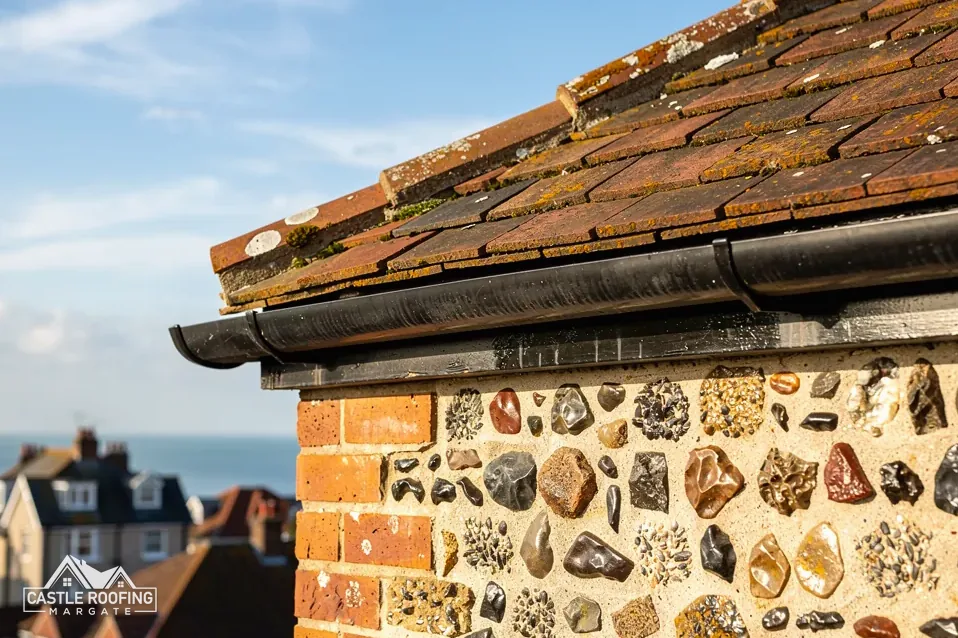
Fixings are worked out for the site under BS 5534, so exposure is part of the survey. The crop below shows three places on a pitched roof where a surveyor looks first.

10-Year workmanship guarantee. In writing
Around Ash
Ash and the Dover District places around it
Ash is planned and building-controlled by Dover District Council, as Sandwich and Deal are, and Kent County Council licenses every scaffold and skip that stands on the highway, so the paperwork route here carries over to the neighbouring villages, which eases planning across two or three of them.
St Nicholas, three boundaries and Dover's approval list
Whose consent covers re-roofing the Church of St Nicholas in Ash?
As a working Church of England church, it goes through the faculty system, not listed building consent, because of the ecclesiastical exemption in the 1990 Act. Roman Catholic, Baptist, URC and Methodist buildings in use answer to their own schemes; Quaker and Unitarian buildings, like those the Churches Conservation Trust holds, take listed building consent. If you look after a church roof, start by confirming who uses the building and which route that points to.
Do Ash's Grade II and Grade II* houses need different consent for a roof repair?
Both are listed, and listed building consent follows works that affect a building's character. The grade is the rank of the entry, not a switch that turns consent on or off. A repair that matches what is there may not touch character at all, and that call belongs to Dover District Council, so we read the entry and put the detail to it.
Will Dover District Council's building control need to sign off a re-tile of an Ash house?
Dover's approval list takes in new coverings for pitched and flat roofs, even where the new tiles copy the old ones, so for a Dover address we plan on approval and confirm the route before work. A registered building control approver can be used instead; the register opened on 6 April 2024, though private sign-off is older. We settle which route applies when we survey.
Can a scaffold stand on an Ash street without a licence from Kent County Council?
No. Section 169 of the Highways Act 1980 requires a licence, and Kent County Council takes the application from the scaffolding firm, at least 5 working days ahead. The fee is £52 per week for 2026 to 2027, with £78 for a site inspection if the council thinks one is needed. We agree the dates with the firm once the survey has fixed the scope.
How do Ash's three conservation areas affect adding a roof window?
Each is article 2(3) land, which removes dormer permitted development, and demolition of an unlisted building there needs permission. A roof window brings separate conditions, covered in our roof window planning guide. We check your address against Guilton, Street End and The Street, and against any Article 4 direction, before telling you which route the window follows.
Your Ash roof, looked at first
Send pictures of your Ash roof or ask for a visit; one written total price follows the survey.