What happens at an emergency roof call-out, from the make-safe to the written price for the lasting repair, what the national guides show for call-out charges, and where the law leaves you on cancelling.
When a roof fails, people expect one visit to fix it. What usually happens is two jobs with different aims. The first stops the damage getting worse: water kept out, loose material secured, anyone underneath protected. The second repairs the roof properly, once somebody has seen what is wrong in daylight and from close up.
Knowing the split helps you judge what you are being offered. A make-safe is a stop-gap and is priced as one. A permanent repair needs a survey first and a written price after it. This guide sets out what each stage involves, what the national cost guides show for call-outs, and what the law says about changing your mind once you have asked a roofer to come out in a hurry.
It belongs to our roof repairs and emergency service. How soon anyone can reach you depends on the weather, the access and how many roofs failed in the same gale, so treat a fixed arrival time offered by a stranger with caution.
The make-safe comes before everything else
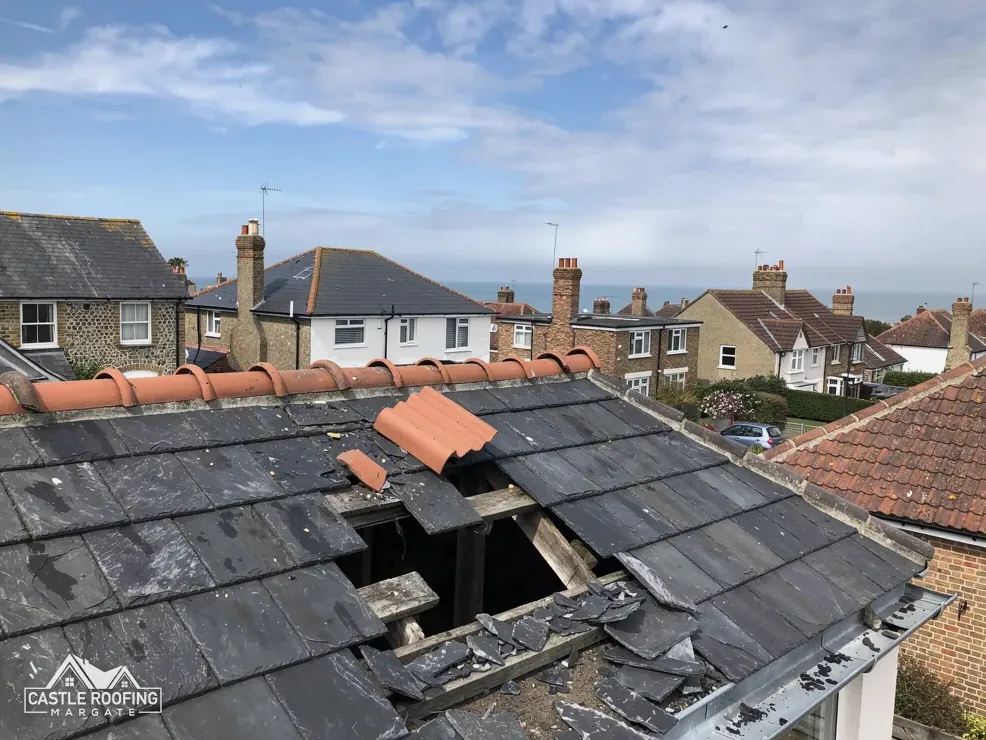
The first visit has one aim, which is to leave the roof in a state where the next rain does no more harm. That is a different job from repairing it. It is quick work, done with what can be carried up a ladder, and it is not meant to last.
Depending on the failure, a make-safe can include:
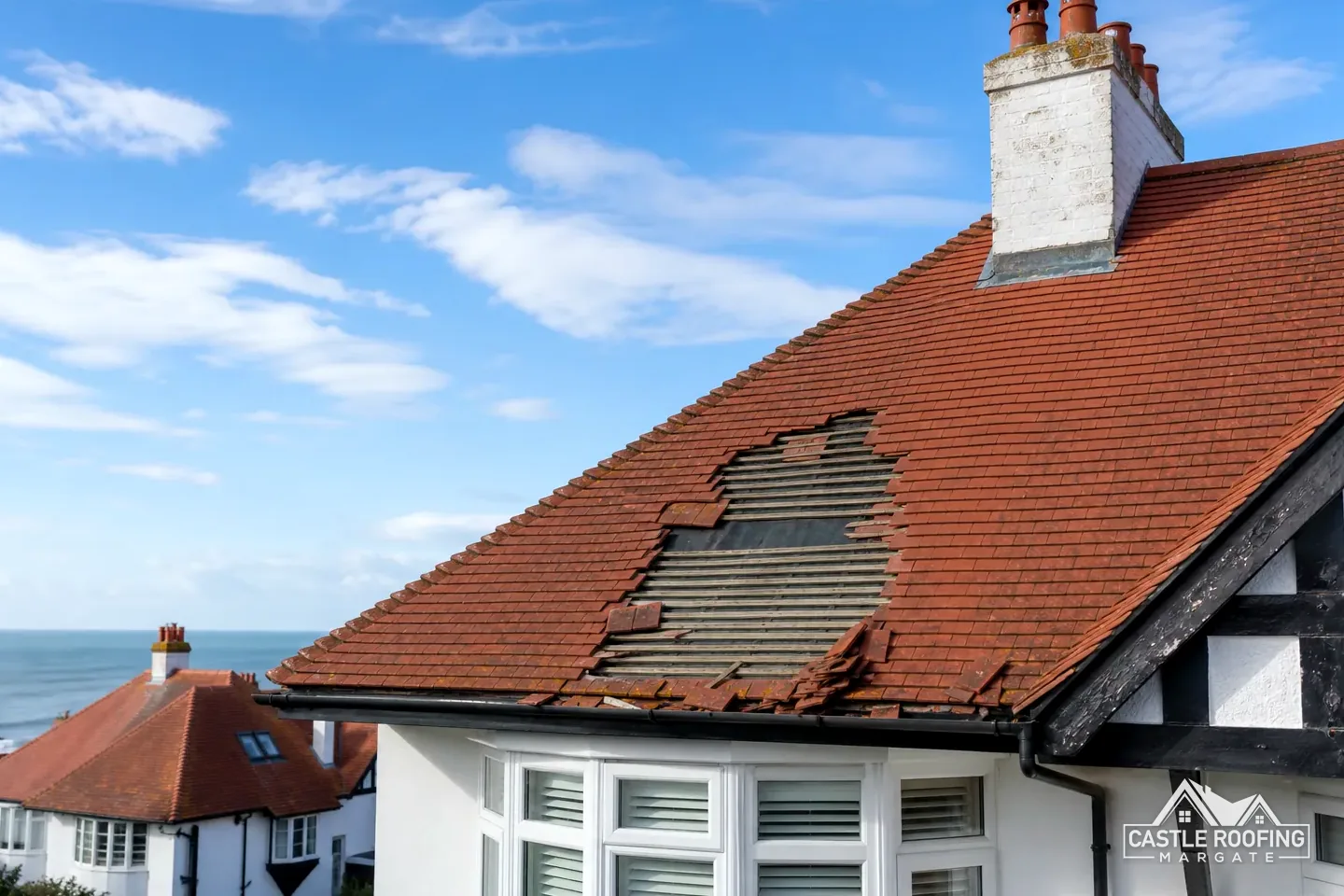
- refixing or removing slipped and loose tiles so they cannot fall onto a path or a street
- boarding over an open gap, or battening a heavy-duty sheet across a damaged slope
- clearing a blocked outlet or gutter that is sending water down a wall
- securing a loose ridge, flashing or chimney pot
- lifting any debris from a flat roof so water can reach the drain again
A flashing is lead shaped to seal the joint between a roof and a chimney stack or wall; the ridge is the capping at the apex, where the two slopes join. Both are places where trouble tends to show first.
On a flat roof the make-safe may be as plain as clearing the outlet and covering a split in the membrane with a temporary patch, so that rain runs away instead of standing on the weak spot until a proper repair can be planned, and you can see for yourself that the water has gone.
Afterwards you should be told, plainly, what was done and what was not. A sheet over a slope is a bandage. The roof underneath is still broken, and the make-safe is only part of the answer until the permanent repair has been surveyed and priced.
Finding out where the water is getting in
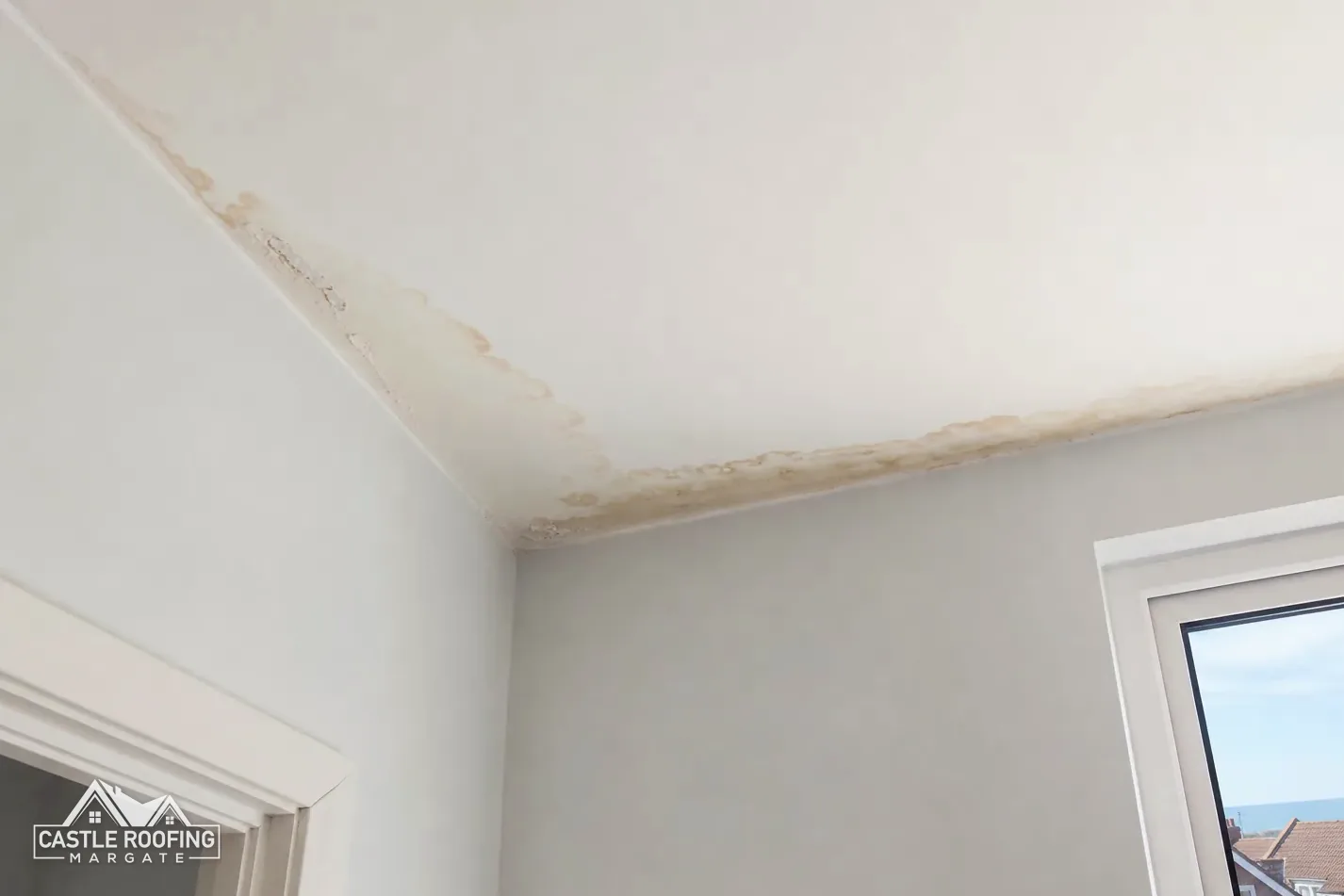
Once the immediate danger is dealt with, the survey starts. It looks at the damaged area from the roof, from the scaffold or ladder, and from inside the loft where the hatch allows. Water seldom comes in where the stain shows on the ceiling, because it runs along rafters and underlay before it drips.
The survey looks for:
- the point of entry, which may be a slipped tile, a split valley, a failed flashing or a cracked slab of render on a chimney
- how far the wet has spread through the insulation and the timbers
- whether the covering around the damage is sound or tired
- whether the problem is a one-off, such as a branch or a gale, or a covering that is simply worn out
Photographs are taken as the work goes on, and you receive them, so the fault is something you have seen, not only something you were told. They also serve your insurer, who will want evidence of the damage and the timing.
Our guide to finding the source of a roof leak walks through the tracing of a leak. Until the survey is done, nothing beyond the make-safe should go ahead without your agreement.
Where insulation lies across the joists, the survey lifts a corner to check whether it is wet underneath, because a damp patch there can be older than the storm that revealed it.
What an emergency call-out costs
The national guides give a picture, though they are third-party figures and not our prices. MyJobQuote, in October 2026, puts an emergency roofer's call-out at typically £150 to £300, and extensive storm damage at £1,200 or more. Which? Trusted Traders, in November 2025, gives a range for a few tiles, and adds that homes in London or the South East, Kent among them, are more likely to land at the dearer end.
| Job | Range | Source |
|---|---|---|
| Emergency roofer call-out | £150 to £300 | MyJobQuote, Oct 2026 |
| Storm repairs | start at around £300 | MyJobQuote, Oct 2026 |
| Extensive storm damage | £1,200 or more | MyJobQuote, Oct 2026 |
| One to six broken tiles | £75 to £400, ex VAT | Which? Trusted Traders, Nov 2025 |
| Average roof repair | around £650 in 2026 | MyJobQuote, Oct 2026 |
The gap between a make-safe and a repair is the reason to ask what the visit covers before it starts. Ask whether the figure is a call-out only or includes the work, and whether VAT is added. The same words can mean different things from different firms. A scaffold, a larger area or a hidden fault underneath will take a job out of the range, and those are priced once the roof has been seen, not guessed at over the phone. Our page on the roofer call-out charge explains the idea and its limits in more detail.
Your rights when you asked for an urgent visit
Consumer law treats an urgent call differently from a planned job, and it is worth knowing before you ring. The Consumer Contracts Regulations 2013 give you a 14-day cancellation period on any contract agreed somewhere other than the trader's own premises, and a quote accepted at your kitchen table after a survey counts as one. Regulation 28(1)(e) carves out one case: where you called the trader out yourself for urgent repairs or maintenance, cancellation rights fall away.
Citizens Advice describes the same exception as inviting the business into your home for urgent repairs or maintenance. In practice it works like this:
- an urgent repair you asked for carries no cooling-off right, so ask what you are agreeing to before work starts
- a permanent repair agreed after the survey normally carries the 14 days, counted by Citizens Advice from the day after the contract starts
- work may start inside that period only if you ask for it, and for an off-premises contract that request must be recorded in writing or another durable form
- a trader who never explained cancellation leaves the window open for up to 12 months longer
Whatever the route, section 49 of the Consumer Rights Act 2015 expects reasonable care and skill from whoever does the work. For general advice, the Citizens Advice consumer helpline is 0808 223 1133. We cover the cancellation side in cancelling an emergency roof repair.
Paperwork to ask for before the roofer leaves
An emergency is the moment when records get lost, and an insurer, a landlord or a buyer may ask for them months later. Before the roofer leaves, ask for these things in a form you can keep, such as emailed photos or a WhatsApp thread:
- Photographs of the damage as found, and of the make-safe once it was in place.
- A short written note of what was done and which parts of the roof were left untouched.
- The written total price for the permanent repair, if you are going ahead.
- A receipt for anything you paid on the day.
The insurer comes first on the telephone. Structural engineers advise telling the insurer, making the damage safe, and keeping photographs and receipts, since the photographs are the main evidence of what happened. The Financial Ombudsman links a storm to violent winds, which tend to bring rain, hail or snow, and notes that some insurers set a wind threshold; its helpline is 0800 023 4567.
Nobody can promise that an insurer will pay. A roofer's paperwork helps your case, and it cannot decide it. Treat anyone who offers a guaranteed outcome with suspicion.
For the permanent work, Citizens Advice recommends gathering at least 3 written quotes before you choose a trader. A make-safe buys you the time to do that, so use it. Ask who will take the old material away, too, because waste removal belongs to the job. You are not obliged to hand the permanent repair to whoever fitted the sheet.
When the roof itself is the danger
Some jobs stop at the make-safe because the roof cannot be worked on safely. High wind is the usual reason: a person on wet slate in a gust is a person at risk, and regulation 6(3) of the Work at Height Regulations 2005 makes the employer responsible for preventing a fall, to the extent that is reasonably practicable. A roofer who declines to go up in a gale is applying that duty, not avoiding the job.
Fragile roofs are the other. HSE guidance treats an asbestos cement roof as fragile in every case, and its rule is that a house built before 2000, or refurbished before then, should be treated as holding asbestos. Nobody should walk on such a roof, and cement sheeting that has broken needs careful handling by a competent firm. If the roof is fibre cement, tell the roofer before they go up.
Two more things can limit the first visit:
- a roof with no safe way on, where the make-safe needs a scaffold first, and a scaffold that sits on the public footway cannot go up until Kent County Council has issued its licence, which the scaffolder applies for on 5 working days' notice
- a flat roof under standing water, where the cause has to be found before any covering can be laid
In each case, the answer is to make the inside safe, move belongings out of the way of drips, and wait for the right conditions rather than rush work at height.