A roof that leaks only in heavy rain is telling you something specific. This guide explains how wind pushes water into places a calm shower never reaches, which details are the usual cause, and how to record the pattern for a roofer.
A roof can behave perfectly through light rain and then drip in a storm. That does not make the leak random, or mean the weather was simply too much for any roof. A leak that needs heavy or wind-driven rain to show itself has a reason, and the reason is a small gap that only a hard push of water can use.
Gentle rain falls straight down and runs off the covering. Driven rain arrives sideways, in gusts, and is forced up and in, under laps and behind flashings, in directions the roof was never meant to shed. Add a gutter that cannot carry the volume and water can back up under the lowest course.
This guide explains how that happens, which details give way first, and what to note down so a roofer can find the gap quickly. It belongs with our roof repairs and emergency work, where a pattern like this one is the best clue a survey can start from.
What driven rain does to a covering
Slates and tiles shed water by overlapping. Each course sits over the one below, and the amount it covers is the lap. The design relies on gravity to carry water down and over, so a lap only has to resist water that is travelling downhill.
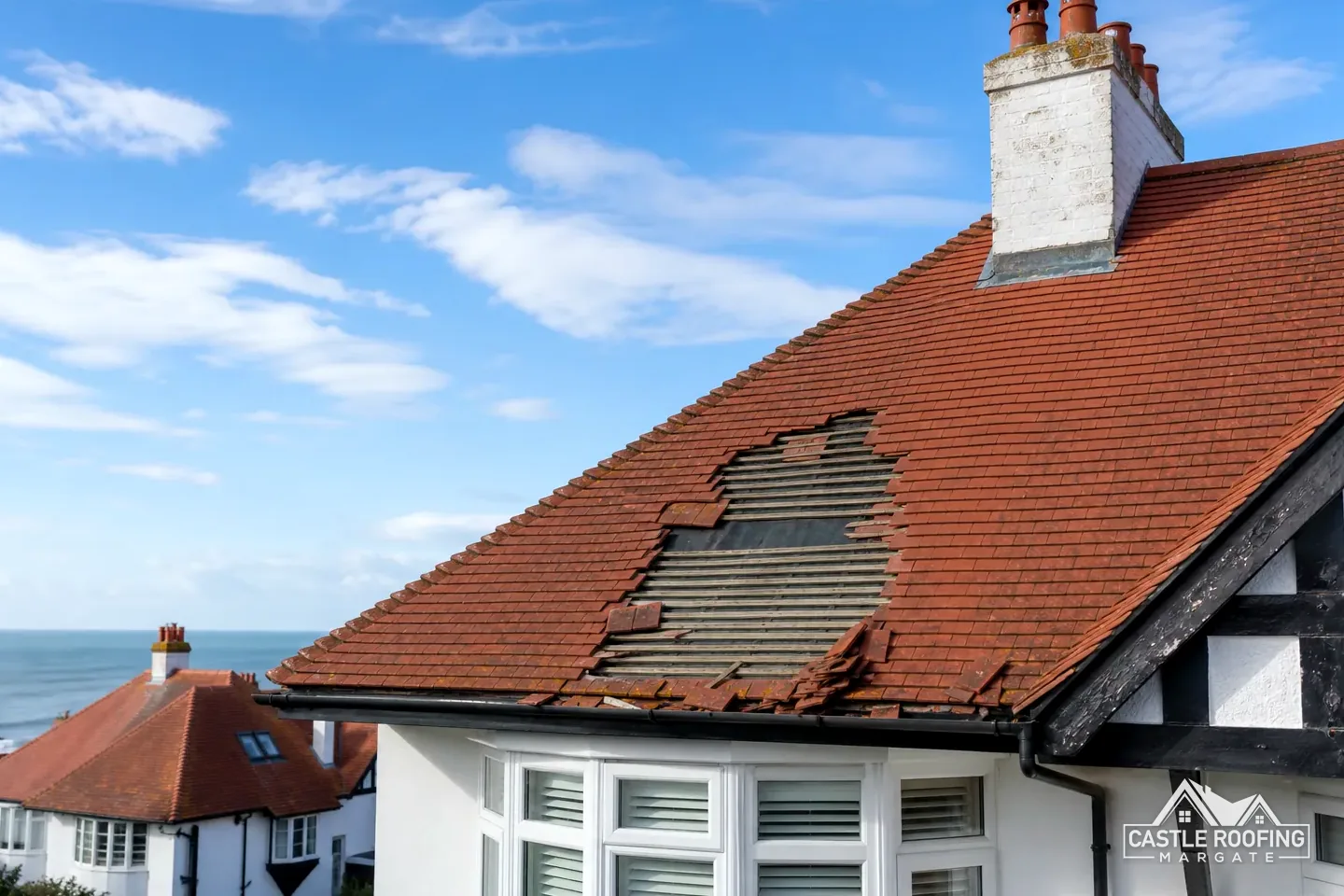
Wind changes that. A gust can push water up the slope, flick it sideways under the edge of a tile, or force a thin film through a gap that a still shower would never find. The harder the wind and the heavier the rain, the further the water travels against the slope.
The Met Office records give a sense of the conditions the roof lives with. At the Met Office's Manston climate station, 1991 to 2020 averages come to about 613 mm of rain a year over 110.05 days with 1 mm or more, with a 9.86 knot mean wind at 10 m. They are averages for Manston, not a figure for Margate, and a single hard storm can sit well above any average.
The point for a homeowner is simple:
- a roof sees many rain days over the year, and only some are windy
- a defect that needs wind behind the rain will show on those days alone
- the same gap that is dry for months can run for an hour in a gale
That is why the pattern of when a roof leaks is more useful than the stain. It tells the roofer which side of the house the weather comes from and which detail faces it.
Laps, pitches and the data sheet
How much a tile or slate overlaps the one below depends on the pitch of the roof. A steeper slope sheds water faster and needs less lap. A shallow slope needs more, and below a certain pitch a covering cannot be used at all, because water is not carried away quickly enough and wind can drive it in.
Each product has its own minimum, which is why the product data sheet is the thing to check. Marley lists a minimum pitch for each product, with the data sheet as the final word. A few examples from its list:
| Tile | Minimum pitch |
|---|---|
| Concrete Plain | 35° |
| Concrete Anglia | 25° |
| Concrete Double Roman | 22.5° |
| Concrete Mendip 12.5 | 12.5° |
For natural slate, Cupa says BS 5534 indicates a minimum pitch of 20 degrees for moderate exposure with a 500 mm slate and a 115 mm lap, and rules out hook fixings on any slope shallower than 25°. A longer lap or a smaller exposure can be needed in a more exposed place.
A roof that was laid at the right pitch for its tile can still go wrong. Extensions add a further risk: a lean-to, a dormer or a back addition may carry a covering at a lower pitch than the data sheet allows, and it will pass in a shower and fail in a gale. The first job on any such roof is to measure the pitch and read the sheet.
Flashings and the joints wind attacks
A flashing is a strip of metal, usually lead, set into a wall or a stack and dressed down over the covering. A pitched slope with no flashings is just a surface. The flashings are what make it a watertight roof, and they take the most punishment from wind.
Driven rain tests every upstand, which is any wall or stack that rises out of the slope. Water hits the face of the wall, runs down it and meets the flashing. If the flashing has lifted at an edge, split along a fold, or lost its seal into the brickwork, the water goes behind it. In a gentle shower only a little water reaches that joint, and the gap stays unnoticed.
Places to check when the leak follows a hard blow:
- the chimney, on the face that takes the weather
- the junction with a taller neighbour or a gable wall
- the verge, where the roof ends at a side wall
- the valleys, which gather the water from two slopes
- the ridge and hips, where wind lifts the capping
A drip that arrives only when the wind blows from one side points to the slope and the upstand facing it. The roofer will ask which way the wind was blowing, and a note of it made when the stain appeared beats a guess from memory later.
The same logic applies to a roof window. The seal around the frame and the flashing set into the covering are each a joint a gust can push water past. Our guide to roof leaks that only show when it is windy goes further on this.
When the gutter cannot keep up
Heavy rain puts a large volume of water onto a gutter in a short time. A gutter that is clear and level carries it away. A gutter that is blocked, sagging or too small spills over the front, or backs up and pushes water behind the first course at the eaves, onto the fascia and into the wall.
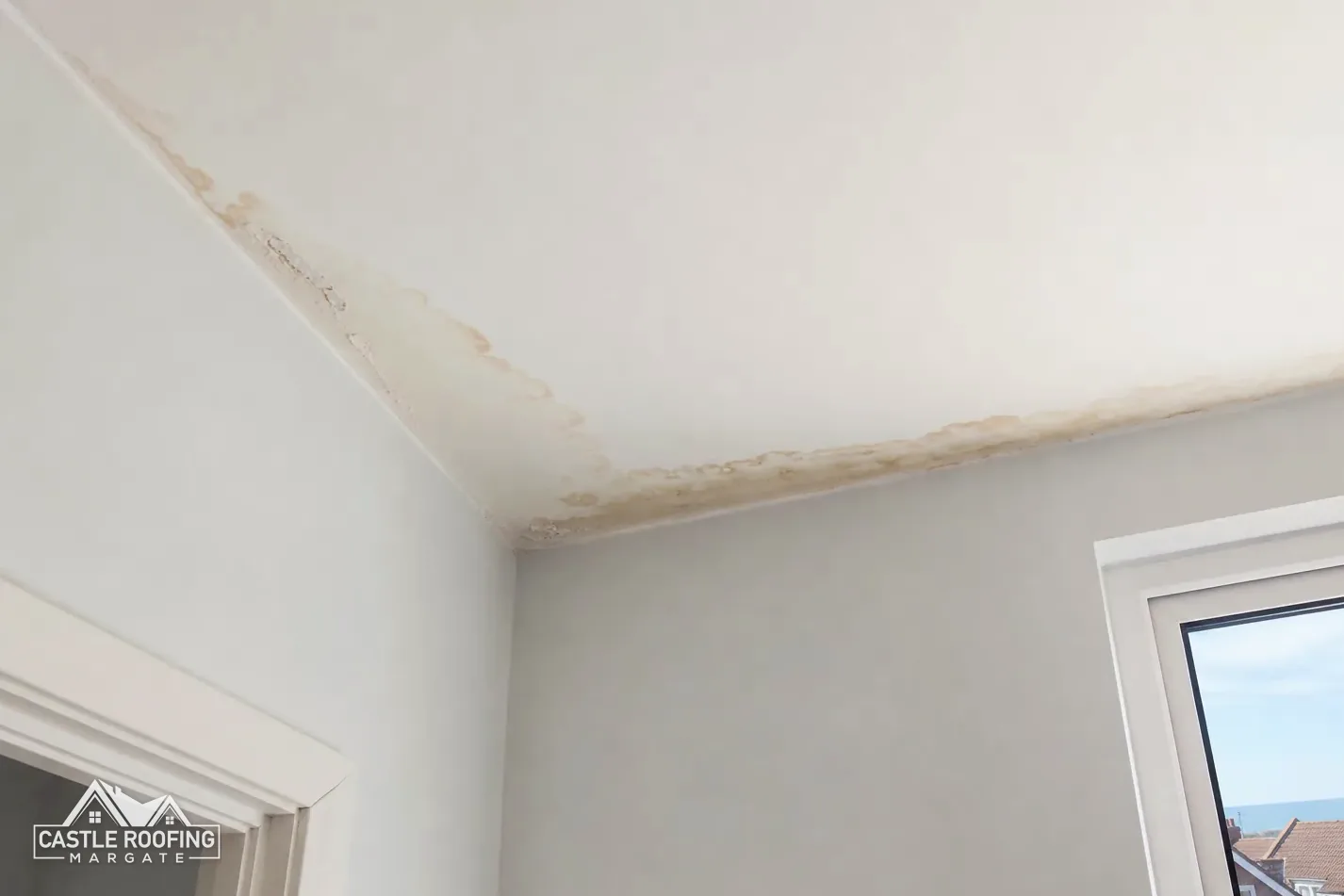
That kind of leak is easy to mistake for a roof fault. The stain appears on the ceiling along an outside wall, or the damp comes through the wall below the eaves. The covering may be sound, and the fault is the water backing up at the edge.
Causes to look for:
- leaves, moss and silt blocking an outlet or a downpipe
- a joint that has opened, so water drips behind the run
- a gutter that has dropped, so it holds water instead of carrying it
- a run too small for the roof area it serves
Brett Martin's installation guidance gives a fall of 1 mm for every 600 mm of gutter, a very gentle slope, which is why a small sag shows up as standing water.
The test is simple. Watch the gutters during a downpour from a safe position. Overflow at the joints or over the front lip shows a rainwater problem. If the gutters run clean and the water still comes in, the cause is higher up. Our guide to what happens if a roof leak is left explains why waiting costs more.
Small gaps that only open under load
Some leaks have no single obvious fault. They come from small defects that only open when the roof is under load from wind and water together.
Common examples:
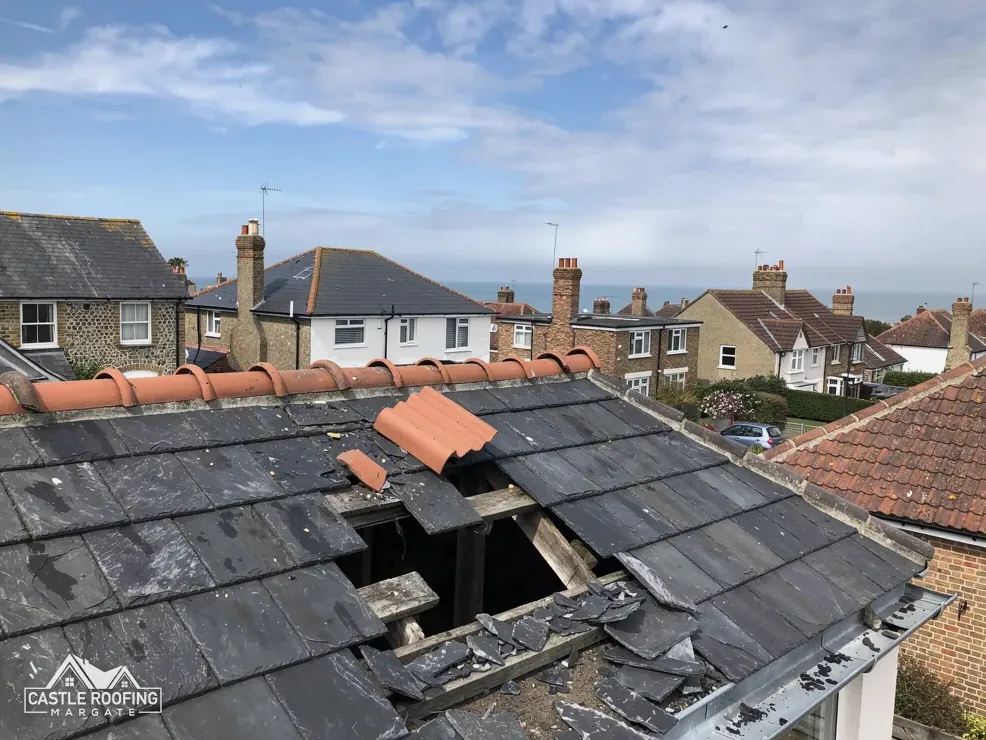
- a slipped slate or tile, shifted a little so the lap is open, which shows only when water is pushed up the slope
- a cracked tile whose crack is hairline, dry in a shower and weeping in a storm
- a nail hole or an old fixing that has worked loose
- a tear in the underlay, which is the second line of defence under the covering
- bedding that has cracked along a ridge or hip
Underlay is a membrane run over the rafters, under the battens, catching whatever the covering lets by and sending it to the gutter. When it is intact, a gap above it may never show at all. When it is torn, perished or lapped badly, water that would have been caught drips onto the timber and the ceiling instead. That is why a roof can be covered in sound tiles and still leak in a gale.
None of these can be confirmed from the ground. The roofer goes up, works along the covering course by course, and checks the underside from the loft where access allows. The photos show you what was found.
A small gap can mean a small repair. A new slate, a section of ridge re-bedded or a patch of underlay may be all it takes.
Recording the pattern for a roofer
You can help the diagnosis a good deal without leaving the house. A leak that appears only in heavy rain is easier to find when a roofer has a record of it, because the roofer cannot summon a storm to order.
Notes worth keeping each time it happens:
- The date, and roughly how long the rain had been falling.
- Which way the wind blew, if you can tell which side of the house took the rain.
- The position of the stain or drip, with a photo from the same spot each time.
- Whether the gutters overflowed.
- How long the stain took to dry afterwards.
A bucket under a drip is sensible while you wait. So is moving furniture and lifting the carpet back. Do not poke a swollen ceiling, as water may be held behind the plaster. If it bulges, keep everyone out from under it until a roofer has seen it.
If your home insurance covers storm damage, tell your insurer first, take photos and keep receipts. The Financial Ombudsman says that rain by itself can constitute a storm, and some insurers apply a wind threshold, so read your policy's own storm definition. MyJobQuote puts storm repairs at around £300 and up (October 2026), with extensive storm damage at £1,200 or more.
A survey of the roof itself sets the price, and your notes are the best place for it to begin.