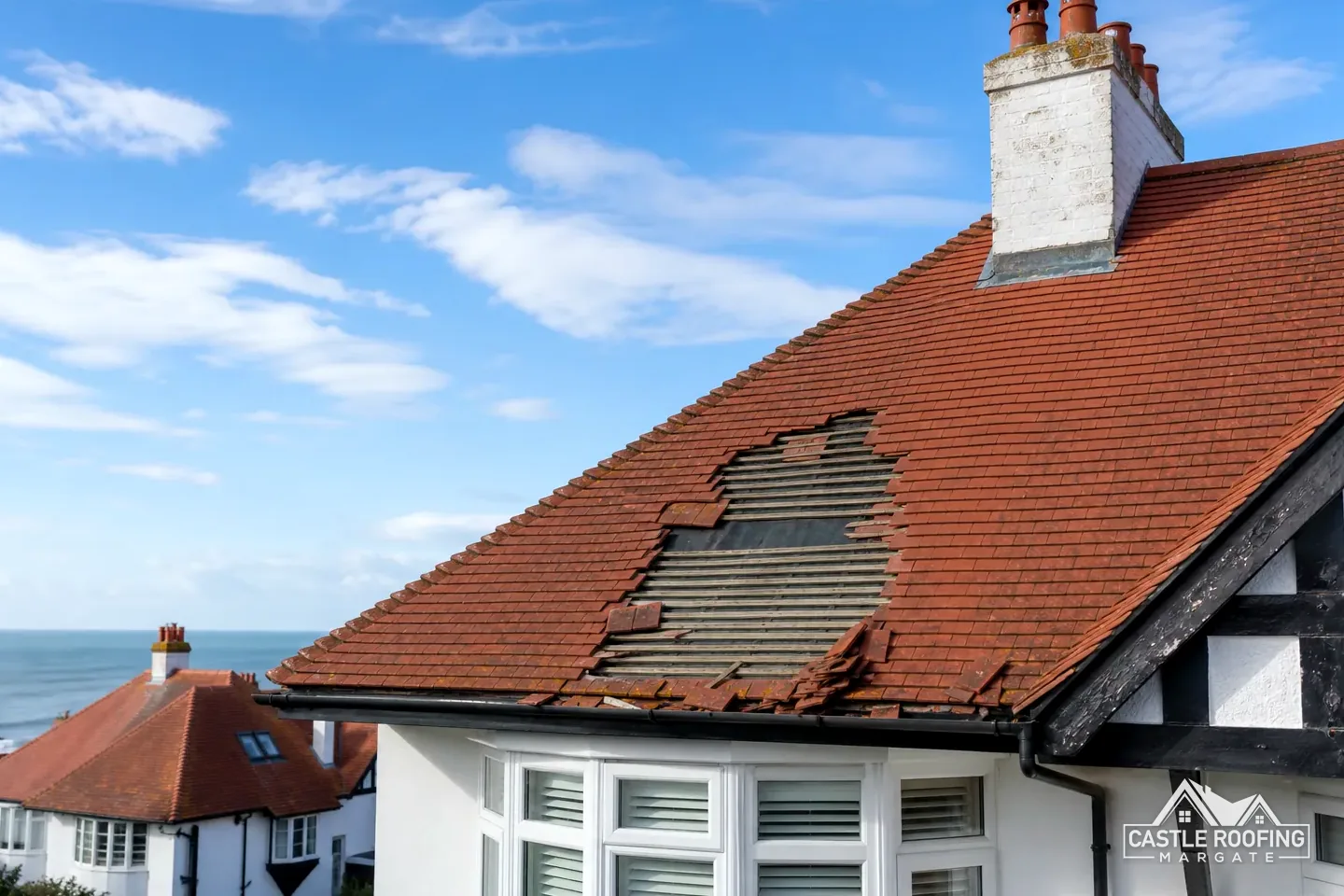
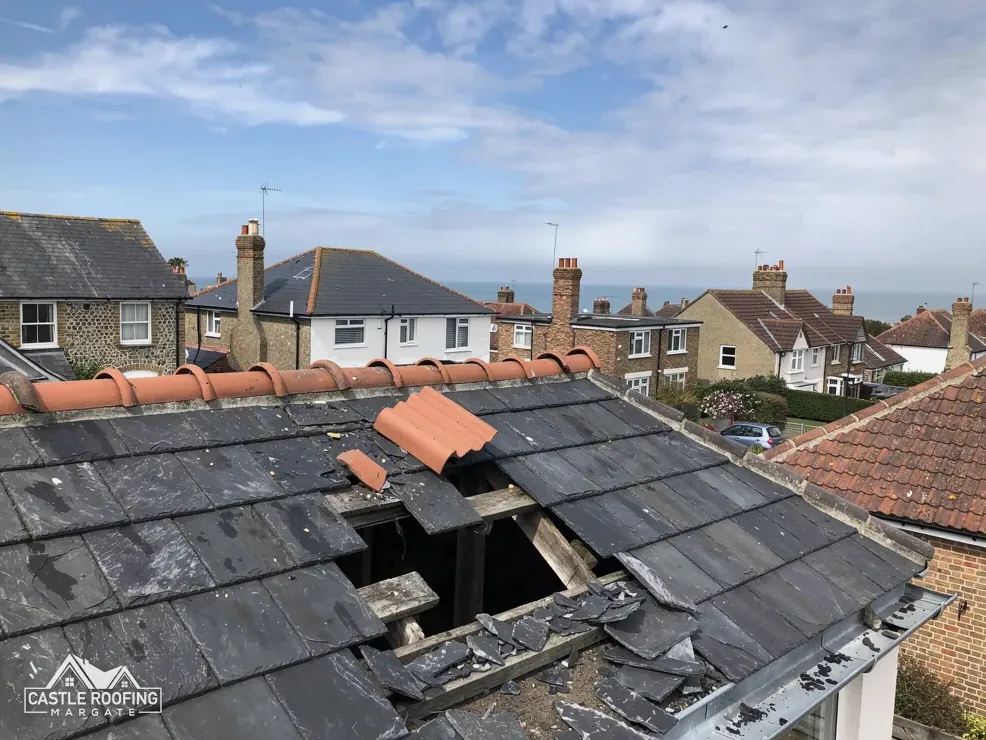
Older houses need repairs that match the roof they have. This guide covers what Thanet's own conservation area appraisals say about roofs in two parts of Cliftonville, the details that fail on older roofs, and the consent questions to ask first.
A repair on a house built a century or more ago is a different job from one on a recent roof. The covering was laid by hand, the timbers are old, the lead was dressed to suit that one building, and the street may be protected. A repair that ignores any of this can look wrong from the pavement, or break a rule that the owner did not know existed.
The aim on an older roof is a repair that matches. That means the same material, the same size and colour of slate or tile, and the same way of laying it, so the repaired section reads as part of the whole. It does not mean replacing the whole roof because one part has failed, and it does not mean patching with whatever is to hand.
This guide covers matching, the details that need special care on a period roof, and the consent questions that arise in a conservation area or on a listed building. It sits within our roof repairs and emergency work, and it points to the council for anything the council decides.
What Thanet's appraisals say about two roofs
Thanet District Council has issued conservation area appraisals, and two of them, both in Cliftonville, describe the roofs there.
Thanet's appraisal of the Clifftop area in Cliftonville describes a varied mix of roofing, with clay tiles in red and natural slate side by side, and says tall chimney stacks remain in many spots. The Northdown Road appraisal describes slated or tiled roofs that are often hidden from the street by parapets, with some covered in fishscale slates.
| Area | Roof details noted |
|---|---|
| Cliftonville Clifftop | Red clay tiles, natural slate, tall chimney stacks |
| Northdown Road | Slate or tile, parapets, fishscale slates |
Thanet's conservation area table gives 20 October 2016 as the designation date for both. The point for a repair is that even inside one small area the roofs differ: a street can hold a slate roof next to a tiled one, and a parapet roof next to an open eaves. Your own roof is the thing to match, and the only way to know what it is made of is to look at it.
A fishscale slate is a small slate with a rounded or pointed tail, laid in a pattern that resembles scales. It is a decorative covering, and a repair should use slates of the same shape and size. Plain rectangular slates in their place leave a visible patch, one that can be seen from the street below.
Repairs that match, not repairs that merely fit
A repair that matches has four things in common with the roof around it: the material, the size, the colour and the laying pattern. Getting three right and one wrong still shows.
What this looks like in practice:
- Slate is replaced with slate of the same type and size, and where possible the same weathering. Salvaged slates from the same roof can be used for the patch, with new ones set in less visible spots.
- Clay tiles are matched for colour, texture and curve. Modern tiles of a similar shade often differ in profile and sit proud of the old ones.
- Lead is replaced with lead, not with a bitumen strip or a smear of sealant, which looks wrong and fails sooner.
- Ridge and hip tiles match the profile of the originals.
A repair that is nearly right is still a visible repair. If a slope of slate carries a patch of different tiles from an earlier job, the survey should record that, and say whether the patch is worth putting right when the roof is next opened.
The temptation on an older house is to cover a failing slope in a different material because the original is hard to source. That changes the look, and it can change the weight on the old timbers. Under the Planning Portal's test, approval is required for a covering 15 per cent or more heavier, so the weight of a replacement is a real question, not a detail.
Lifespans are ranges. HomeBuilding gives "100+ years" for Welsh slate and "60-80 years" for clay tile. The roof in front of you may be inside or outside them.
Parapets, valleys and the lead behind them
A parapet is a low wall that rises above the edge of the roof, and on some houses it hides the slope behind. The Northdown Road appraisal notes roofs concealed by parapets from the street. Behind the parapet there is often a lead-lined gutter that carries water to an outlet at one end, and it is out of sight, which is why it gets forgotten until a stain appears in the front room.
Parapet gutters are a repair job for lead, and lead is covered in the Royston Lead table by codes that run from Code 3 at 1.32 mm to Code 8 at 3.55 mm. The specification fixes the code for each detail, with Code 3 recommended for soakers only. Lead follows BS 6915 via Approved Document C, and HomeBuilding gives a typical life of 60 to 100 years for lead flat roofs. MyJobQuote's figure for lead flashing is over 80 years, a floor, not a forecast.
Things that fail on a parapet roof:
- the lead at the wall junction lifts or cracks where it has moved with the weather
- the outlet is blocked by leaves and debris, and the gutter fills
- the stone or render coping above lets water into the wall behind the lead
- the fall in the gutter has settled, so water pools in it
Valleys between two slopes and the soakers at a party wall are the same family of detail. Soakers are small lead sheets tucked beneath slates at a wall abutment. On an older house the lead was worked to fit that wall, and the repair should be too.
Tall chimney stacks
The Clifftop appraisal's tall chimney stacks are a feature, and they are also where an older roof meets the weather head-on. A stack sits proud of the roof, so it is exposed on every face. The pointing weathers, the flaunching cracks, the lead round the base lifts, and the pots can loosen.
On a period house the stack may be shared with the house next door. A stack that stands on a party wall serves two owners, and work to it raises the question of who does what. Party wall questions go to a party wall surveyor, not to building control, and the Party Wall Act asks for two months' notice for work to a chimney breast on a party wall unless the adjoining owner agrees to it in writing. Our guide to repairing part of a roof covers where a repair stops.
The checks at the base of a period stack:
- Pointing: gaps and crumbling mortar between the bricks.
- Flaunching: the mortar bed round the pots, checked for cracks.
- Step flashings: the lead stepped into the brick on the slope, and the back gutter behind the stack.
- Lean: a stack that leans needs a structural opinion before any repair.
Repointing should use a mortar chosen to suit the brick, set by a roofer who has looked at the stack up close. The price follows an inspection, since it cannot be set from the ground.
Conservation areas, listing and who decides
Before work on an older house, check whether it carries a listing or lies inside a conservation area. The answer changes the route, though not always the work.
| Situation | What to check |
|---|---|
| Ordinary house | Class C permitted development normally covers re-roofing |
| Conservation area | Ask the council whether an Article 4 direction applies |
| Listed house | Listed building consent, where the work affects its character |
| Flat | No permitted development rights; planning permission may be needed |
Thanet lists 27 conservation areas, and its conservation page suggests that a repair matching what is there stands a reduced chance of requiring planning permission. That is guidance, not a ruling on your house. Article 4 directions on Thanet's list cover three conservation areas, Pegwell first, then Ramsgate and its Marina extension, and the council is who to ask about what they cover.
A listed house keeps its permitted development rights, yet it also needs listed building consent for works touching its character (Listed Buildings Act 1990, section 7). Canterbury City Council's wording is that you will need listed building consent for any changes which affect the building's character. Swapping to a different material may be such a change. A like-for-like repair may not be, and the conservation officer is the person to ask.
If a church or a monument is involved, different systems apply. Take the question to the council before the scaffold goes up.
Surveying an older roof before it is priced
An older roof is surveyed before it is priced, and the survey does more than on a recent one. The surveyor climbs up to look over the slates or tiles and the metalwork, then checks the roof from beneath in the loft where access is safe. You are sent photographs of the roof itself, so the decision rests on what is really up there.
What the survey records on a period roof:
- the covering, its type and size, and whether sound pieces can be saved for the repair
- earlier repairs, and whether they match
- the state of the timbers, including old rot and woodworm marks
- the lead: what it is, what shape it is in and what it protects
- the stacks, pots, parapets and any decorative ridge or finials
Then comes the advice. Repair wins when the defects are local and the roof around them is sound. Replacement is the right call when the covering has failed across a slope. Advice on an older house should always say what a repair would leave behind, so you can weigh it.
Kent County Council licenses scaffold that stands on the pavement, and the scaffolding firm applies on your behalf. The fee is £52 per week for 2026 to 2027. Notice is 5 working days. A terraced front that opens onto the street is the usual case.
Last comes a single price in writing, fixed once the survey is finished, with the consent route named in it.