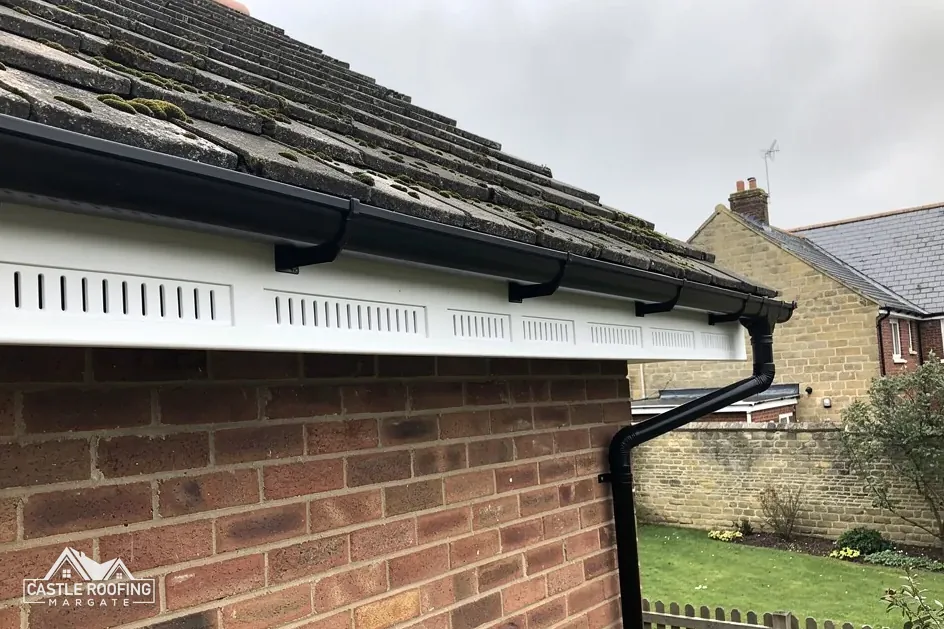
Listen first: which sound means what
The noise is a clue, and it helps to match it to a place before anyone reaches for a ladder.
| Sound | Likely cause | Look at |
|---|---|---|
| Slow drip, hours after rain | Water held in the run | Fall and sag |
| Drip from one spot | A joint or stop end | The seal |
| Tapping on a downpipe | Water dropping from the outlet | Outlet and bend |
| Ticking when the sun comes out | Movement with temperature | Brackets |
The last of those is harmless on its own. A gutter is a long strip of material, and it moves a little as it warms and cools. A tick or a creak in the morning sun is not a fault, but a rattle in the wind means a bracket has loosened and the run is no longer held firmly.
A drip that goes on well after the rain has stopped is the one to take seriously. It means water is lying somewhere, and standing water is what shortens the life of a gutter.
Fall: why a few millimetres matter
A gutter has to tilt gently towards its outlet, so water runs off rather than lingering. Brett Martin, the guttering maker, says to lay a fall of "1mm for every 600mm". On a 6 metre run that is a 10mm drop from the high end to the outlet, barely visible to the eye and easy to lose.
It is lost in several ways. A bracket pulls free or a screw loosens in a soft fascia, and the channel drops at that point. Weight from leaves, moss or wet debris pulls the run down between brackets. Or the board it hangs from has moved, because the timber has rotted behind the fixings.
Once the fall is flat, or reverses, water collects in the dip and drips from the nearest joint or lip long after the rain has gone. The dip also fills with silt, which holds more water, and the problem builds.
Our short guide to gutter fall explains how a fall is set and checked, and the note on a sagging gutter covers the repair.
Joints, outlets and the drip you can trace
Where a drip comes from one point, look at what is there. Gutter sections meet at a seal or a clip, and the seal can perish or work loose with age and movement. A stop end that has lost its seal will do the same. Our guide to repairing leaking gutter joints covers the repair.
Tapping that comes from the outlet is a different matter. If the outlet or the first stretch of downpipe is partly blocked, water backs up and falls in drips rather than a steady flow. A bend choked with leaf debris can also make the downpipe knock, and a downpipe that has pulled away from its clips will rattle in the wind.
You can find the source with a hosepipe, with a second person watching. Run water into the high end and follow it along the run. Where it hesitates, spills or drips, you have the spot.
Do not hang off the gutter for the test, and leave the upper runs to someone with proper access, because a gutter will not take a person's weight and a fall from height is serious. Cleaning from a ladder has its own limits, which our note on doing it yourself safely sets out.
Fixes, in the order worth trying
Start with the simplest and least invasive step, and move on only when it has not worked.
- Clear the run and the outlet of leaves, silt and moss, then watch it in the next shower.
- Tighten or replace loose brackets and screws, and refit any clip that has come away.
- Reseal a leaking joint or replace a perished stop end.
- Reset the fall by rehanging the run on firm brackets at the right spacing.
- Replace a failed section, or the whole run, if the channel itself has split or warped.
If the board behind the gutter is soft, none of this will hold, because the fixings have nothing to bite into. Fix the board first.
A roofer can often do steps one to three in a single visit and tell you whether the rest is needed. You are given one total for the job in writing before anything starts, and it is worked out from what the survey finds rather than from a list of guesses.
For the wider picture, guttering, soffits and fascias is the place to begin.