Find the right consent route for your roof before any scaffold goes up. It covers listed houses, like-for-like repairs, churches and chapels by denomination, the Canterbury World Heritage Site and scheduled monuments.
A listed roof is not one that cannot be touched. Slates slip, lead splits and ridges crack on a listed house just as they do on any other, and somebody has to mend them. What changes is the paperwork. The question that decides it is whether the work affects the building's character, and that is a question for the council, not for the roofer or the owner.
This guide sorts the routes out by building. A listed house is handled one way. A church in use is handled another way, and it depends on the denomination. A scheduled monument has its own system again. East Kent has all of them within a few miles of each other: houses in Thanet's seaside towns, the cathedral city of Canterbury with its World Heritage Site, and village churches across Dover and Swale.
Getting the route right costs a phone call. Getting it wrong can mean work stopped halfway, so the first job on any listed roof is to establish who has to say yes, and in what order, before a quote is accepted.
A listed house keeps permitted development and adds consent
Listing does not switch off permitted development for a house. Class C is the general class for roof alterations to a dwellinghouse, and re-roofing sits inside it. Neither Class C nor Class B, the dormer class, contains an exclusion for listed buildings, so a listed house keeps both on paper.
What listing adds is a second layer. Section 7 of the Planning (Listed Buildings and Conservation Areas) Act 1990 bars any alteration that would affect a listed building's character as one of special interest, unless the work has been authorised. Canterbury City Council's guidance is the same in plain words: changes that touch the building's character need listed building consent.
So two separate questions apply to a listed roof:
- Does permitted development cover the work? If it does, planning permission is not needed.
- Does the work touch the building's character? If it does, listed building consent is needed anyway.
Passing the first does not answer the second. A re-roof can be permitted development and still need consent because of what it does to the way the building looks and is built.
Settle the consent question before a quote is accepted, and expect the roofer to say who they would ask. Our guide to planning permission for roof work explains the planning half, and the two together decide the order of events.
Flats are different again. Canterbury City Council says a flat has no permitted development rights of its own, so a flat in a listed building needs a planning application as well as the consent wherever the work alters how the flat looks from outside.
Reading the roof you have before changing a thing
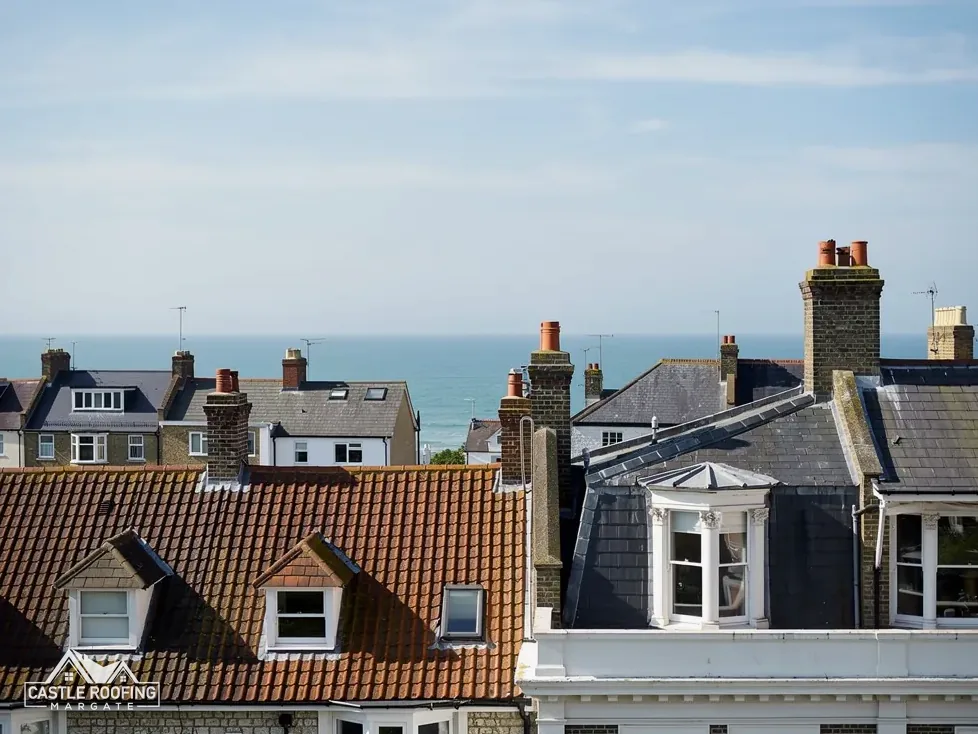
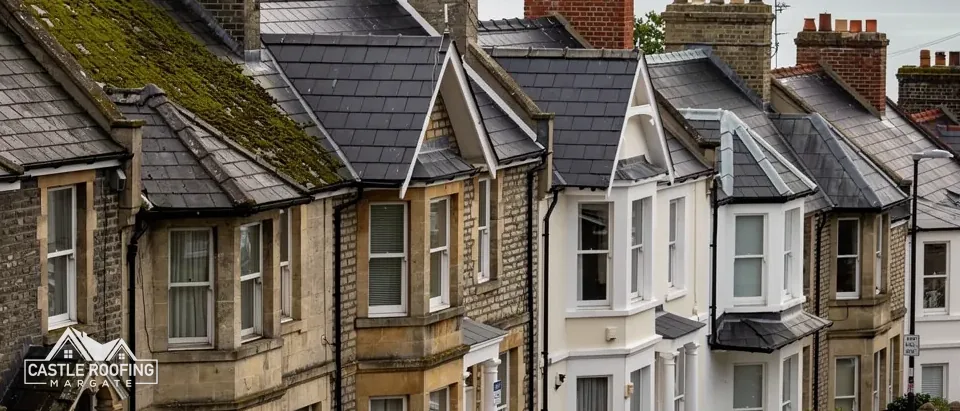
Whether a repair affects character turns on what is on the roof now, so the survey starts by recording it. Thanet District Council's conservation area appraisals show how varied the local covering can be. Its Cliftonville Clifftop appraisal calls the roof materials quite mixed, red clay tile alongside natural slate, and tall chimney stacks still standing in numerous places. The Northdown Road appraisal describes slate and tile, frequently screened from the street by parapets, with fishscale slating in places.
Those are descriptions of two conservation areas, not a rule for your house. They explain why a surveyor writes down the details before proposing anything:
- the covering, its size and its pattern, including any fishscale or decorative courses
- the ridge and hip details, and the verges
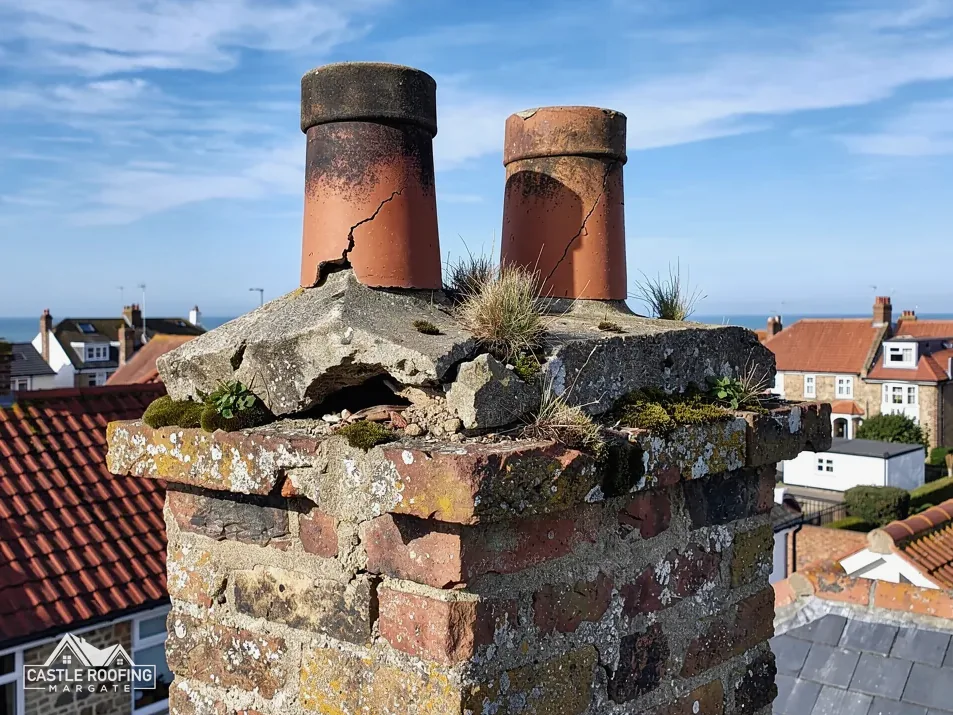
- the chimney stacks, pots and flaunching
- the lead at valleys, parapets, stacks and abutments
- the gutters and downpipes, and what they are made of
Photographs of each item give the council something to assess and give you a record of what was there. Where a change is proposed, such as a different material or a new ridge system, that record shows exactly what is being altered.
Lead has its own place in the survey. The Royston Lead brochure lists most work on historic or listed buildings among the uses of sheet lead, and which lead code suits each detail is a specification decision, never a rule of thumb.
Chimneys deserve the same care. A stack, its pots and the lead around its base are all part of the roof's character, so each one is photographed before any repair is proposed.
Like for like, and who decides what it means
It is easy to hear the phrase "like for like" and take it as permission. It is a description of the work, and the council decides what it means for your building. On its conservation area page, Thanet District Council links a like-for-like job with a lower likelihood of needing planning permission. That is a statement about likelihood, and it concerns conservation areas, not listed buildings.
For a listed roof, a sound approach is to describe the repair in terms the council can answer:
- which slates, tiles, lead or timber are being replaced, and in what quantity
- what the replacements are made of, and where they come from
- whether sound original material is being kept and reused
- whether any part of the structure under the covering is being altered
Reuse is worth raising early. A natural slate can outlast the nails and battens that hold it, so sound slates are often worth saving. HomeBuilding gives a typical life of 50 to 80 years for reclaimed Welsh slate, a range that describes the material and not any particular roof.
Replacing a failed covering across a whole slope is a different conversation from patching, and the council needs to know which one you mean. A quote that does not distinguish the two leaves you exposed if the council later disagrees.
Ask for the council's answer in writing, and keep it with your survey photos. Both belong in the house file.
Where the answer is yes, the consent should be in place before the strip starts, and the date it was granted belongs on the paperwork you are given at the end.
Churches and chapels: which system applies
A church can be listed, but the route for work on its roof does not run through the council in the same way. The reason is the ecclesiastical exemption. Section 60 of the 1990 Act lifts the usual listed building controls from an ecclesiastical building while it is in ecclesiastical use. A 2010 order limits that exemption to named denominations, and DCMS guidance says no other faiths currently benefit from it.
| Building | Consent route |
|---|---|
| Church of England, in use | Faculty |
| Cathedral | Care of Cathedrals Measure |
| Roman Catholic, Methodist, URC, Baptist | The denomination's own system |
| Unitarian or Quaker meeting house | Listed building consent |
| Churches Conservation Trust property | Listed building consent |
Canterbury Cathedral shows the Measure at work. The Care of Cathedrals Measure 1990, amended in 2005, governs most of the precincts, and the Cathedral building itself carries a matching exemption from listed building consent.
For a Church of England parish church still used for worship, whether in Thanet, Swale or Dover, the roof work needs a faculty. A meeting house of the Quakers or the Unitarians goes to the council, and so does anything held by the Churches Conservation Trust. Check which applies before the scaffold is booked, because the paperwork and the lead time differ. Ask the body that holds the building, or the council, which route applies, and get the answer in writing. Our page on church roof repairs and consent goes into the process.
Canterbury's World Heritage Site and scheduled monuments
Canterbury is the one place in our area where a roof can sit inside a World Heritage Site. The Site has three parts. Along with the Cathedral there is St Augustine's Abbey and St Martin's Church. UNESCO inscribed it in 1988 and joined the parts by a buffer zone. It is not general housing.
The Site matters for planning. Under Schedule 1 of the General Permitted Development Order, a World Heritage Site is article 2(3) land, and article 2(3) land removes the Class B right to add a dormer. Class C, the right to alter a house roof, has no article 2(3) exclusion. The Order says nothing about the buffer zone.
The same article 2(3) rule reaches two other kinds of land:
- conservation areas, including those in Margate, Cliftonville, Broadstairs, Ramsgate and Canterbury
- land inside the Kent Downs National Landscape, designated as an Area of Outstanding Natural Beauty
On a listed house inside any of those, the dormer right is gone and the consent question remains.
A scheduled monument is a separate category. Unauthorised works to one are an offence under section 2 of the 1979 Act on ancient monuments and archaeological areas, and the authorisation takes the form of scheduled monument consent. Where a monument is also a roofed building, that consent applies alongside any other route.
If you are unsure whether your building is listed, scheduled or inside the Site boundary, find out before you ask for quotes. The answer changes who you must ask and in what order.
Conservation areas, Article 4 and who to ring
A listed building can also sit in a conservation area, and each council publishes its own picture. Thanet counts 27 conservation areas, Canterbury 97, Dover 57 and Swale 51. Folkestone & Hythe gives no count on its page and points owners to its interactive map.
Article 4 directions can withdraw permitted development in an area. The ones that touch roofs are specific:
- Thanet's Article 4 directions cover three conservation areas, namely Ramsgate, its Marina extension and Pegwell. The classes are not stated per address, so check with Thanet District Council.
- In Faversham, Swale's direction reaches the roof coverings of main elevations facing a public highway.
- Dover's directions may cover a roof alteration where any face of the dwelling looks out on a road, open public space or a waterway, so a listed corner house deserves a check.
For Canterbury and Folkestone & Hythe, check whether a direction applies with the council itself, and ask what it covers before you plan any alteration. None of this replaces the survey, which tells you which of these cases fits your address. Our short guide to finding out whether your house is in a conservation area shows where to look.
On a listed roof we survey first and send photos of your own roof, then name the consent route in the same breath as the repair. Our roofing across Thanet and East Kent starts with that survey, and one written total price follows it, so the paperwork is clear before any money moves.