Three, and why that number
The advice comes from Citizens Advice, which recommends obtaining at least 3 written quotes from separate traders before you commit to one. It says at least, so more is fine, but the rest of this page gives a reason to stop at three or four.
One quote tells you nothing about whether the price is high, low or right. Two give you a difference but no way of saying which one is the odd one out. Three let you see a pattern, and a quote that sits well apart from the other two is a quote to question, whichever way it sits.
Do not let the written part slide. A figure said at the door cannot be compared with anything, and it cannot be pointed to later. A written quote from a trader who has looked at the roof is the thing to collect.
Treat the first quote as the start of the comparison, not a deadline, and do not decide on the day it is handed over. Ask each trader how long the figure stays open, and note the date of the survey. Material prices move, and a quote that is silent on how long it lasts is harder to set beside one that gives a date.
Compare what each one covers
Quotes only compare if they describe the same job. Two prices for different amounts of work are not a comparison, and the cheaper one may simply be doing less. Before you look at the totals, lay the descriptions side by side:
- Which slopes, and whether the ridge, hips, verges and flashings are included.
- The covering: type, make where named, and what happens to the underlay and battens.
- Whether the scaffold is included, and who applies to Kent County Council for it.
- VAT: is it in the figure, at the standard rate of 20%?
- Waste: whether the old covering is taken away.
Write the same short brief for every firm and ask the same questions in the same order. That keeps the answers comparable, and it shows quickly which firm has understood the roof and which has skimmed it.
Then compare the one total at the bottom of each. That is the price you would pay, and it is the only number that can be set against another.
Push back on any quote that cannot say what it covers.
When the totals differ widely
For a whole roof, even the published guides sit far apart. The table gives two for the same kind of job, each with its source.
| Source | Job | Range |
|---|---|---|
| Which? Trusted Traders, Nov 2025 | Whole roof, average three-bedroom house | £7,000 to £21,000 ex VAT |
| HomeBuilding, Sep 2025 | 3-bed semi, 65 m², plain concrete tiles | £10,000 to £15,000 |
These are national figures, not a Kent price. Both publishers put London and the South East at the dearer end, and Kent sits inside the South East, so expect local quotes toward the upper end.
A fourth quote earns its place when two of the first three sit far apart. Ask the extra firm to explain in writing why the job is bigger or smaller than the others think.
When two local quotes differ, check first that they describe the same work. A re-roof and a repair are not the same job, and a roofer who finds that a repair is the better buy should say so in writing.
Why a quote needs a survey first
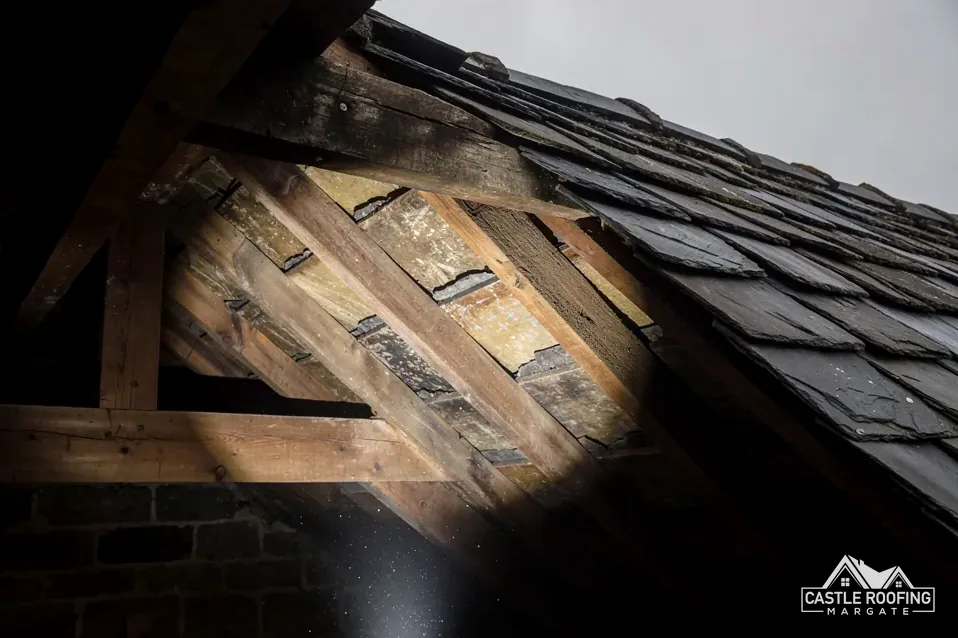
A trader who gives you a price without looking at the roof is guessing. The condition of the battens, the state of the lead and the number of slipped tiles are only known once someone has been up there, or looked at close photographs.
That is the order we follow around Margate and Thanet: a proper look at the roof, photographs of your own slopes sent to you, and then a single figure, in writing.
Be wary of any firm that presses you to decide on the spot or says the price is only good today. A quote given after a proper survey does not need a countdown. Keep the quotes together with your notes of what was said. If a firm changes its figure after a second visit, keep both versions, so you can see what moved and ask why.
For the questions to ask when you read them, see what a written roofing quote should include, the checklist for choosing a roofer in Kent, and our cost guide for Margate.