A decision table covering age, slipped units, underlay, nail fatigue and leaks, then typical UK repair and replacement costs from named guides, and the questions that settle it for your own roof.
A stain on the landing ceiling, a tile in the front garden after a gale, a slate that has crept down by an inch: each one raises the same worry. Is this a repair, or the start of a new roof? The two answers sit a long way apart on price, and the wrong choice in either direction is expensive. Patching a roof that is failing everywhere buys a season or two. Replacing a roof that had one bad flashing spends several thousand pounds on a problem a few hundred would have fixed.
What separates the two cases is rarely the size of the leak. What counts is whether one spot has failed or the whole covering, and the layers under it, are wearing out together. A roofer tells the difference by looking, not by guessing from the ground, which is why a roof gets inspected before anything is priced and why you should see photographs of your own slopes.
Below is a table you can hold against your own roof, the typical costs published by national guides, and the order in which the questions are usually settled. If you want the bigger picture on new coverings, our roof replacement page covers it.
The one question a survey is really asking
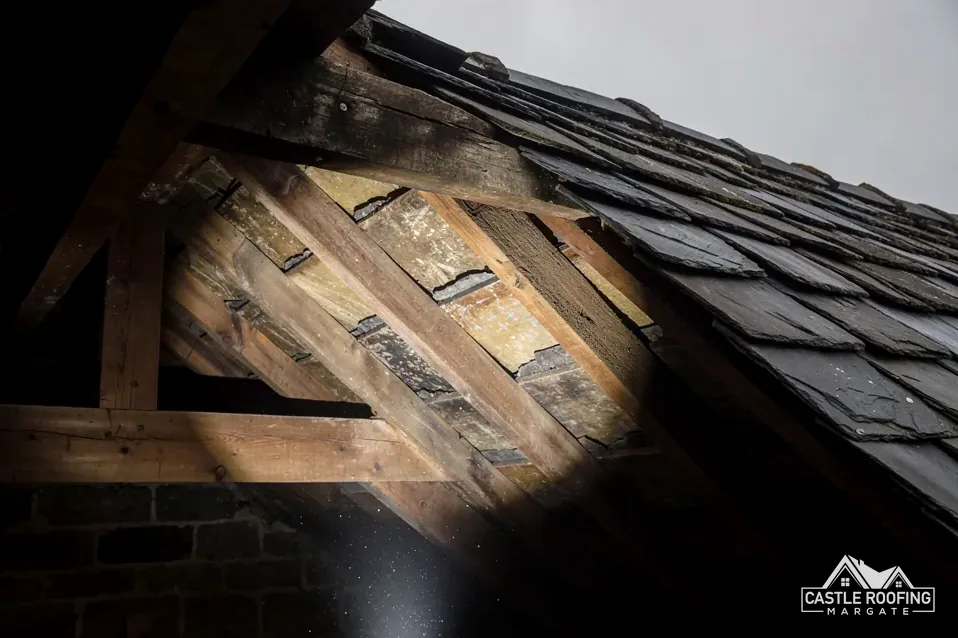
Everything on a roof inspection comes back to a single test: does the fault sit in one place, or in the whole system? A cracked valley lining, a failed flashing and a handful of lifted tiles are all local. A covering that is brittle across every slope, battens that have gone soft, and underlay that has turned to paper are the system.
When the surveyor climbs up, or works from photographs taken along the slopes, these are the points that decide it:
- how many units (slates or tiles) are loose, cracked or missing, and whether they cluster or scatter;
- whether the fixings still hold, which means testing a few nails and clips by hand;
- what the underlay looks like where a tile is lifted;
- the state of the battens (the timber strips the covering is hung from);
- how many separate places the water gets in.
A cluster in one corner usually means an exposure or flashing problem. Scatter across all slopes usually means age. The first is a repair job and the second is a conversation about replacement.
Local faults share a pattern. They sit where two surfaces meet or where something pushes up through the roof, such as a chimney, a valley, a ridge, a verge or the cheek of a dormer (its side wall). Those are the places where lead, mortar and sealant do the work, and they tend to age faster than the covering around them.
A decision table to hold against your roof
Use the table as a first sort, not a verdict. It lists what you can see from outside or from the loft hatch, what it normally points to, and the route that usually follows.
| What you see | What it points to | Usual route |
|---|---|---|
| Covering worn on every slope | Age across the whole roof | Replace, or plan to |
| A few slipped or missing units | Local fixing or wind damage | Repair |
| Torn or crumbling underlay | Layer below the covering has failed | Repair if local, re-roof if widespread |
| Slates sliding, rusty nails | Nail fatigue | Re-fix or strip and re-cover |
| One leak, one spot | Flashing, valley or one unit | Repair |
| Leaks in several rooms | System-wide failure | Replace |
Nail fatigue deserves a word because it fools people. The nails holding slates corrode and let go, so sound slates start to slide down the roof. The slates look fine and the roof is failing anyway. If the nails are going everywhere, patching only moves the problem along, and the roof is stripped and re-covered, re-using the existing slates where they are sound.
Ridges and verges make their own case. Mortar bedding that has cracked can be repaired locally, but since the 2015 amendments to BS 5534 mortar alone is not relied on to hold the covering, and dry-fix systems to BS 8612 are the modern way to secure ridge, hip and verge tiles.
Underlay works the other way round. A roof can look tired from the street while the layer beneath is sound, which is why a loose tile is lifted and checked before a verdict is given.
What repairs typically cost, according to named UK guides
Repairs are the smaller sums on a roof, so they come first. These are typical UK figures from national guides, not prices for any particular roof:
- a repair of one to six cracked or absent standard tiles: £75 to £400 ex VAT (Which? Trusted Traders, November 2025);
- putting in a new ridge tile: £80 to £300 ex VAT (Which? Trusted Traders, November 2025);
- an average roof repair: around £650 in 2026 (MyJobQuote, October 2026);
- MyJobQuote also puts ridge tile work at between £225 and £550.
Which? gathered its figures from a survey of 11 of its Trusted Traders and warns that prices lean toward the top of the scale in the South East. Thanet sits inside that region, so read the Which? range from the middle upward rather than from the bottom. The Which? figures exclude VAT, so add 20% when comparing with a quote that includes it. Check every quote you receive for whether VAT is included in its total.
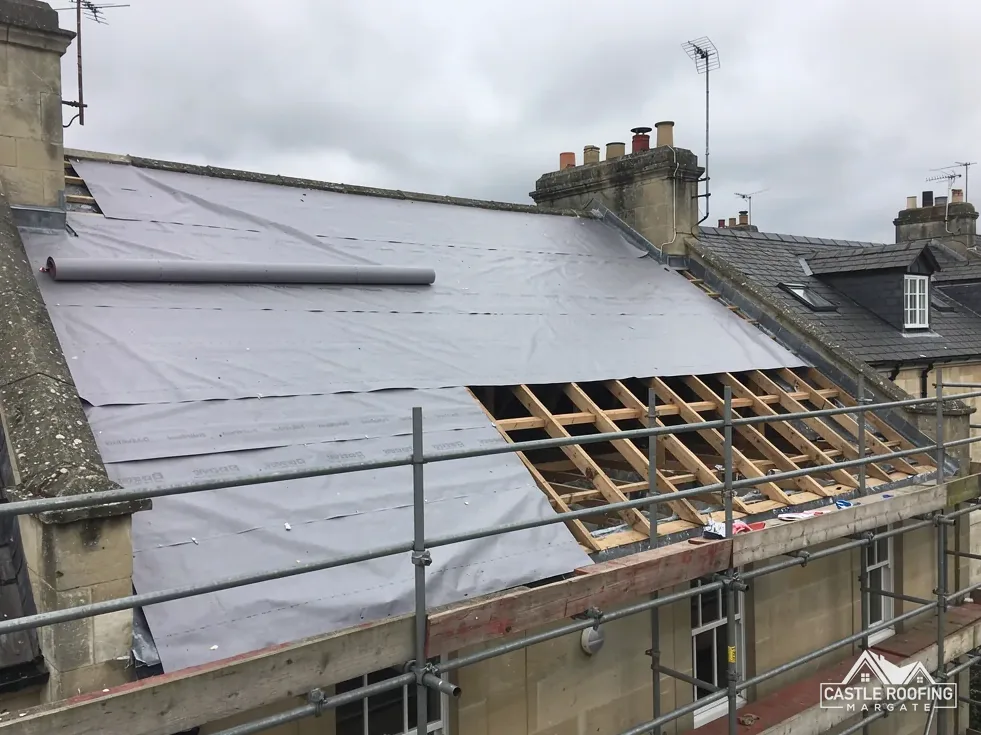
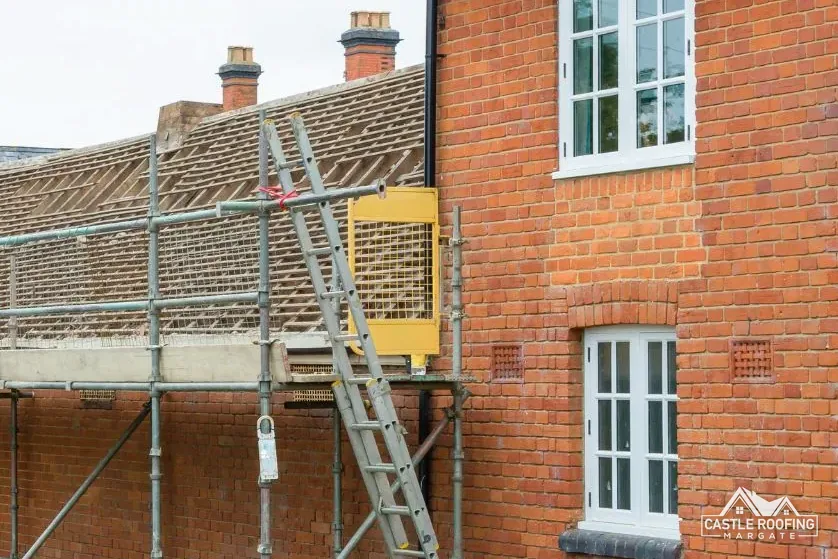
Two things sit outside these figures. Scaffold is a survey item, since its cost turns on how high the eaves sit, how narrow the street is and the licence. Nor do the figures say how much of the day goes on getting safely to the fault, so ask what the total covers before comparing it with a number from a guide. A tile swap at a low eaves and the same swap at a high gable are different jobs, even though the guide lists them under one heading.
Whole-roof costs, and why the guides disagree
On whole-roof replacement the national guides give different answers, so it is sensible to quote more than one and to name each:
- a full re-roof on an average three-bedroom house: £7,000 to £21,000 ex VAT (Which? Trusted Traders, November 2025);
- a three-bedroom semi with a 65 m² roof in plain concrete tiles: between £10,000 and £15,000, with Welsh slate possibly reaching £18,000 (HomeBuilding, September 2025);
- a lower average of around £5,250 (MyJobQuote, October 2026).
The spread is wide for good reasons. Roof area and complexity, the covering chosen, the number of dormers and chimneys, the scaffold, and whether the timbers underneath need work all move the total. HomeBuilding notes that London and the South East carry higher labour rates, a point that reaches Thanet too.
A figure per square metre should never be multiplied up into a total for your house, because the scaffold, the ridge and the flashings do not scale with area. The rates published for repairs, for instance, apply to areas of up to 3 m² only, and a whole roof is priced a different way. What helps instead is asking the surveyor what is included in the total: the scaffold, the waste, the new underlay and battens, the lead and the clear-up.
Set beside these totals, a repair at the figures above is a modest outlay, which is why a repair can be the better buy whenever the roof under it is sound.
Age, exposure and what lifespans really tell you
Age is the factor people lean on most, and the published lifespans help only if they are read as ranges. HomeBuilding gives these typical lives:
- Welsh natural slate: 100 years or more;
- clay tiles: 60 to 80 years;
- plain concrete tiles and Double Roman concrete tiles: 40 to 50 years.
These are typical ranges for the materials, not promises for any single roof, and a maker's figure is not a warranty. A concrete-tile roof at 45 years is in the zone where age becomes a live question. A slate roof at 45 years is barely into its life, unless the nails have given up.
Exposure shortens or lengthens those ranges in ways nobody can print as a number. Met Office figures for the Manston station, covering 1991 to 2020, give annual rainfall of about 613 mm, a mean wind speed of 9.86 knots and 21.43 days of air frost. They are long-run station averages, not a forecast, and they describe Manston rather than any one street.
For that reason a survey weighs three things together: the material's typical life, the roof's actual condition, and how exposed the site is. Age alone is never the verdict, and neither is a single bad winter. A roof facing the prevailing weather on an open street is read differently from one tucked behind a taller neighbour, even when the two were built in the same year.
Settling it: the order of the decision
With the inspection done, the choice tends to resolve in a set order:
- Is the damage local? If yes, a repair is priced first, and it is the better buy where the roof around it is sound.
- Do the fixings and underlay hold elsewhere? If they do not, patching postpones the real job.
- Has the covering reached the end of its typical range? If so, a repair may be sensible for a season while a replacement is planned and saved for.
- Does the repair itself need the scaffold? If it does, part of the replacement's cost is already being spent, and that tips some jobs toward doing the whole slope at once.
If the answer is replacement, building control comes into it. The Planning Portal's test asks whether less than 25 per cent of the building envelope and less than 50 per cent of the roof are affected, so a full strip normally means raising it with building control. Our page on the fifty per cent roof rule explains the test, and the signs you need a new roof page lists the evidence that points to it.
For a fuller view of typical totals, the roof replacement cost page sets them out in context. None of this has to be decided on the day of the inspection: seeing both routes set out side by side lets you weigh a repair now against a replacement later, and the cheaper route today is not always the cheaper route over ten years.