

Roofers in Manston
2.9 road miles from Margate. Repairs, re-roofs, chimneys and flat roofs around Manston Green and the village, priced after a visit to the roof, with photos of it sent to you.
- Thanet decidesPlanning authority: Thanet District Council.
- Four listed entriesFour listed entries within 500 metres.
- Inspected by ThanetThanet Building Control: 01843 577522.
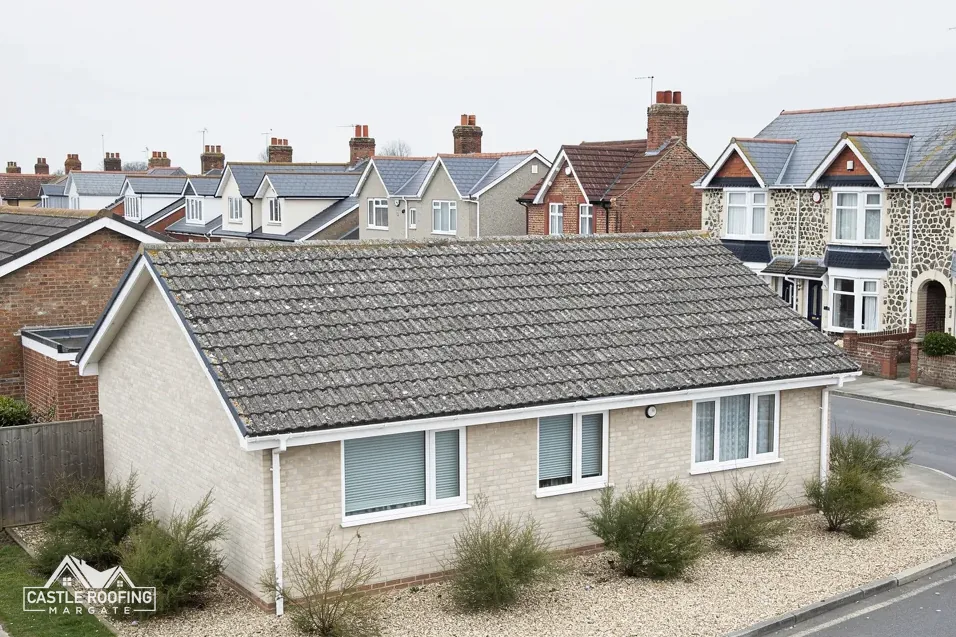
A forge house, a green-side barn and a 2015 memorial listing
Forge House
Old Forge House has been Grade II listed since 13 September 1974, so any roof work there starts with its list entry.
The barn
A barn at Manston Green is Grade II listed, and its consent route is settled before a tile is lifted.
Wind figures
The Met Office's Manston station averages 9.86 knots of wind at 10 metres, with about 613 mm of rainfall across the year.
Manston and Manston Green
One parish of 1,975 people and four nearby listed entries
| Council | Thanet District Council |
|---|---|
| Building control | Thanet District Council's own Building Control team |
| Scaffold and skip licences | Kent County Council |
| Population, 2021 | 1,975 (Manston parish) |
| From Margate | 2.9 road miles, about 6 min |
| Grade II, first listed 1974 | Old Forge House |
| Grade II, first listed 2015 | Manston War Memorial |
| Nearest conservation areas | Ramsgate, Royal Esplanade; Pegwell |
Manston is a Thanet village with its own parish, 1,975 usual residents at the 2021 Census, and Thanet District Council as planning authority. Four listed entries lie inside 500 metres of the village centre, which is why the list gets checked first.
Sources: ONS Census 2021, Thanet District Council, Kent County Council, OSRM road routing.
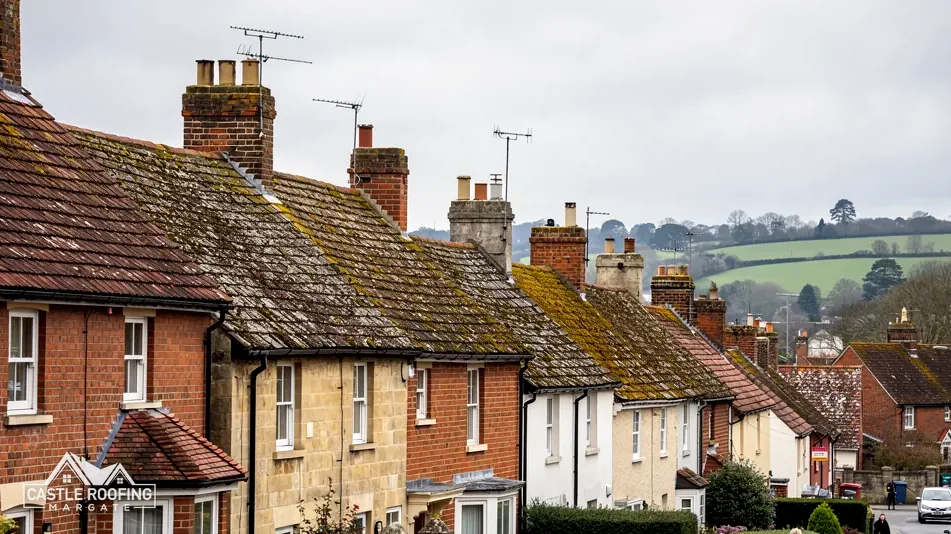
Listings, wind and licences
Manston roofs, from the listed forge house and barn to station averages and site-set fixings
Three chapters on the listed buildings near the green, the Manston weather averages, and the building control, scaffold and skip steps a village re-roof needs.
Chapter 01 of 03
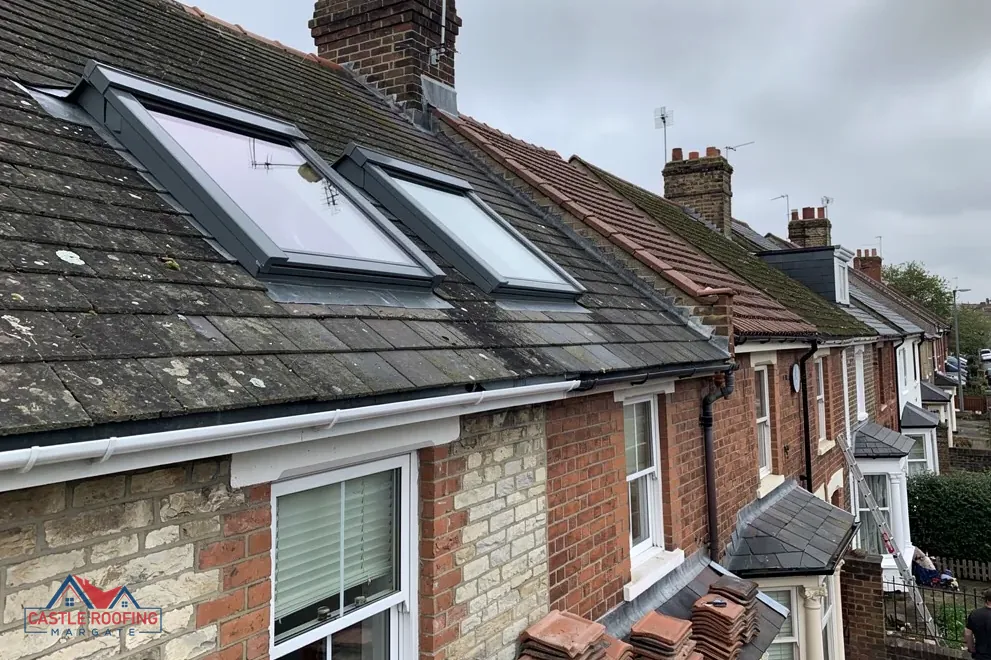
Old Forge House, the green-side barn and the list
A roof job in Manston starts with the list. Historic England's National Heritage List has four entries within 500 metres of the village centre, and three can be named: Old Forge House, a barn at Manston Green and Manston War Memorial. All three are Grade II. Old Forge House was first listed on 13 September 1974 and the memorial on 6 November 2015, so the entries span more than forty years of listing decisions. An entry gives the building's grade, its list number and the date it first went on the list. The three Manston entries carry the numbers 1336624, 1085445 and 1430779, and a number is the quickest way to confirm that a building really is the one on the list. If you are unsure whether your own address appears, send it over and it is checked before anything else is discussed.
Listing applies to the entire structure, with the roof among its parts. Listed building consent, required under section 7 of the Planning (Listed Buildings and Conservation Areas) Act 1990 for work that alters a listed building's character, therefore reaches the roof, because the roof carries a good share of that character: its slope, its covering, its ridge (the apex where the two pitches meet), its chimney stack and the lead flashing (the dressed strip of lead that weatherproofs the joint where a slope meets masonry). Changing any one of these can touch the character, so the entry is looked up ahead of any price.
Where a Manston building is listed, Thanet District Council decides the consent application. We look at every slope and stack, you receive photos of what we looked at, and the repair is described in plain terms so the application matches the work on the roof. Old slates, tiles and lead are kept in step with the existing roof, unless you and the council settle on a change. Our pitched roofing page covers coverings in more detail, and chimney repairs deals with the stacks.
A neighbour's listing is a different question from your own, so the entry for your address is the one that counts. It is also worth knowing before a scaffold is booked, because a listed barn or outbuilding takes the same route as a listed house: the entry first, then the consent question, then the dates.
Chapter 02 of 03
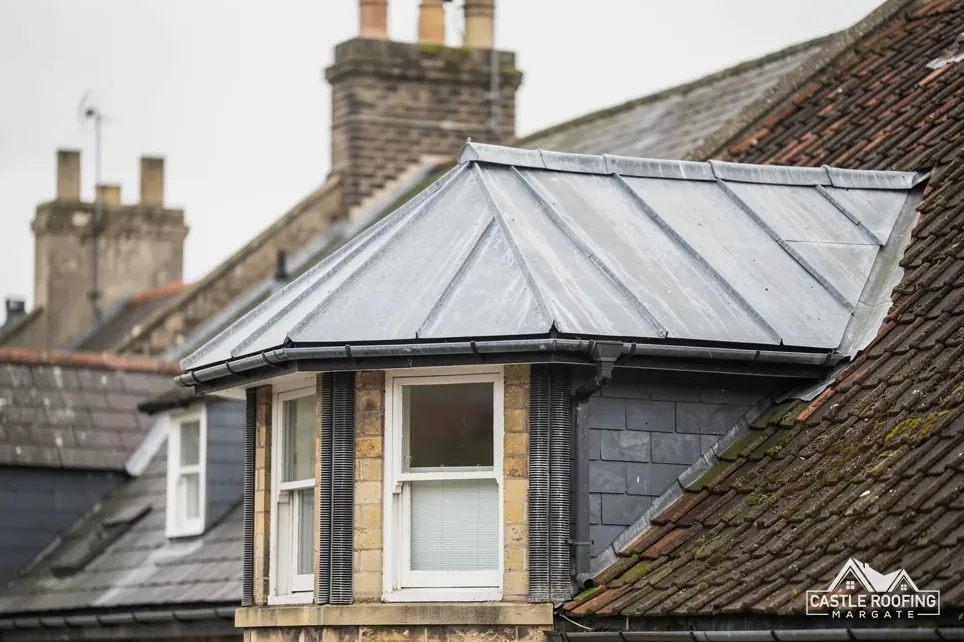
What Manston's wind and rain averages ask of a roof
The Met Office keeps long-term climate averages for a station it calls Manston. For 1991 to 2020, the Met Office's Manston station gives about 613 mm of rainfall over the year, falling on 110.05 days that each bring 1 mm or more. The Met Office's Manston record puts the mean wind speed at 10 metres at 9.86 knots, rising to 11.21 knots in January, and counts 21.43 days of air frost a year. These are averages for that station, not a forecast for one street, and they are quoted here as averages.
For a roofer, the lesson is that fixings matter. Cupa's slate-fixing advice puts sites on slopes or hills, and tall buildings, in a higher exposure grade. BS 5534 covers slating and tiling, and it includes wind uplift formulas and a way of working out fixing specifications, so each slate or tile is held to a figure worked out for the site instead of copied from the last job.
| Measure | Average |
|---|---|
| Rain over a year | About 613 mm |
| Days at 1 mm or above | 110.05 |
| Mean wind at 10 metres | 9.86 knots, Met Office Manston |
| Mean wind in January | 11.21 knots, Met Office Manston |
| Days of air frost | 21.43 |
Source: Met Office, Manston 1991 to 2020
Marley points out that installing to BS 5534 is not required by law, but the standard has changed what good practice looks like. Marley records that from 2015 mortar was no longer enough on its own at a ridge. BS 8612:2018 is the specification for ridge, hip and verge units that are fixed mechanically, with clips and screws rather than a bed of mortar alone. On a Manston roof, those are the lines we look at first after a windy spell: the ridge, the hips (the sloping lines running down the outward corners of the roof) and the verges (the sloped edges at the gable ends). Wind-driven rain is tested at the abutments, where a roof meets a wall or a stack, and a lifted or cracked flashing shows itself there first. Our roof repairs page explains how a repair is scoped.
Fixings are one half of the job. The other is what lies beneath the covering: the underlay (the membrane under the slates or tiles) and the battens (the sawn timber that the slates or tiles are fixed to). A few tiles are lifted so both can be seen, which means the quote describes the roof as it is, not as it looks from the road. If the survey shows that a repair would serve, the written quote says so plainly, and a new roof is only put forward when the survey supports it.
Chapter 03 of 03
Building control, scaffold and skip notices for a re-roof
Thanet District Council runs its own Building Control team, on 01843 577522, and points owners to the Planning Portal's Interactive House, a tool that shows whether consent is likely to be needed. Under the Planning Portal's test, work on a roof that affects under 50 per cent of it, and under 25 per cent of the total building envelope, normally needs no application. Where a new covering weighs 15 per cent or more on the roof than the one it replaces, approval is needed, and before work starts the Planning Portal says to speak to a structural engineer or surveyor.
Planning is a separate question. Conditions for roof windows, dormers and similar changes are collected in our roof window planning guide. For conservation areas, the closest in the national dataset are Pegwell and Ramsgate's Royal Esplanade, no further than about 2.5 km from Manston, which is a reason to ask Thanet District Council about your own address rather than assume either way. Thanet's page places its own Article 4 directions in Ramsgate, the Marina extension and Pegwell, and the council confirms the position address by address.
Any scaffold over a road or footway must have a licence under section 169 of the Highways Act 1980. Kent County Council issues it and expects the scaffolding firm, not the householder, to apply. The fee is £52 per week for 2026 to 2027, the application has to be with Kent County Council 5 working days before the licence period opens, and the firm must carry public liability cover of £5 million. Its conditions keep a clear 1.2 metres between scaffold and carriageway. Skips in the road take a separate permit, £45 per week for 2026 to 2027, no longer than 5 metres or wider than 2. Should the skip have to sit on the pavement, express permission is required and a 1.5 metre pedestrian walkway must stay open.
By the time the scaffold goes up, none of this should be a surprise. The survey sets the scale of the job, the notices follow from it, the waste (old slates, battens and underlay) leaves with us, and the order below shows where each notice falls. Each day ends with a short update on what was done and what is next, so the household knows what to expect. If the weather moves the finish date, the licence renewal is raised with the scaffold firm in good time.
A Manston re-roof, notice by notice
Survey and photos
We look at the roof up close and you receive photos of what we saw.
Listing and area check
Your address is checked against the list and the nearby conservation areas.
Scaffold application
The scaffolding firm applies to Kent County Council 5 working days ahead.
Work and tidy
Fixings set for the site, a daily update, and the waste taken away.
10-Year workmanship guarantee. In writing
Around Manston
Manston and the Thanet villages around it
Manston shares Thanet District Council, its Building Control team and Kent County Council's highway licences with Acol, Cliffsend, Ramsgate and Margate; a roof job here follows the same route as in each neighbouring parish.
Manston listings, wind averages and permits
Is my Manston house near a listed building, and does that matter for the roof?
Four listed entries lie within 500 metres of the village centre, including Old Forge House and a barn at Manston Green, so it is worth checking. Listed building consent under section 7 of the 1990 Act applies to the listed building itself, which makes the first question whether your own address appears on the list. Your address is checked against the National Heritage List before a price is given.
What do the Manston wind averages mean for slate and tile fixings?
The Met Office's Manston averages for 1991 to 2020 give a mean wind of 9.86 knots at 10 metres, and 11.21 knots in January. Those are averages, not a forecast. BS 5534 includes wind uplift formulas, so the fixings for each slate or tile are worked out for the exposure of your site, and the specification goes into your written quote.
Which conservation areas should a Manston owner check?
The national dataset puts the nearest conservation areas, Pegwell and Ramsgate's Royal Esplanade, no further than about 2.5 km from Manston. Thanet's page places its Article 4 directions in Ramsgate, the Marina extension and Pegwell, so for any address close to those, ask Thanet District Council to confirm what applies before you sign off a job.
How far ahead must the scaffold licence for a Manston re-roof be requested?
Kent County Council wants every application, renewals included, lodged 5 working days ahead of the start. The application is the scaffolding firm's to make, not the householder's. For 2026 to 2027 Kent County Council's scaffold fee is £52 per week, and it may charge £78 for an inspection of the site if it thinks one is necessary. The scaffolders and the start date are fixed after the survey.
Send photos of your Manston roof
Book a look at your Manston roof or send photos; a single written total follows the survey.