Read this to see what a flashing kit contains, why the covering decides which kit fits, where the soakers and aprons sit, and what goes wrong when a window is set with the wrong one.
A roof window is a hole cut in a sealed slope, and the frame is only half the answer to keeping that hole watertight. The other half is the flashing kit: the collar of metal or lead pieces that carries water from the slope round the frame and back onto the covering. A flashing is simply a strip that bridges a joint and sheds water over it.
The weak point on a roof window is the joint between the frame and the covering, not the glass. A profiled tile has a rise and fall that a flat slate does not, and a plain tile has its own thickness and overlap, so a kit made for one covering leaves gaps on another. That is why the covering has to be named before the window is ordered, not after it arrives.
This guide stays in general terms. Each maker publishes its own kit sizes and fixing instructions, and those instructions govern the job. What follows is the logic behind them: what the pieces do, how profiled-tile and slate flashings differ, and what to look for on your own roof. It belongs to our roof windows and skylights work, and the two fitting pages go further for a tiled roof and a slate roof.
What a flashing kit contains
Kits differ in detail between makers, but every one does the same job: it builds a watertight frame in the slope and ties it into the covering. A kit normally comes as a set of formed pieces, each named for where it sits round the window.
- The bottom apron sits below the window. It sheds water that runs down the glass out onto the covering beneath.
- The side flashings run up each side of the frame. They catch water running down the slope beside the window and pass it under the covering below.
- The top flashing, sometimes called the head flashing or head gutter, sits above the window and turns the water that runs down the slope round either side of the frame.
- An underlay collar, or a set of trays, guides stray water back out over the frame instead of into the roof space.
The order of fitting matters as much as the pieces. The bottom apron goes on first, the side flashings next, and the top flashing last, so that each piece laps over the one below it and every joint sheds water the right way. A kit fitted from the top down, or with one piece tucked the wrong side of another, can look tidy from the street and still funnel water inward.
Replacement windows are a separate question from replacement flashings. A new window can sometimes be dropped into the old opening and re-use the existing flashing, but a flashing that has been dressed over a different frame size or a different covering will not sit right. When the covering around the window has changed or the window is a different size, the kit is renewed with the window.
Why the covering decides the kit
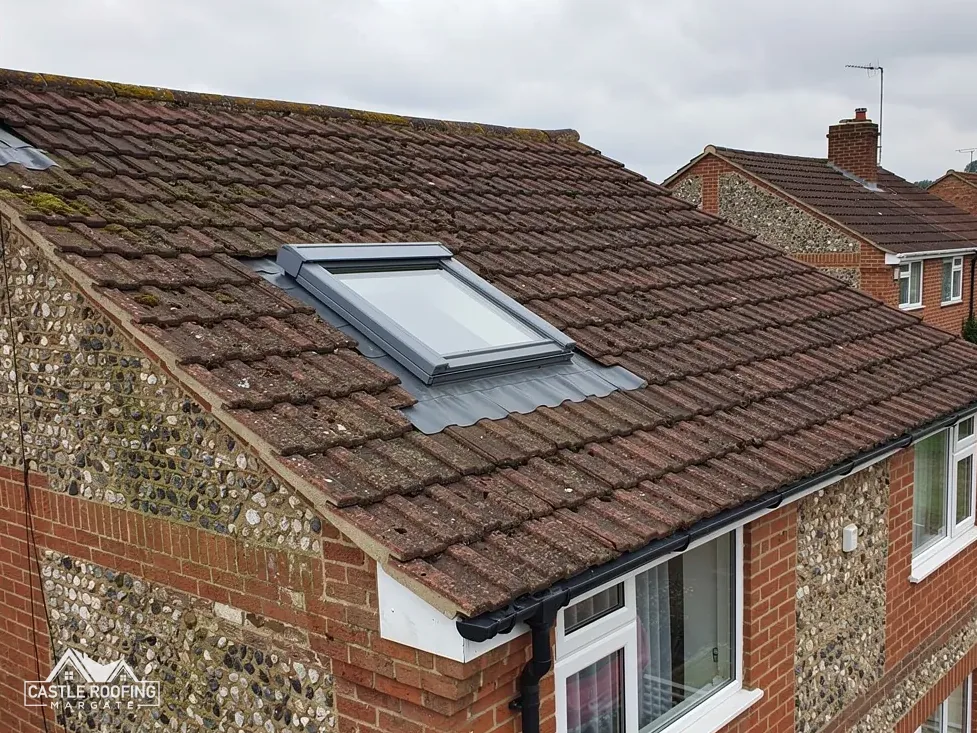
The kit has to match what the water runs over. A flat slate has an even, thin edge, a plain tile is thicker and overlaps in a double lap, and a profiled tile rises and falls across its width. The flashing along the side of the window has to follow whichever of these it sits against, or it leaves a gap for the weather.
| Covering | What the side flashing must do | Why it matters |
|---|---|---|
| Profiled tile | Follow the rise and fall of the tile | A flat piece leaves a gap in each trough. |
| Plain tile | Sit under and over the tile courses | The extra thickness needs more depth. |
| Natural slate | Pair with a lead soaker in each course | The edge is thin, so overlap carries the seal. |
Kits are sold by covering type for this reason, with a separate size for each window frame. The frame size sets the opening in the roof, and the covering sets the depth of the flashing that has to rise from the covering to the frame. A kit for a deeper covering fitted into a thinner one sits proud of the slope and lifts at the edges. A kit for a thin covering fitted into a deeper one leaves the water too little height to run clear.
If the covering is a mix, for example a repair patch of different tiles near the window, say so at the survey. The flashing follows the covering it actually touches, not the covering the roof started with.
Soakers and aprons round a slate roof
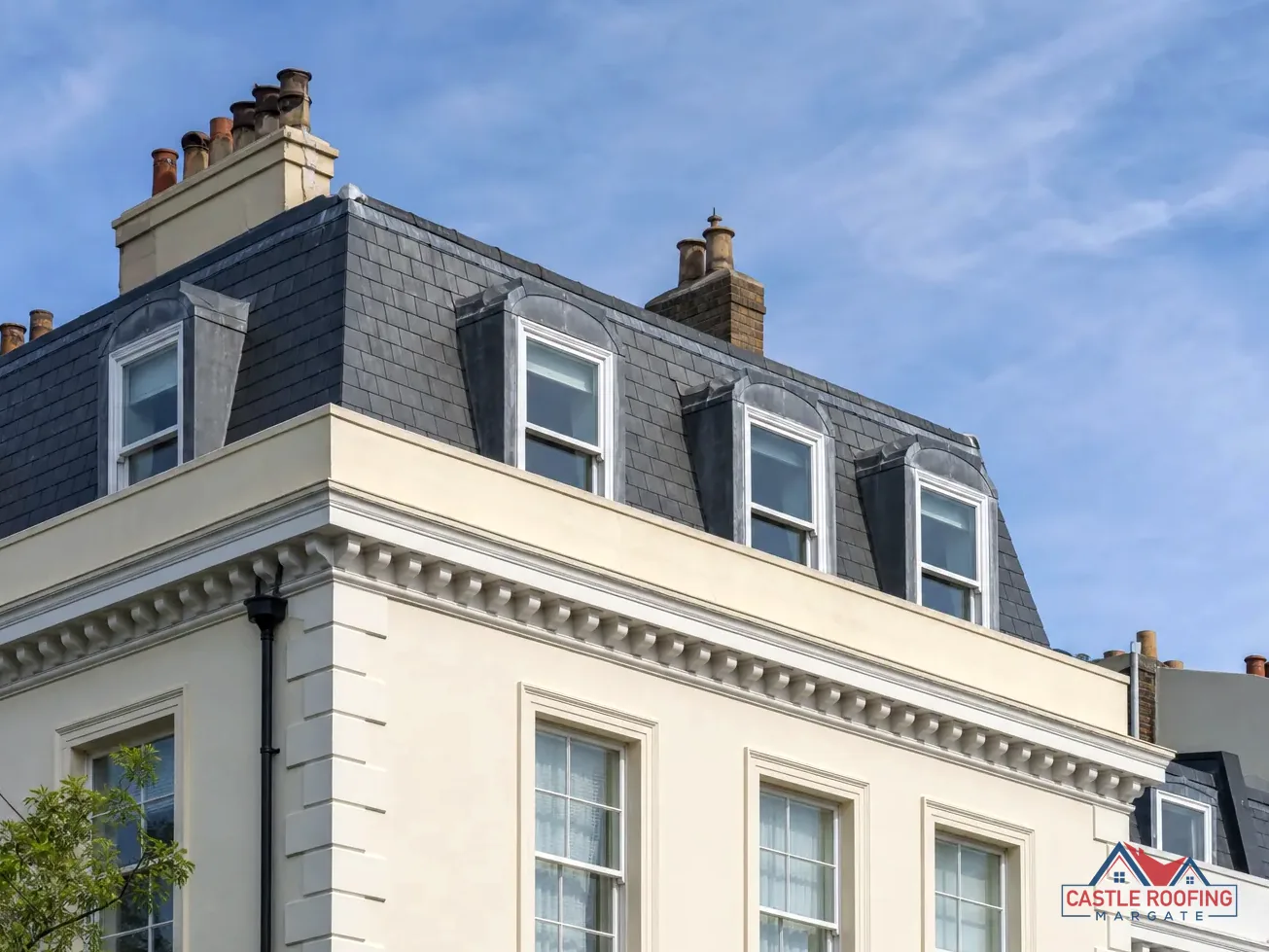
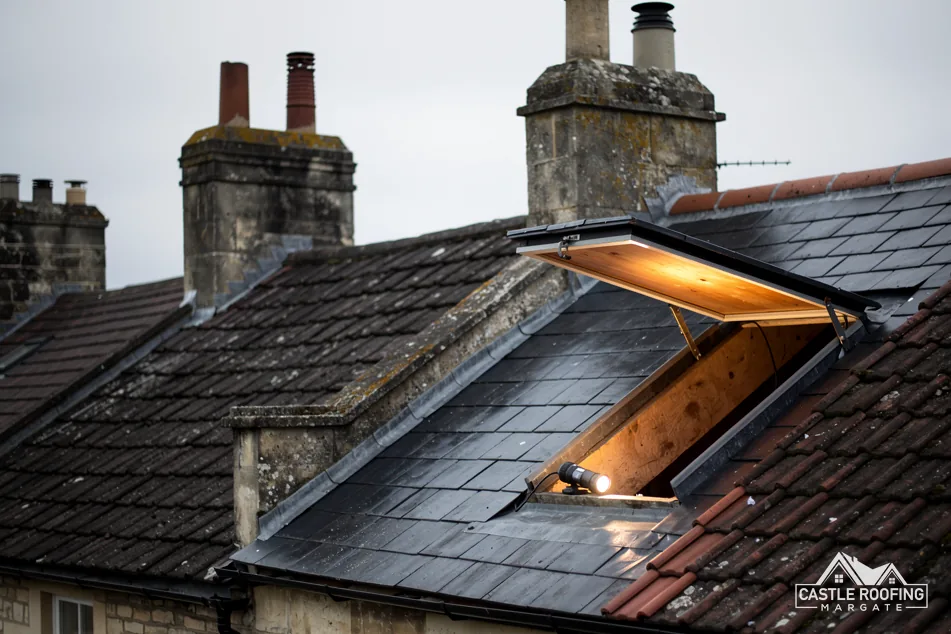
Slate is laid flat in overlapping courses, so a window in a slate slope is flashed differently from one in a tiled slope. The side of the frame is sealed with soakers: small pieces of lead, bent to an L, with one leg slipped under the slate and the other turned up against the frame. One soaker goes in with every course, so the lead overlaps itself all the way up the side of the window.
A soaker is the lead that lives underneath the covering, and the side flashing is dressed down over it, so water that gets past the visible edge meets the soaker before the roof. Cast lead comes in numbered codes, each a fixed thickness. The Royston Lead table starts at Code 3, 1.32 mm, and finishes at Code 8, 3.55 mm. Its brochure recommends Code 3 for lead soakers only. Elsewhere on the window the specification picks the code, so a heavier one is not automatically better for a soaker.
The bottom apron on a slate roof is formed to sit over the slates below the window, with its lower edge dressed so water leaves it cleanly. The top is the part not to rush. It needs to tuck up under the slates above the window, not sit on top of them, or it will gather rain and run it behind the frame.
Lead is also the long-lived part. MyJobQuote notes that lead flashing can last for over 80 years, as a floor for the range and no guarantee for one particular detail. That long life is only reached when the soakers and flashing are dressed and lapped properly in the first place.
How the wrong kit lets water in
A kit that does not fit the covering fails slowly, at the joints. Wind-driven rain gets under an edge that is not lapped, then finds the next gap. The stain on the ceiling around a window frame is often the last stage of a long path.
Common ways a mismatched or badly fitted kit fails:
- A flat-profile flashing on a profiled tile leaves an open channel in every trough along the side of the window.
- A kit sized for a deeper covering stands proud of the slope, so wind can lift its edge.
- A top flashing laid over the covering above the window, not under it, collects rain and passes it behind the frame.
- Soakers that are too short, or missing from a course, break the lap on the side of a slate window.
- Sealant used to bridge a gap that a correct piece would cover. Sealant dries and splits, and it is no substitute for a lapped joint.
None of these is dramatic at first. Each one lets a little water past in heavy rain, and a little water is enough to dampen insulation, rot a batten or stain plasterboard. By the time a stain shows, the damage behind it has been building for some time.
Our page on a leaking roof window explains how a drip is tracked back to its source, and the flashing is checked before the glass or seals take the blame.
Fitting the kit with the covering
A flashing kit is fitted as part of the covering, not on top of it. That means the covering is stripped back round the opening, the frame is set to the correct depth against the battens, and the flashing is laid in step with the tiles or slates as they are replaced. Doing it in that order is what lets each piece lap under the course above.
- Mark out the opening against the rafters and the battens, and cut back the covering round it.
- Fit the frame at the depth the maker's instructions give for that covering.
- Lay the underlay collar or tray so water that gets in has a path back out.
- Fit the bottom apron, then work up the sides with the side flashings, or with a soaker in each course on slate.
- Fit the top flashing last, tucked under the covering above.
- Check every lap by eye while access is still in place, and look for gaps between the flashing and the frame.
The fixings and the covering itself still follow BS 5534:2014+A2:2018, the slating and tiling code, which since its 2018 amendment reaches repairs as well as new work. Marley points out the law does not demand it; a roof is still built to it as the working standard. On a slate slope, Cupa says the lowest pitch BS 5534 gives for natural slate is 20 degrees under moderate exposure, with a 500 mm slate and a 115 mm lap, and adds that hooks are ruled out on a slope shallower than 25 degrees. A shallow slope is checked for these before a window goes in.
Questions to put to a roofer
A written quote for a roof window should name the covering the kit is made for. You can check this at the survey stage, before anything is ordered, and it takes a minute.
- Which covering is the kit made for, and does it match the roof as it stands today?
- Are soakers being fitted on a slate slope, and in which lead code?
- Is the existing flashing being reused, and if so, what condition is it in?
- Will the surrounding covering be disturbed, and who relays it?
- Will you see photos of the finished flashing before the scaffold comes down?
Photos of the roof round the window go to you as the job runs, so each answer can be checked against the roof itself. The survey comes first and the written figure afterwards is a single total for the window, kit and covering work together. The usual cost guide for this kind of job is MyJobQuote, which puts an average mid-range roof window at around £1,100 in its September 2026 update, a figure that depends on the window and the roof.
If a roof window was installed some time ago and now leaks, the first thing to establish is whether the original kit matched the covering. A match problem is fixed by renewing the flashing. A fault in the glass or seals is a different job, and it is not helped by more sealant round the outside.