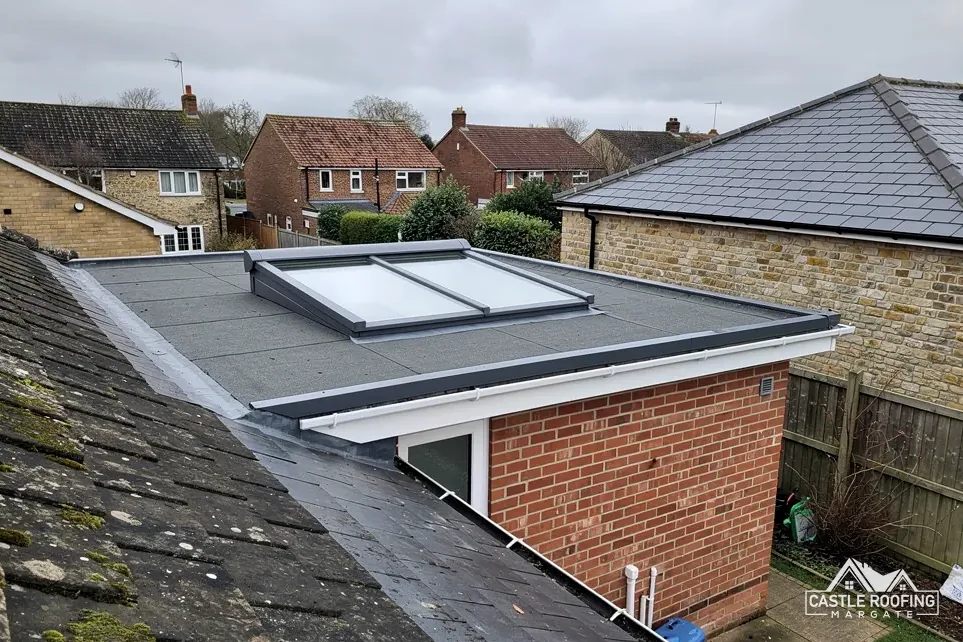
Droplets on a roof window look alarming, but they have a short list of causes. This guide shows where to look, which habits and settings help, and how to tell condensation from a leak before you call anyone.
You wake up, look at the roof window above the bed, and the glass is running with water. The first thought is a leak. Often it is not. It is the air in the room, which carries water vapour from breathing, showers, cooking and drying clothes, meeting a pane that is colder than the rest of the room. Where the air touches the cold surface, the vapour turns back into water. That is condensation, and it forms on the inside.
Roof windows are prone to it for a simple reason. They sit in a sloping ceiling above the warmest air in the house, in rooms such as loft bedrooms and top-floor bathrooms that are small and breathed in all night. Cold nights and still air make it worse, which is why the glass is clearest by mid-morning and wet again the next dawn.
This guide separates the causes that are a matter of ventilation from the ones that are a fault. It sits beside our pages on roof window ventilation and the leaking roof window, and it is the place to start when you are not sure which of the two you have. Both belong to our wider roof windows and skylights work.
Warm moist air meeting a cold pane
Air carries water vapour, and it carries more of it when warm. When damp warm air touches a surface colder than the air can stay damp at, some of its water drops out on that surface. A roof window is one of the coldest surfaces in a top-floor room, because the glass and its frame are thin compared with the insulated roof around them.
The vapour has to come from somewhere. In a loft room it comes from the people in it and the habits of the house:
- breathing and sweating through the night in a closed bedroom
- a shower or bath with the bathroom door left open to the landing
- cooking with the pans uncovered and no extractor running
- clothes drying on radiators or airers indoors
- an unvented tumble dryer or a portable gas heater
No item on that list is a fault of the roof. Together they raise the amount of water in the air, and the coldest pane gets the blame.
The glazing itself matters as well. A double-glazed unit keeps its inner pane warmer than a single pane would be, which is part of why the energy figures matter. Approved Document L holds a new roof window to 1.4 or WER Band B, and a lower figure generally means a warmer inner pane. A tired or older unit with a poor seal, or a frame with a cold spot, will mist before a newer one does.
Condensation on the room side is a sign of damp air. It is the house telling you the water has nowhere to go, and the cure is to give it somewhere.
Where the water shows, and what it points to
The position of the moisture is the first clue, and it is worth checking before anything is changed. Write down what you see and take a photo in the morning, when the glass is at its worst. A repair visit goes quicker when we can see what you saw.
| Where it shows | What it points to | First step |
|---|---|---|
| Inner glass, lower edge | Damp room air on a cold pane | Ventilate the room |
| Between the two panes | A failed seal in the sealed unit | Photograph and ask for a survey |
| Frame or lining, inside | Cold bridge or damp air at the edge | Wipe, ventilate, watch |
| Stain below the sill only after rain | Water entering at the flashing | Do not wait; book a survey |
A film of fine droplets across the lower part of the inner glass, clearing as the day warms, is the classic picture of room condensation. Mist trapped between the two panes is different. It cannot be wiped off, because the water is inside the sealed unit, and it means the seal has failed. In many cases the glass can be replaced without taking out the whole window, which our page on replacing roof window glass explains.
Stains that arrive after rain, a damp patch around the lining, or a drip that appears with a gust have a different story and a different fix. The next sections come back to them.
When you take notes, include the time of day, the weather the night before, and whether anyone had a shower or dried washing in the room. A pattern in those answers can settle the question before anyone climbs a ladder.
Ventilation settings and trickle vents
The most effective step is to let the damp air leave. Roof windows are generally built with a ventilation position that holds the sash open a small way, with a lock so it stays secure at night. Some also have a vent flap or trickle vent built into the top of the frame, a small slot that admits a trickle of outside air even when the sash is shut. The exact arrangement depends on the make and model, so check the maker's instructions for your unit.
A few habits do most of the work:
- Open the vent or the sash a fraction while the room is in use and for some time after a shower.
- Keep the bathroom door closed while the extractor runs, and leave it running after the shower.
- Use lids when cooking, and run the cooker hood.
- Dry clothes outside or in a vented dryer, not on a radiator under the window.
- Leave air able to move: a wardrobe pressed against the slope shuts it out.
BS 5250:2021 sets out how moisture in buildings is managed. The habits above come down to three aims: less vapour at the source, air moving where it is made, and warmer surfaces.
Closing a trickle vent to save heat, or covering one with a blind, can turn a window that used to be fine into one that mists. If your roof window has an electric motor, a rain sensor may close the sash when it rains, and a timer that keeps it shut at night can trap the damp air.
If a window keeps misting after the habits above have changed, the cause is probably in the frame, the glass or the roof around it, and a survey is the next step.
Condensation or a leak?
The two are easy to mix up, and the wrong guess costs time. Condensation comes from the room air and forms on the inner face. A leak comes from outside and enters at the flashing, the joint between window and roof, or through a damaged covering. Four questions tell them apart:
- When does it happen? Condensation follows cold nights and morning use. A leak follows rain, and often wind-driven rain from one direction.
- Where is the water? Condensation is a film across the glass. A leak shows as a stain or drips at the top corners, the sides of the lining, or the sill.
- Does it dry? Condensation clears as the room warms. A leak keeps coming back until it is repaired.
- Is the lining discoloured at one corner? A stain that grows after storms is water getting in.
Wipe the glass dry and watch the same spot over the next dry cold morning. If the droplets return on an evening with no rain, it is room air. If a patch appears after a wet night with a dry room, it is the roof.
Do not leave a suspected leak. Energy Saving Trust, writing about spray foam, warns that leaking water rots the timbers it reaches, and a slow drip behind a lining can run unseen for a long time. If in doubt, treat it as a leak until a survey says otherwise.
We look at the window from the outside and from the loft, check the flashing and the lining, and give you photos of what we found. If the cause is a leak, the repair is a flashing or covering job. If it is condensation, we tell you so and leave the window alone.
The roof space around the window
Sometimes the damp is not on the glass at all but in the roof structure around it. A roof window is cut into the pitched roof, and the space between the roof covering and the ceiling is supposed to move air. In a cold roof the insulation sits along the ceiling line and the void over it stays cold. Where the loft has been converted into a room, the insulation sits along the slope instead, and the way the roof breathes is part of the design.
Underlay is the membrane stretched over the rafters beneath the battens. HR underlay is non-breathable, and under a cold roof Marley specifies a continuous 10 mm gap at the eaves above a 15° pitch, and 25 mm at 15° or below. Approved Document C, paragraph 6.11, treats ventilating a cold deck roof as meeting its moisture requirement. A blocked eaves gap, a gap packed with insulation or a roof where insulation has been added without keeping the air path, lets moist air collect near the window lining.
Spray foam applied under the roof is another cause to look at. RICS says foam sprayed over the roof timbers hides them from inspection, and its guide asks owners to check with the mortgage provider that the lender permits it. Open-cell foam carries a much lower rot risk, according to Energy Saving Trust, and lower is not the same as none.
None of this is for guessing. A survey from the loft and the roof sorts out whether the problem is the window, the ventilation or the roof layers around it.
When replacing the window is the answer
Much misting can be handled with habits and settings. Some cannot, and the signs are clear enough to act on.
- Mist or droplets trapped between the panes, which means the seal has failed.
- A frame whose lining stays damp, or where paint and plaster keep blistering, even with good ventilation.
- A sash that no longer closes tight, so cold air leaks past the seals.
- A repair that keeps being needed on a window that is old and tired.
If the seal has gone, new glass in the existing frame is sometimes possible. If the frame itself is the problem, a replacement is more sensible, and a new unit comes with the current energy figure, which for roof windows is 1.4 or WER Band B. How long a roof window lasts depends on the make, the fit and the exposure, and a maker's data is the place to read it.
Replacing the window is also the moment to check the flashing, the lining and the insulation around the opening. A new window set into a tired surround carries the old problem with it.
The decision is made after we look. We go up, check the glass, the seals, the flashing and the lining, and tell you whether the cure is a vent setting, a pane, a flashing or a new unit. You get photos of what we saw, and one written total follows.