How to stay safe from the ground, keep fallen pieces off a public footway, record the damage for your insurer, and understand what a lasting repair involves once wind has lifted tiles, ridge or verge.
A tile that has blown off lands somewhere, and where it lands matters more than the gap it left. On your drive it is a clean-up job. On the pavement, in the road or on a neighbour's car it is a hazard to other people, and the loose tiles still on the slope are the next to fall. So the first thing after a gale is safety, not the roof.
Here the problem is taken in the order it arrives: what to do from the ground, who to call about pieces on a public footway, what to record for your insurer, why tiles lift in the first place and what a repair that lasts involves. It sits within our roof repairs and emergency work, which is where a blown-off tile usually ends up.
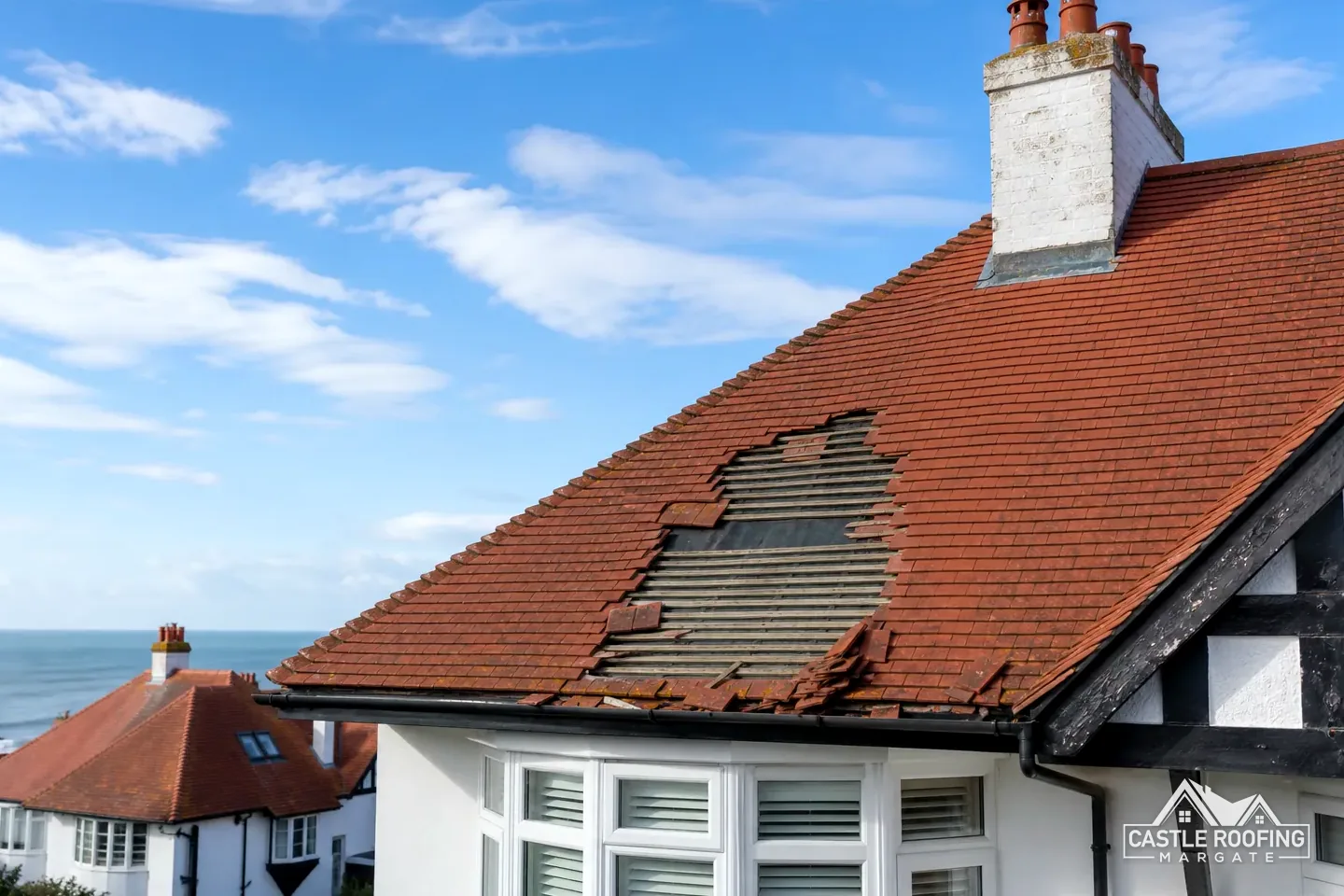
Some wind damage is small, such as one or two plain tiles lifted from an edge. Some is wider, with a run of ridge displaced or a verge stripped back. From the street you cannot always tell which you have. That is why we go up and look before we name a figure, and why pictures of your own slopes reach you afterwards.
Staying safe while it is still blowing
Stay off ladders in a gale, and keep clear of any roof that is wet or still gusting. Look from the garden, the street or an upstairs window, and zoom in with a phone camera instead of your feet. Tiles that have already moved can slide further, and a loose ridge can follow a gap in the slope.
From the ground, these are the things worth noting:
- a dark gap in the slope where the battens, the wooden strips fixed across the rafters, show through
- tiles sitting crooked or ridden up out of their courses, which are the horizontal rows
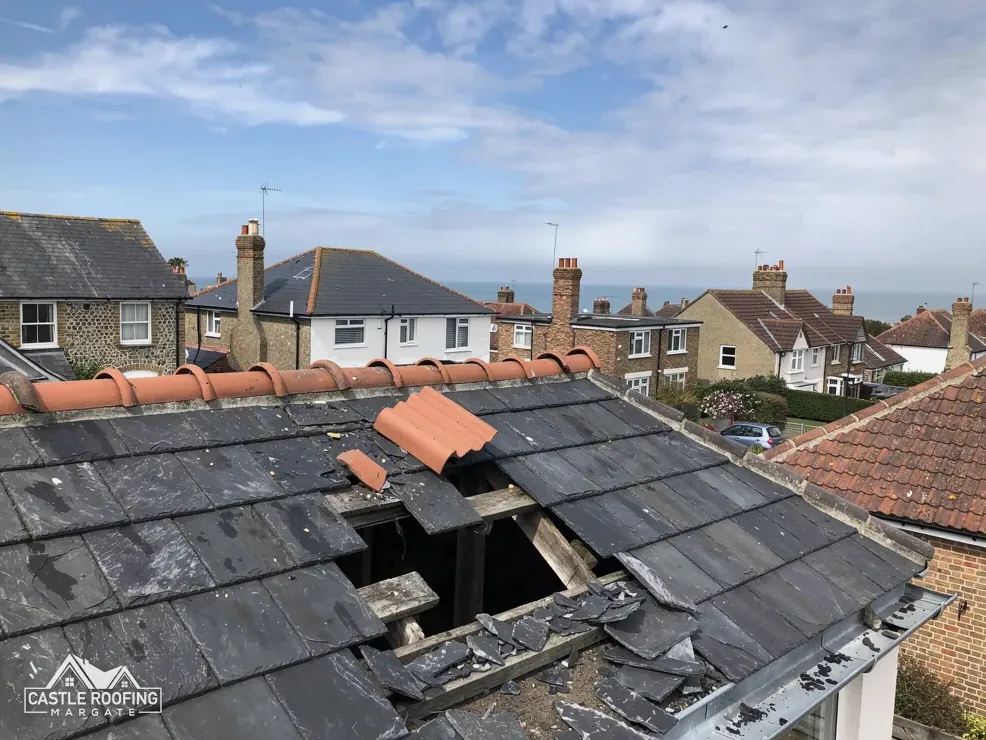
- a ridge or hip line that looks broken, lifted or out of line
- pieces lying in a gutter, on a flat roof, on a lower roof or in the garden
- a verge, where the roof ends against a gable wall, with tiles missing or the cement along it cracked away
Keep people and pets out from under that part of the roof, and move cars away from the wall if you can. Pieces left in a gutter deserve attention too, because a fragment can block the outlet and send water over the edge at the next shower.
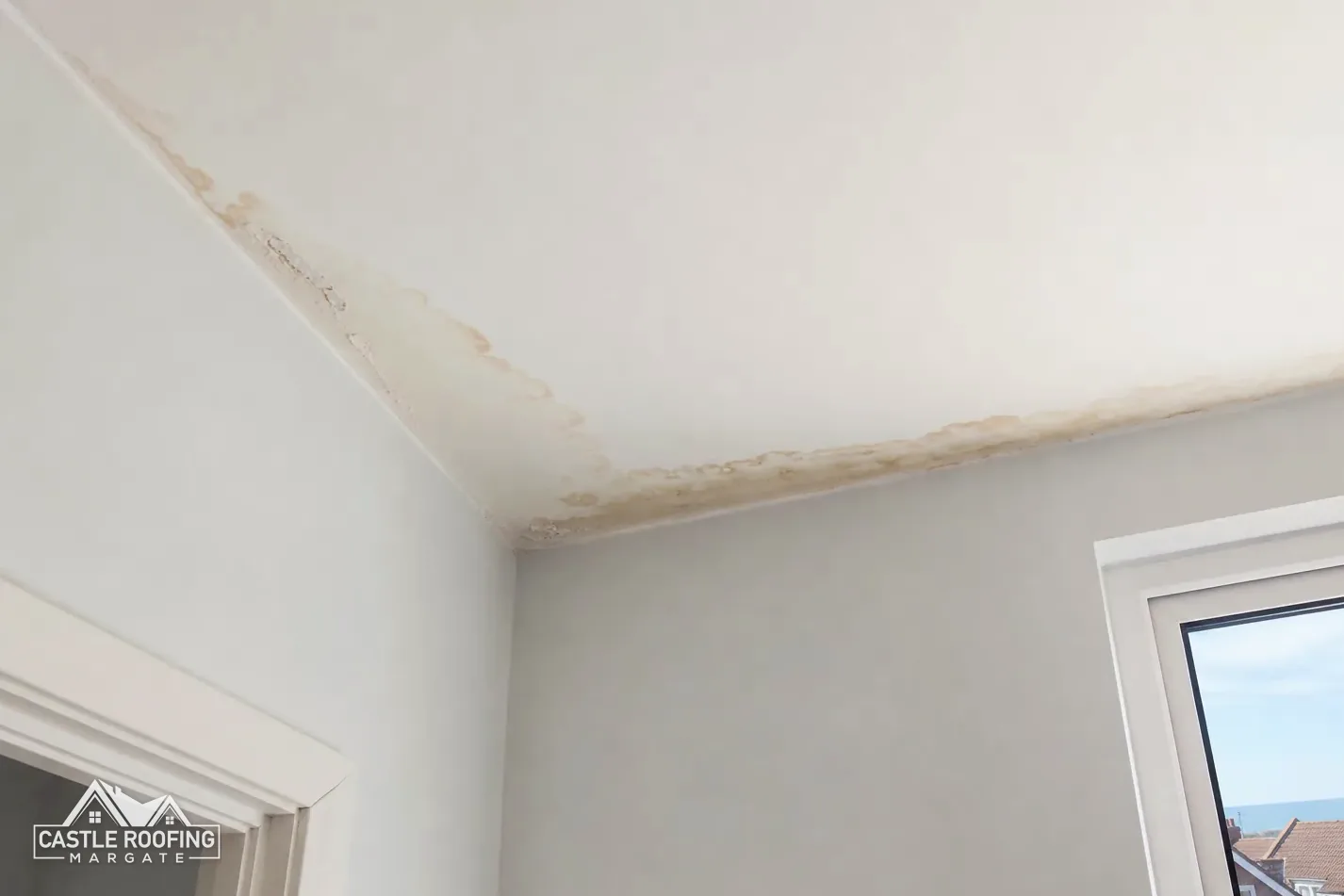
Inside, check the ceilings under the damaged slope. In the loft, a torch held from the hatch will show daylight where tiles are gone, or a dark wet patch on the underlay, the sheet under the tiles. Either one puts a bucket and a towel on your list for the night, and it is worth a photo before you move anything.
Pieces on the pavement or the road
If tiles or fragments have landed on a public footway, put something visible over or around them if you can do it safely from your own ground, and keep people moving round them. Photograph them where they fell before anything is swept up, because the picture shows the direction and spread of the damage as well as the pieces.
Kent County Council looks after the roads and pavements of Thanet and the other East Kent districts, and the district councils do not run the road. Kent County Council is the highway authority for the carriageway itself, while the clearing of your own tiles stays with you.
The same council matters if the repair needs a scaffold on the pavement. Section 169 of the Highways Act 1980 requires a licence for scaffolding that blocks the highway. The scaffolder makes the application to Kent County Council, which wants 5 working days of notice, and its scaffold permit is £52 per week for 2026 to 2027.
That notice period is why a make-safe and a full repair are different jobs. A few tiles refixed from a roof ladder may need no scaffold at all, while work along a front edge over a public footway might. A shopfront or terrace on a busy street raises the same question, because the pedestrian route round the scaffold has to be kept clear. For the footway side in more detail, see loose roof tiles over a pavement.
What to write down for your insurer
Ring your insurer before anyone does anything permanent, make the damage safe, and keep every photo and receipt. Structural engineers' own storm advice treats photographs as the key evidence of a claim. Take them from outside, up in the loft and of any pieces on the floor, and take them before things are moved. A phone stamps each photo with its date.
Whether wind damage counts as a storm is a question for your policy. The Financial Ombudsman describes a storm as usually involving violent winds, often with rain, hail or snow, and says the Beaufort Scale is part of its thinking. Insurers differ: the Ombudsman records that some set a floor on wind strength before it counts. What matters is your policy's own storm definition, so read yours before you ring.
Cover often excludes damage that built up slowly and ordinary wear, which the Ombudsman lists among common exclusions. A tile that has been slipping for months is therefore a different conversation from one that went in a single gust. Which? reported that only 32% of storm-related claims made in 2024 resulted in a payout, and a payout is never something a roofer can promise on an insurer's behalf.
Should the insurer turn the claim down and you think it wrong, the Financial Ombudsman's helpline is 0800 023 4567. Our guide to what counts as a storm for insurance goes through the wording in more depth.
Why tiles lift in a gale
Wind does not so much push tiles off a roof as get underneath them. Air forced up the slope and over the ridge creates suction on the far side, and a tile held on by one rusted nail or a perished clip has nothing left to resist it. The weak points are along the eaves, at the gable edges and on the ridge line, where the air has most to work on.
The Met Office climate station at Manston records a mean wind speed at 10 m of 9.86 knots for 1991 to 2020. The Met Office average for January at Manston is 11.21 knots. These are long-run averages at one station rather than gusts, and no single roof can be read from them. Cupa, the slate maker, marks up the exposure of buildings that are tall, high-sited or near the coast.
That grading is what BS 5534 is for. Marley describes the standard as holding wind uplift formulas and a way to calculate the fixing specification. It is not the law, but it is the method a repair is measured against, and Marley notes that since the 2015 amendments, mortar cannot be the only thing holding a covering on.
On a repair, the new tiles are fixed with clips or nails calculated for the exposure of your site under BS 5534, not simply set back where the old ones sat. Neighbouring tiles left on worn fixings are the ones a second gale can take next, so a good repair looks at them too.
Typical repair costs, and why a survey comes first
A handful of tiles is one of the smaller roof jobs, and the national guides show a spread. These are typical UK ranges from published guides, not our prices. Both Which? and HomeBuilding put South East prices above the national picture. Kent is in that region.
| Repair | Range | Source |
|---|---|---|
| One to six broken or missing tiles | £75 to £400, ex VAT | Which? Trusted Traders, Nov 2025 |
| Replacing roof tiles, average | around £215 | MyJobQuote, Oct 2026 |
| One new ridge tile | £80 to £300, ex VAT | Which? Trusted Traders, Nov 2025 |
| Storm repairs | start at around £300 | MyJobQuote, Oct 2026 |
| Extensive storm damage | £1,200 or more | MyJobQuote, Oct 2026 |
The low and high figures describe very different jobs, from a call-out visit to extensive storm damage, so neither end of the table is a forecast for your roof. Six loose tiles on a low rear slope and a displaced ridge on a three-storey front are different afternoons on site, and the second may need a scaffold that the first can manage without. A ridge repair is measured along a line, so its cost follows the length that has moved rather than the number of tiles.
A price over the phone would therefore be a guess. Once we have been up, the price comes as a single written total, which you can hold against these ranges and against any other quote you collect.
What a lasting repair involves
A repair after wind runs in a set order, and it takes more than putting tiles back in a gap:
- Make the roof weathertight, with a temporary cover if the weather has not settled. Our guide to a temporary roof repair explains what that covers.
- Look at what sits under the missing tiles: the battens, the underlay and any lead at a chimney or a wall.
- Match the covering, so the new tiles are the same type and size as the old.
- Refix the loose neighbours, not just fill the gap.
- Fix ridge, hip and verge pieces with a system that does not leave mortar as the only fixing. BS 8612:2018 covers ridge, hip and verge parts fixed dry, with no wet mortar bed.
Underlay is the part people forget. A tile torn off by wind often takes a strip of underlay with it, or leaves it split, and a new tile laid over damaged underlay hides the problem until the next rain. Lead is the other one: a flashing is lead shaped to cover the gap where a roof butts up against a chimney stack or a side wall, and the same gust can lift it.
Where the surrounding tiles are worn out, not just the blown ones, a repair can be the wrong answer, and we say that before anything is priced. When the work is done, the gutters are cleared of fragments, the site is left tidy and the waste goes with us.